Nicholas Sarah, Thyselius Malin, Holden Marissa, Nordström Karin
Centre for Neuroscience, Flinders University.
Department of Neuroscience, Uppsala University.
J Vis Exp. 2018 May 19(135):57711. doi: 10.3791/57711.
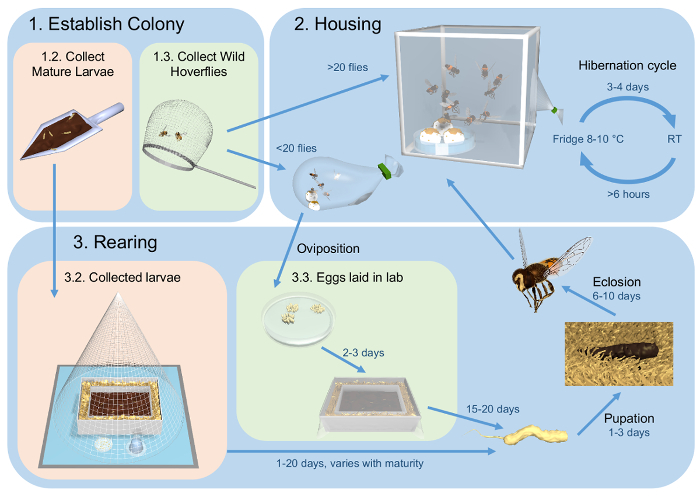
With an estimated 6000 species worldwide, hoverflies are ecologically important as alternative pollinators to domesticated honeybees. However, they are also a useful scientific model to study motion vision and flight dynamics in a controlled laboratory setting. As the larvae develop in organically polluted water, they are useful models for investigating investment in microbial immunity. While large scale commercial breeding for agriculture already occurs, there are no standardized protocols for maintaining captive populations for scientific studies. This is important as commercial captive breeding programs focusing on mass output during peak pollination periods may fail to provide a population that is consistent, stable and robust throughout the year, as is often needed for other research purposes. Therefore, a method to establish, maintain and refresh a captive research population is required. Here, we describe the utilization of an artificial hibernation cycle, in addition to the nutritional and housing requirements, for long term maintenance of Eristalis tenax. Using these methods, we have significantly increased the health and longevity of captive populations of E. tenax compared to previous reports. We furthermore discuss small scale rearing methods and options for optimizing yields and manipulating population demographics.
食蚜蝇在全球估计有6000种,作为家养蜜蜂的替代传粉者,在生态上具有重要意义。然而,它们也是在可控实验室环境中研究运动视觉和飞行动力学的有用科学模型。由于其幼虫在有机污染的水中发育,它们是研究微生物免疫投入的有用模型。虽然农业上已经有大规模的商业养殖,但目前还没有用于科学研究的圈养种群的标准化方案。这一点很重要,因为专注于在授粉高峰期大量产出的商业圈养繁殖计划可能无法提供全年一致、稳定和强健的种群,而这往往是其他研究目的所需要的。因此,需要一种建立、维持和更新圈养研究种群的方法。在这里,我们描述了利用人工冬眠周期,以及营养和饲养要求,来长期维持黑带食蚜蝇。使用这些方法,与之前的报告相比,我们显著提高了圈养黑带食蚜蝇种群的健康状况和寿命。我们还讨论了小规模饲养方法以及优化产量和控制种群数量的选择。