Department of Anesthesiology and Pain Medicine, Presbyterian Medical Center, Jeonju, Republic of Korea.
Department of Anesthesiology and Pain Medicine, Wonkwang University College of Medicine, Iksan, Republic of Korea.
PLoS One. 2018 Jun 4;13(6):e0198147. doi: 10.1371/journal.pone.0198147. eCollection 2018.
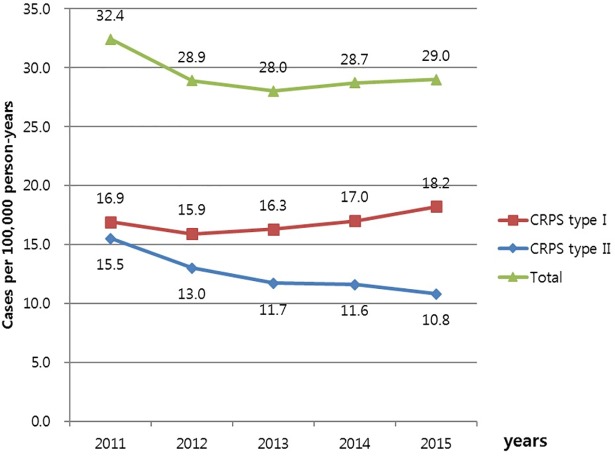
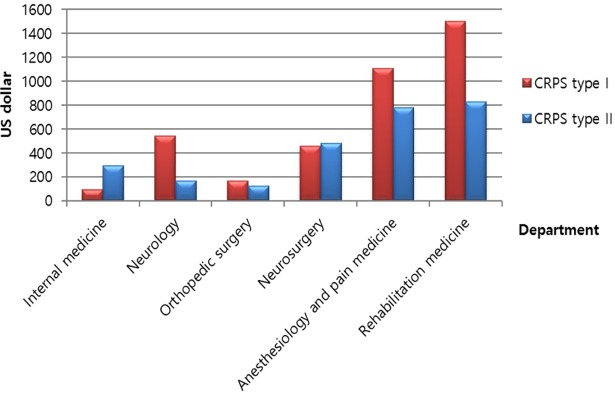
Chronic regional pain syndrome (CRPS) is an inflammatory and neuropathic pain disorder characterized by the involvement of the autonomic nervous system with sensory, autonomic, motor, skin, and bone changes. At present, universally accepted consensus criteria for CRPS are not yet established, despite the diagnostic criteria proposed by the International Association for the Study of Pain (IASP). Various hypotheses for the pathophysiology of CRPS have been proposed; as a result, current therapeutic modalities are varied. General epidemiological data on CRPS are necessary for effective management. However, recent data on the epidemiology of CRPS in Korea are scarce. The aim of this study was to evaluate the incidence and other epidemiological features of CRPS in the general population in Korea. In this study on the epidemiology of CRPS in Korea, population-based medical data acquired from 51,448,491 subscribers to the National Health Insurance Service (NHIS) from 2011 to 2015 were analyzed, including the incidence, distribution by the CRPS type, regional distribution, monthly distribution, medical costs, and healthcare resource-utilization. The findings indicated that the incidence of CRPS in Korea was 29.0 per 100,000 person-years in 2015 and was correlated with patient age and sex. CRPS types included type I (63%) and type II (37%); moreover, the number of individuals with CRPS I have shown a growing trend since 2011. There was no monthly distribution, but there was regional variation according to the province. The medical departments managing CRPS I the most were orthopedics, internal medicine, anesthesiology and pain medicine, in order; however, patients with CRPS spent more money per visit in the departments of rehabilitation medicine, and anesthesiology and pain medicine. The incidence rate of CRPS in Korea was 29.0 per 100,000 person-years with an increasing trend, which was correlated with patient age in the 70s and female sex. CRPS type I was more common than CRPS type II; in addition, constant increase in medical expenses, regional imbalance, and differences in medical expense among medical specialties should be considered for early management of patients to reduce the disease burden in Korea. Sharing of knowledge about the diagnostic criteria of CRPS are also needed.
慢性区域性疼痛综合征 (CRPS) 是一种炎症性和神经性疼痛障碍,其特征为自主神经系统受累,伴有感觉、自主、运动、皮肤和骨骼改变。目前,尽管国际疼痛研究协会 (IASP) 提出了诊断标准,但尚未建立普遍接受的 CRPS 共识标准。已经提出了 CRPS 病理生理学的各种假说;因此,目前的治疗方法多种多样。了解 CRPS 的一般流行病学数据对于有效管理至关重要。然而,最近有关韩国 CRPS 流行病学的数据很少。本研究旨在评估韩国一般人群中 CRPS 的发病率和其他流行病学特征。在这项韩国 CRPS 流行病学研究中,对 2011 年至 2015 年期间来自国民健康保险服务 (NHIS) 的 51,448,491 名订阅者的基于人群的医疗数据进行了分析,包括发病率、CRPS 类型分布、区域分布、月度分布、医疗费用和医疗保健资源利用。研究结果表明,2015 年韩国 CRPS 的发病率为 29.0/10 万人年,与患者年龄和性别有关。CRPS 类型包括 1 型 (63%) 和 2 型 (37%);此外,自 2011 年以来,1 型 CRPS 的人数呈增长趋势。没有月度分布,但根据省份存在区域差异。管理 1 型 CRPS 的医疗科室最多的是骨科、内科、麻醉和疼痛医学,依次为;然而,CRPS 患者每次就诊的花费在康复医学和麻醉与疼痛医学部门更多。韩国 CRPS 的发病率为 29.0/10 万人年,呈上升趋势,与 70 多岁的患者年龄和女性有关。1 型 CRPS 比 2 型 CRPS 更常见;此外,还应考虑不断增加的医疗费用、区域不平衡以及各医学专业之间的医疗费用差异,以便对患者进行早期管理,从而减轻韩国的疾病负担。还需要分享 CRPS 的诊断标准知识。