Medical Genetics, Cambridge Institute for Medical Research, Cambridge, Cambridgeshire, UK.
Pain Research Institute, Clinical Sciences Centre, University of Liverpool Faculty of Health and Life Sciences, Liverpool, UK.
J Med Genet. 2024 Jan 19;61(2):163-170. doi: 10.1136/jmg-2023-109236.
Complex regional pain syndrome type 1 (CRPS-1) is a rare, disabling and sometimes chronic disorder usually arising after a trauma. This exploratory study examined whether patients with chronic CRPS-1 have a different genetic profile compared with those who do not have the condition.
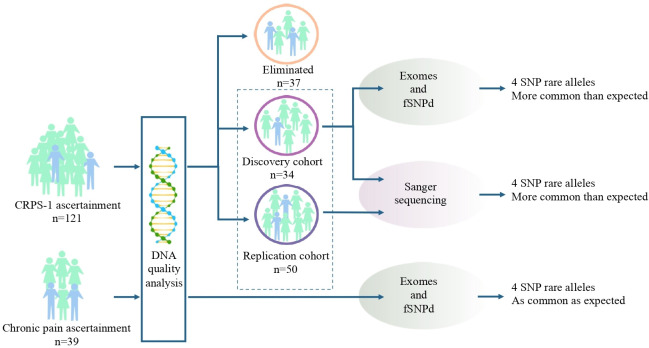
Exome sequencing was performed to seek altered non-synonymous SNP allele frequencies in a discovery cohort of well-characterised patients with chronic CRPS-1 (n34) compared with population databases. Identified SNP alleles were confirmed by Sanger sequencing and sought in a replication cohort (n50). Gene expression of peripheral blood macrophages was assessed.
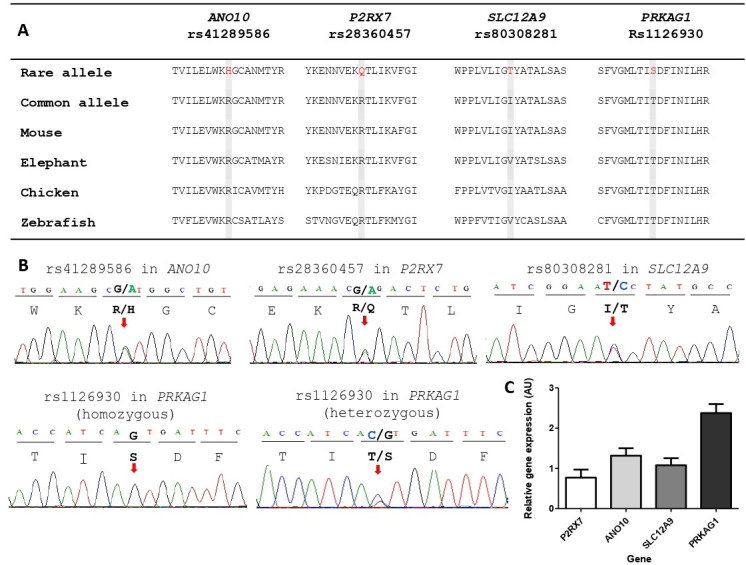
In the discovery cohort, the rare allele frequencies of four non-synonymous SNPs were statistically increased. The replication cohort confirmed this finding. In a chronic pain cohort, these alleles were not overexpressed. In total, 25 out of 84 (29.8%) patients with CRPS-1 expressed a rare allele. The SNPs were rs41289586 in , rs28360457 in , rs1126930 in and rs80308281 in . Males were more likely than females to have a rare SNP allele, 8 out of 14 (57.1%) vs 17 out of 70 (24.3%) (Fisher's p=0.023). , , and were all expressed in macrophages from healthy human controls.
A single SNP in each of the genes and was associated with developing chronic CRPS-1, with more males than females expressing these rare alleles. Our work suggests the possibility that a permissive genetic background is an important factor in the development of CRPS-1.
1 型复杂性区域疼痛综合征(CRPS-1)是一种罕见的、使人丧失能力且有时为慢性疾病,通常在创伤后发生。本探索性研究旨在检查患有慢性 CRPS-1 的患者与没有该病的患者相比,其遗传特征是否存在差异。
对经过充分特征描述的慢性 CRPS-1 患者(n34)的发现队列进行外显子组测序,以寻找改变的非同义 SNP 等位基因频率,并与人群数据库进行比较。通过 Sanger 测序对鉴定出的 SNP 等位基因进行确认,并在复制队列(n50)中进行检测。还评估了外周血巨噬细胞的基因表达。
在发现队列中,四个非同义 SNP 的罕见等位基因频率存在统计学差异。复制队列证实了这一发现。在慢性疼痛队列中,这些等位基因并未过度表达。在总共 84 名 CRPS-1 患者中,有 25 名(29.8%)患者表达了罕见等位基因。这些 SNP 是位于 中的 rs41289586、位于 中的 rs28360457、位于 中的 rs1126930 和位于 中的 rs80308281。男性比女性更有可能存在罕见 SNP 等位基因,14 名男性中有 8 名(57.1%),70 名女性中有 17 名(24.3%)(Fisher 检验,p=0.023)。 、 、 和 均在来自健康人类对照的巨噬细胞中表达。
每个基因( 和 )中的一个 SNP 与慢性 CRPS-1 的发生相关,并且男性比女性更可能表达这些罕见等位基因。我们的工作表明,许可的遗传背景可能是 CRPS-1 发生的重要因素。