Research Unit, Spanish Society of Rheumatology, Madrid, Spain.
Cancer and Environmental Epidemiology Unit, National Center for Epidemiology, Carlos III Institute of Health, Madrid, Spain.
BMC Cancer. 2018 Jun 4;18(1):625. doi: 10.1186/s12885-018-4494-3.
Pancreatic cancer is acquiring increasing prominence as a cause of cancer death in the population. The purpose of this study was to analyze long-term pancreatic cancer mortality trends in Spain and evaluate the independent effects of age, death period and birth cohort on these trends.
Population and mortality data for the period 1952-2012 were obtained from the Spanish National Statistics Institute. Pancreatic cancer deaths were identified using the International Classification of Diseases ICD-6 to ICD-9 (157 code) and ICD-10 (C25 code). Age-specific and age-adjusted mortality rates were computed by sex, region and five-year period. Changes in pancreatic cancer mortality trends were evaluated using joinpoint regression analyses by sex and region. Age-period-cohort log-linear models were fitted separately for each sex, and segmented regression models were used to detect changes in period- and cohort-effect curvatures.
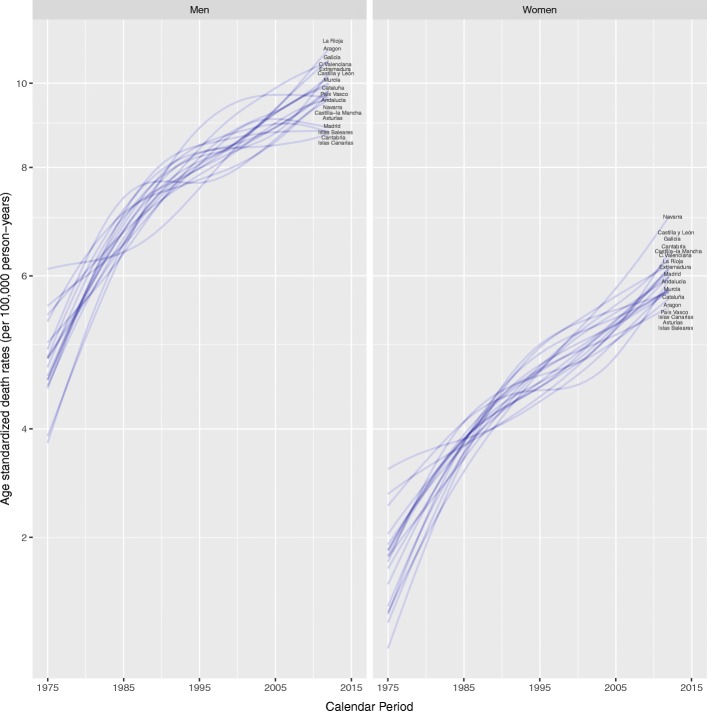
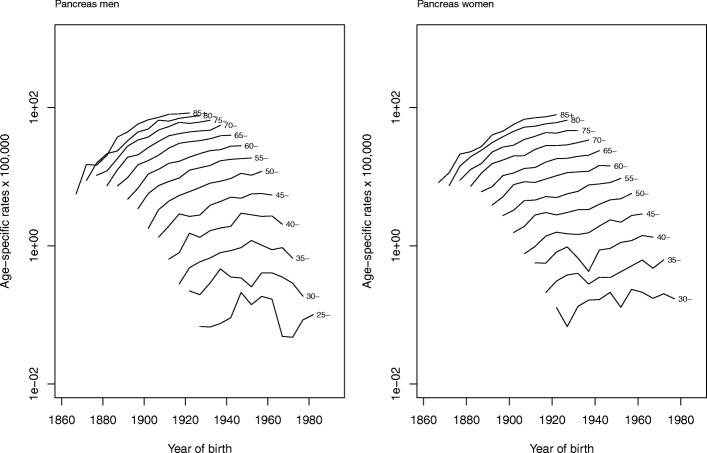
In men, rates increased by 4.1% per annum from 1975 until the mid-1980s and by 1.1% thereafter. In women, there was an increase of 3.6% per annum until the late 1980s, and 1.4% per annum from 1987 to 2012. With reference to the cohort effects, there was an increase in mortality until the generations born in the 1950s in men and a subsequent decline detected by the change point in 1960. A similar trend was observed in women, but the change point occurred 10 years later than in men.
Pancreatic cancer mortality increased over the study period in both sexes and all regions. An important rise in rates -around 4% annually- was registered until the 1980s, and upward trends were more moderate subsequently. The differences among sexes in trends in younger generations may be linked to different past prevalence of exposure to some risk factors, particularly tobacco, which underwent an earlier decrease in men than in women.
胰腺癌作为人群中癌症死亡的一个主要原因,其发病率正不断升高。本研究旨在分析西班牙长期胰腺癌死亡率的变化趋势,并评估年龄、死亡时期和出生队列对这些趋势的独立影响。
从西班牙国家统计局获取 1952 年至 2012 年期间的人口和死亡率数据。使用国际疾病分类 ICD-6 至 ICD-9(157 代码)和 ICD-10(C25 代码)识别胰腺癌死亡病例。按性别、地区和五年时间段计算特定年龄和年龄调整后的死亡率。通过性别和地区使用 Joinpoint 回归分析评估胰腺癌死亡率变化趋势。分别为每个性别拟合年龄-时期-队列对数线性模型,并使用分段回归模型检测时期和队列效应曲线的变化。
在男性中,自 1975 年至 80 年代中期,死亡率每年增加 4.1%,此后每年增加 1.1%。在女性中,1980 年代末期前,死亡率每年增加 3.6%,1987 年至 2012 年期间每年增加 1.4%。关于队列效应,男性的死亡率在 20 世纪 50 年代出生的人群中增加,在 1960 年的转折点后出现下降。在女性中也观察到类似的趋势,但转折点比男性晚 10 年。
在研究期间,两性和所有地区的胰腺癌死亡率均呈上升趋势。在 80 年代之前,死亡率以每年约 4%的速度增长,此后上升趋势较为温和。在年轻一代中,两性之间的趋势差异可能与一些风险因素的过去流行率不同有关,特别是烟草,男性的流行率下降早于女性。