Environmental and Cancer Epidemiology Unit, National Center for Epidemiology, Carlos III Institute of Health, Madrid, Spain.
BMC Cancer. 2009 Sep 28;9:346. doi: 10.1186/1471-2407-9-346.
Gastric cancer is the second leading cause of oncologic death worldwide. One of the most noteworthy characteristics of this tumor's epidemiology is the marked decline reported in its incidence and mortality in almost every part of the globe in recent decades. This study sought to describe gastric cancer mortality time trends in Spain's regions for both sexes.
Mortality data for the period 1976 through 2005 were obtained from the Spanish National Statistics Institute. Cases were identified using the International Classification of Diseases 9th and 10th revision (codes 151 and C16, respectively). Crude and standardized mortality rates were calculated by geographic area, sex, and five-year period. Joinpoint regression analyses were performed to ascertain whether changes in gastric cancer mortality trends had occurred, and to estimate the annual percent change by sex and geographic area.
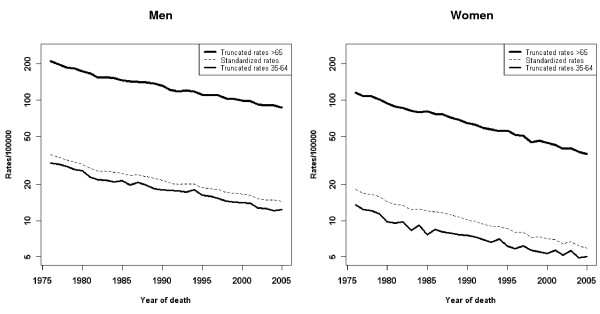
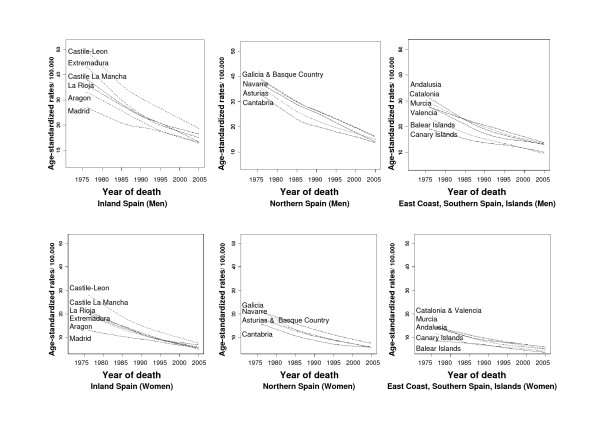
Gastric cancer mortality decreased across the study period, with the downward trend being most pronounced in women and in certain regions situated in the interior and north of mainland Spain. Across the study period, there was an overall decrease of 2.90% per annum among men and 3.65% per annum among women. Generally, regions in which the rate of decline was sharpest were those that had initially registered the highest rates. However, the rate of decline was not constant throughout the study period: joinpoint analysis detected a shift in trend for both sexes in the early 1980s.
Gastric cancer mortality displayed in both sexes a downward trend during the study period, both nationally and regionally. The different trend in rates in the respective geographic areas translated as greater regional homogeneity in gastric cancer mortality by the end of the study period. In contrast, rates in women fell more than did those in men. The increasing differences between the sexes could indicate that some risk factors may be modifying the sex-specific pattern of this tumor.
胃癌是全球第二大肿瘤致死病因。这种肿瘤在流行病学上最显著的特点之一是,近几十年来,全球几乎所有地区的发病率和死亡率都出现了显著下降。本研究旨在描述西班牙各地区胃癌死亡率的时间趋势,涉及男女性别。
我们从西班牙国家统计局获取了 1976 年至 2005 年期间的死亡率数据。使用国际疾病分类第 9 版和第 10 版(分别为 151 和 C16 代码)识别病例。根据地理区域、性别和 5 年时间段计算粗死亡率和标准化死亡率。采用 Joinpoint 回归分析确定胃癌死亡率趋势是否发生变化,并估计男女性别和地理区域的年变化百分比。
研究期间,胃癌死亡率呈下降趋势,女性和西班牙内陆及北部某些地区的下降趋势最为明显。在整个研究期间,男性的死亡率每年下降 2.90%,女性的死亡率每年下降 3.65%。总体而言,下降幅度最大的地区是最初报告发病率最高的地区。然而,下降趋势并非在整个研究期间保持不变:男女两性的 Joinpoint 分析均在 20 世纪 80 年代早期检测到趋势的转变。
在研究期间,无论在全国还是在地区层面,胃癌死亡率在男女性别中均呈下降趋势。各地理区域的死亡率趋势不同,导致研究期末胃癌死亡率的地区差异更加趋于一致。相比之下,女性的死亡率下降幅度大于男性。两性之间差异的增大可能表明某些风险因素正在改变这种肿瘤的性别特异性模式。