Department of Epidemiology, Gillings School of Global Public Health, University of North Carolina at Chapel Hill, Chapel Hill, NC, 27599, USA.
Department of Biomedical Sciences, College of Veterinary Medicine, Cornell University, Ithaca, NY, 14853, USA.
Breast Cancer Res. 2018 Jun 5;20(1):45. doi: 10.1186/s13058-018-0964-4.
MicroRNAs (miRNAs) regulate gene expression and influence cancer. Primary transcripts of miRNAs (pri-miRNAs) are poorly annotated and little is known about the role of germline variation in miRNA genes and breast cancer (BC). We sought to identify germline miRNA variants associated with BC risk and tumor subtype among African-American (AA) women.
Under the African American Breast Cancer Epidemiology and Risk (AMBER) Consortium, genotyping and imputed data from four studies on BC in AA women were combined into a final dataset containing 224,188 miRNA gene single nucleotide polymorphisms (SNPs) for 8350 women: 3663 cases and 4687 controls. The primary miRNA sequence was identified for 566 miRNA genes expressed in Encyclopedia of DNA Elements (ENCODE) Tier 1 cell types and human pancreatic islets. Association analysis was conducted using logistic regression for BC status overall and by tumor subtype.
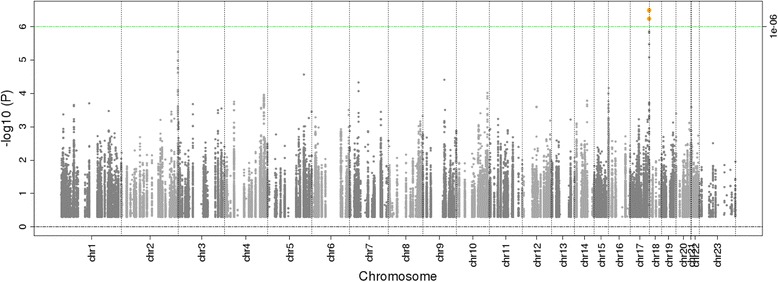
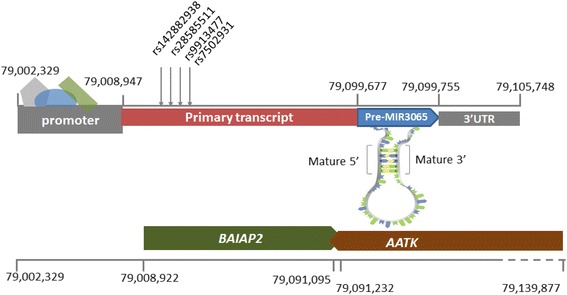
A novel BC signal was localized to an 8.6-kb region of 17q25.3 by four SNPs (rs9913477, rs1428882938, rs28585511, and rs7502931) and remained statistically significant after multiple test correction (odds ratio (OR) = 1.44, 95% confidence interval (CI) = 1.26-1.65; p = 3.15 × 10; false discovery rate (FDR) = 0.03). These SNPs reside in a genomic location that includes both the predicted primary transcript of the noncoding miRNA gene MIR3065 and the first intron of the gene for brain-specific angiogenesis inhibitor 1-associated protein 2 (BAIAP2). Furthermore, miRNA-associated SNPs on chromosomes 1p32.3, 5q32, and 3p25.1 were the strongest signals for hormone receptor, luminal versus basal-like, and HER2 enrichment status, respectively. A second phase of genotyping (1397 BC cases, 2418 controls) that included two SNPs in the 8.6-kb region was used for validation and meta-analysis. While neither rs4969239 nor rs9913477 was validated, when meta-analyzed with the original dataset their association with BC remained directionally consistent (OR = 1.29, 95% CI = 1.16-1.44 (p = 4.18 × 10) and OR = 1.33, 95% CI = 1.17-1.51 (p = 1.6 × 10), respectively).
Germline genetic variation indicates that MIR3065 may play an important role in BC development and heterogeneity among AA women. Further investigation to determine the potential functional effects of these SNPs is warranted. This study contributes to our understanding of BC risk in AA women and highlights the complexity in evaluating variation in gene-dense regions of the human genome.
微小 RNA(miRNA)调控基因表达并影响癌症。miRNA 的初级转录物(pri-miRNA)注释不佳,关于种系变异在 miRNA 基因和乳腺癌(BC)中的作用知之甚少。我们试图确定与非裔美国(AA)女性 BC 风险和肿瘤亚型相关的种系 miRNA 变体。
在美国非裔乳腺癌流行病学和风险(AMBER)联盟下,对四项针对 AA 女性 BC 的研究中的基因分型和推断数据进行了组合,形成了一个包含 8350 名女性 224188 个 miRNA 基因单核苷酸多态性(SNP)的最终数据集:3663 例病例和 4687 例对照。对在 DNA 元件百科全书(ENCODE)Tier 1 细胞类型和人胰腺胰岛中表达的 566 个 miRNA 基因的初级 miRNA 序列进行了鉴定。使用逻辑回归对 BC 状态进行了总体和按肿瘤亚型进行了关联分析。
四个 SNP(rs9913477、rs1428882938、rs28585511 和 rs7502931)将一个新的 BC 信号定位到 17q25.3 的 8.6-kb 区域,在经过多次检验校正后仍然具有统计学意义(比值比(OR)=1.44,95%置信区间(CI)=1.26-1.65;p=3.15×10;错误发现率(FDR)=0.03)。这些 SNP 位于一个基因组位置,其中包括非编码 miRNA 基因 MIR3065 的预测初级转录物和脑特异性血管生成抑制剂 1 相关蛋白 2(BAIAP2)基因的第一个内含子。此外,染色体 1p32.3、5q32 和 3p25.1 上的 miRNA 相关 SNP 分别是激素受体、腔面与基底样以及 HER2 富集状态的最强信号。对包含 8.6-kb 区域中的两个 SNP 的第二个阶段的基因分型(1397 例 BC 病例,2418 例对照)用于验证和荟萃分析。虽然 rs4969239 和 rs9913477 均未得到验证,但与原始数据集进行荟萃分析时,它们与 BC 的关联仍然保持一致(OR=1.29,95%CI=1.16-1.44(p=4.18×10)和 OR=1.33,95%CI=1.17-1.51(p=1.6×10))。
种系遗传变异表明 MIR3065 可能在非裔美国女性的 BC 发展和异质性中发挥重要作用。需要进一步研究以确定这些 SNP 的潜在功能影响。本研究有助于我们了解非裔美国女性的 BC 风险,并强调了评估人类基因组中基因密集区域变异的复杂性。