Larrea Erika, Sole Carla, Manterola Lorea, Goicoechea Ibai, Armesto María, Arestin María, Caffarel María M, Araujo Angela M, Araiz María, Fernandez-Mercado Marta, Lawrie Charles H
Molecular Oncology, Biodonostia Research Institute, 20014 San Sebastián, Spain.
IKERBASQUE, Basque Foundation for Science, 48013 Bilbao, Spain.
Int J Mol Sci. 2016 Apr 27;17(5):627. doi: 10.3390/ijms17050627.
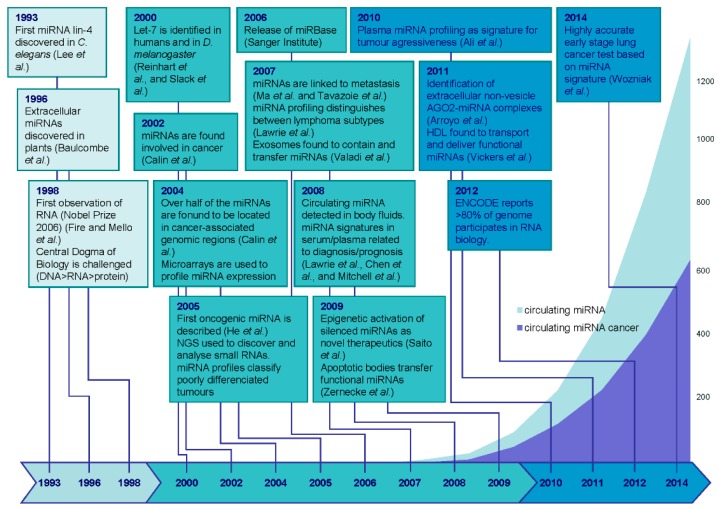
The effective and efficient management of cancer patients relies upon early diagnosis and/or the monitoring of treatment, something that is often difficult to achieve using standard tissue biopsy techniques. Biological fluids such as blood hold great possibilities as a source of non-invasive cancer biomarkers that can act as surrogate markers to biopsy-based sampling. The non-invasive nature of these "liquid biopsies" ultimately means that cancer detection may be earlier and that the ability to monitor disease progression and/or treatment response represents a paradigm shift in the treatment of cancer patients. Below, we review one of the most promising classes of circulating cancer biomarkers: microRNAs (miRNAs). In particular, we will consider their history, the controversy surrounding their origin and biology, and, most importantly, the hurdles that remain to be overcome if they are really to become part of future clinical practice.
癌症患者的有效且高效管理依赖于早期诊断和/或治疗监测,而这通常难以通过标准组织活检技术实现。血液等生物流体作为非侵入性癌症生物标志物的来源具有很大潜力,这些标志物可作为基于活检采样的替代标志物。这些“液体活检”的非侵入性本质最终意味着癌症检测可能更早,并且监测疾病进展和/或治疗反应的能力代表了癌症患者治疗的范式转变。下文,我们将综述最有前景的一类循环癌症生物标志物:微小RNA(miRNA)。特别是,我们将探讨它们的历史、围绕其起源和生物学的争议,以及最重要的是,如果它们真的要成为未来临床实践的一部分仍有待克服的障碍。