Zhang Jingyu, Tian Xiao-Jun, Chen Yi-Jiun, Wang Weikang, Watkins Simon, Xing Jianhua
1Department of Computational and Systems Biology, School of Medicine, University of Pittsburgh, Pittsburgh, PA 15260 USA.
4Present Address: School of Biological and Health Systems Engineering, Arizona State University, Tempe, AZ 85287 USA.
NPJ Syst Biol Appl. 2018 May 28;4:18. doi: 10.1038/s41540-018-0060-5. eCollection 2018.
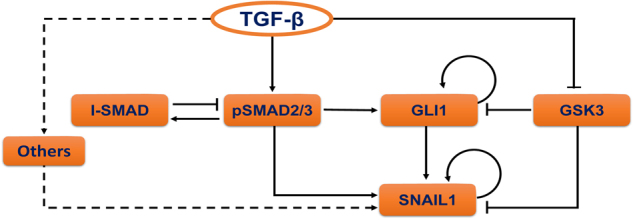
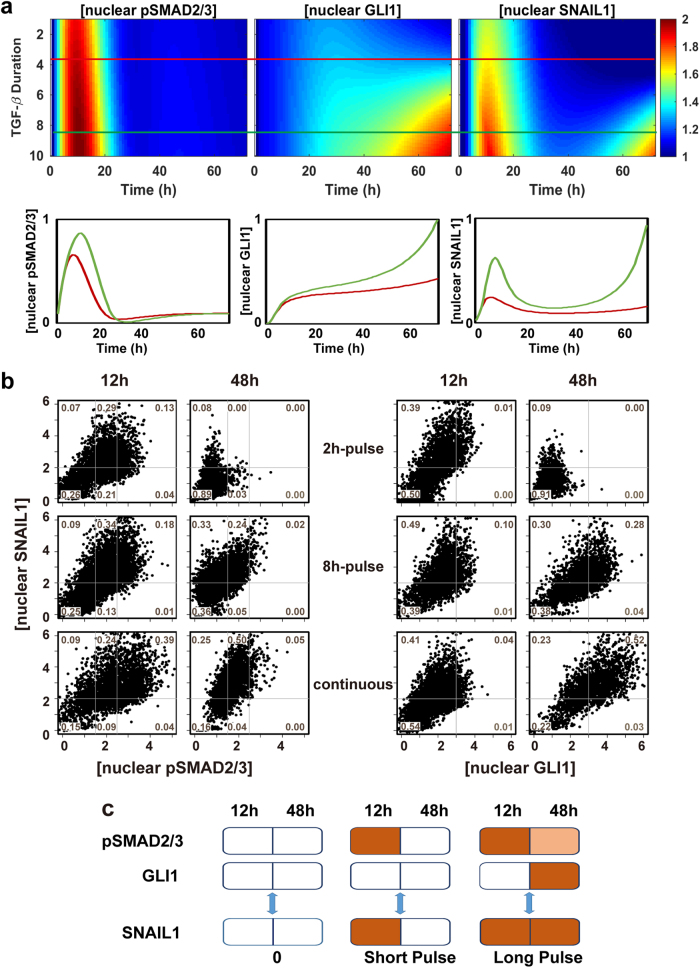
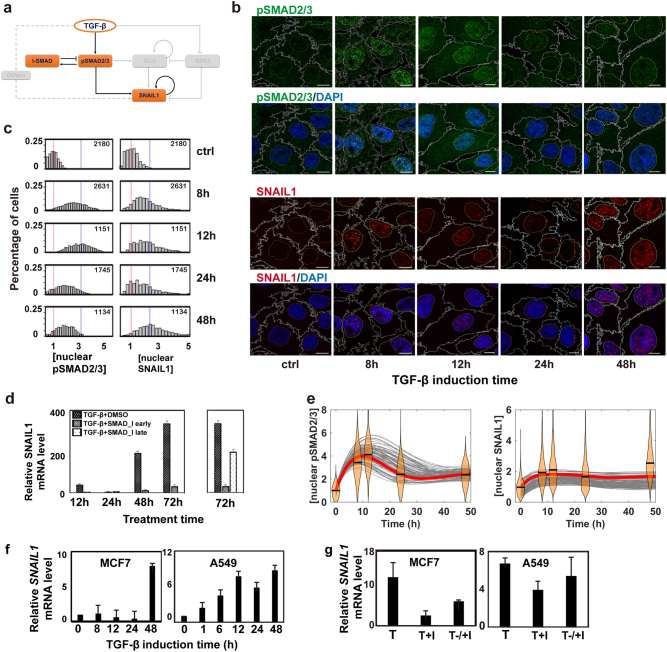
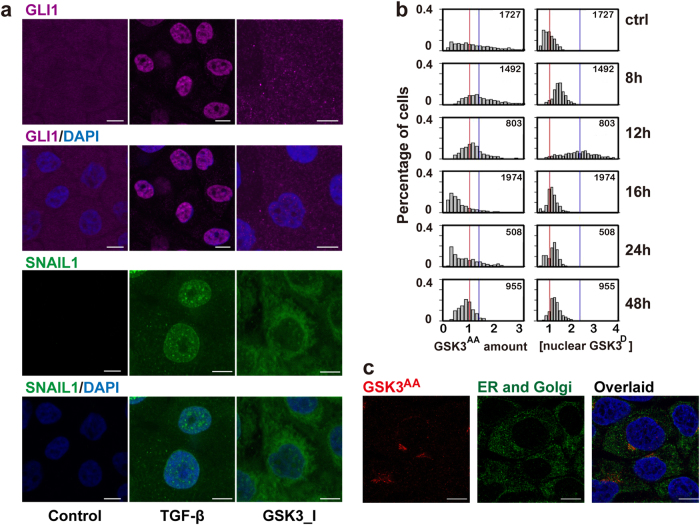
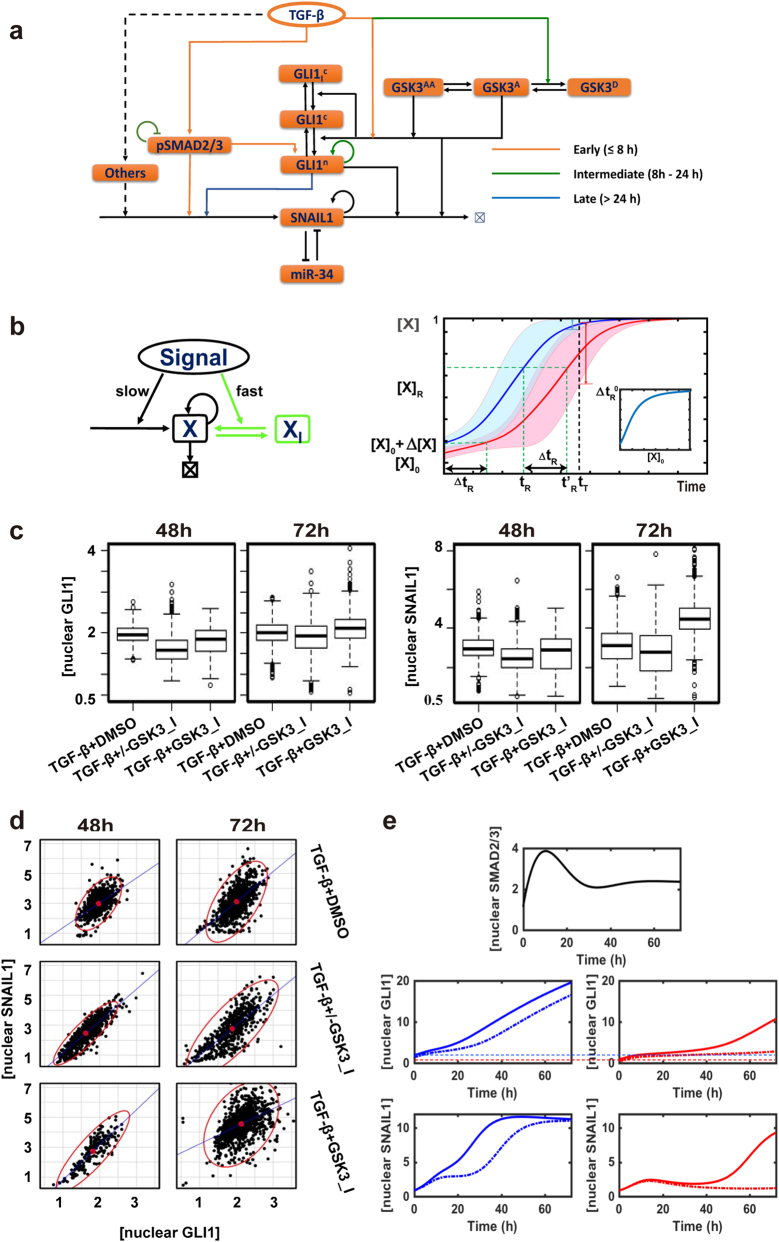
The detection and transmission of the temporal quality of intracellular and extracellular signals is an essential cellular mechanism. It remains largely unexplored how cells interpret the duration information of a stimulus. In this paper, we performed an integrated quantitative and computational analysis on TGF-β induced activation of SNAIL1, a key transcription factor that regulates several subsequent cell fate decisions such as apoptosis and epithelial-to-mesenchymal transition. We demonstrate that crosstalk among multiple TGF-β activated pathways forms a relay from SMAD to GLI1 that initializes and maintains SNAILl expression, respectively. SNAIL1 functions as a key integrator of information from TGF-β signaling distributed through upstream divergent pathways. The intertwined network serves as a temporal checkpoint, so that cells can generate a transient or sustained expression of SNAIL1 depending on TGF-β duration. Furthermore, we observed that TGF-β treatment leads to an unexpected accumulation of GSK3 molecules in an enzymatically active tyrosine phosphorylation form in Golgi apparatus and ER, followed by accumulation of GSK3 molecules in an enzymatically inhibitive serine phosphorylation in the nucleus. Subsequent model analysis and inhibition experiments revealed that the initial localized increase of GSK3 enzymatic activity couples to the positive feedback loop of the substrate Gli1 to form a network motif with multi-objective functions. That is, the motif is robust against stochastic fluctuations, and has a narrow distribution of response time that is insensitive to initial conditions. Specifically for TGF-β signaling, the motif ensures a smooth relay from SMAD to GLI1 on regulating SNAIL1 expression.
细胞内和细胞外信号的时间质量的检测与传递是一种重要的细胞机制。细胞如何解读刺激的持续时间信息在很大程度上仍未得到探索。在本文中,我们对转化生长因子-β(TGF-β)诱导的SNAIL1激活进行了综合定量和计算分析,SNAIL1是一种关键转录因子,可调节随后的几个细胞命运决定,如细胞凋亡和上皮-间质转化。我们证明,多个TGF-β激活途径之间的串扰形成了从SMAD到GLI1的信号传递,分别启动和维持SNAIL1的表达。SNAIL1作为来自通过上游不同途径分布的TGF-β信号信息的关键整合者。这个相互交织的网络充当一个时间检查点,以便细胞可以根据TGF-β的持续时间产生SNAIL1的瞬时或持续表达。此外,我们观察到TGF-β处理导致高尔基体和内质网中GSK3分子以酶活性酪氨酸磷酸化形式意外积累,随后细胞核中GSK3分子以酶抑制性丝氨酸磷酸化形式积累。随后的模型分析和抑制实验表明,GSK3酶活性的初始局部增加与底物Gli1的正反馈环耦合,形成具有多目标功能的网络基序。也就是说,该基序对随机波动具有鲁棒性,并且具有对初始条件不敏感的狭窄响应时间分布。具体对于TGF-β信号传导,该基序确保在调节SNAIL1表达时从SMAD到GLI1的平稳信号传递。