Dpto. Ciencias Agroforestales, Escuela Técnica Superior de Ingenierías, Universidad de Valladolid, Avda. De Madrid, Palencia, Spain.
Instituto Universitario de Investigación en Gestión Forestal Sostenible (iuFOR), Avda. De Madrid, Palencia, Spain.
PLoS One. 2018 Jun 7;13(6):e0198766. doi: 10.1371/journal.pone.0198766. eCollection 2018.
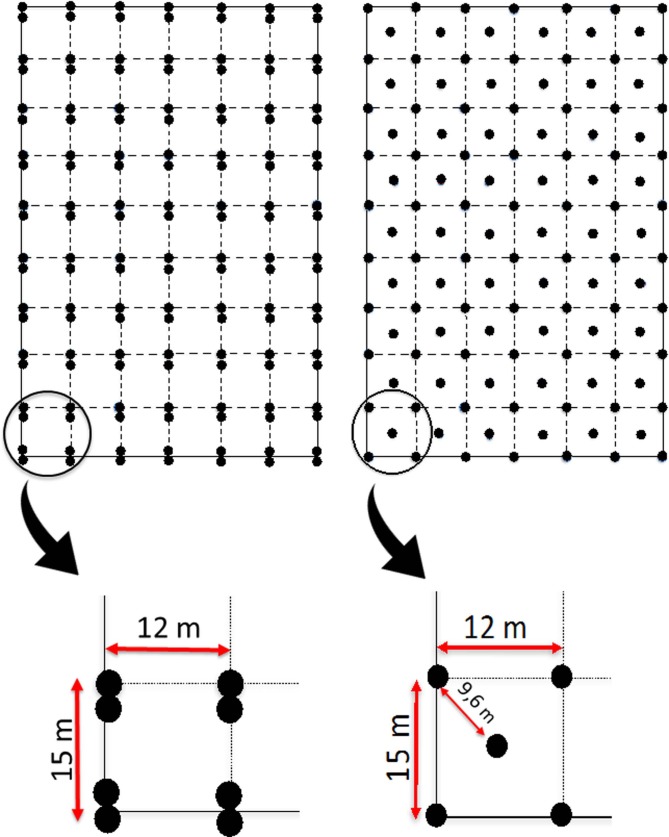
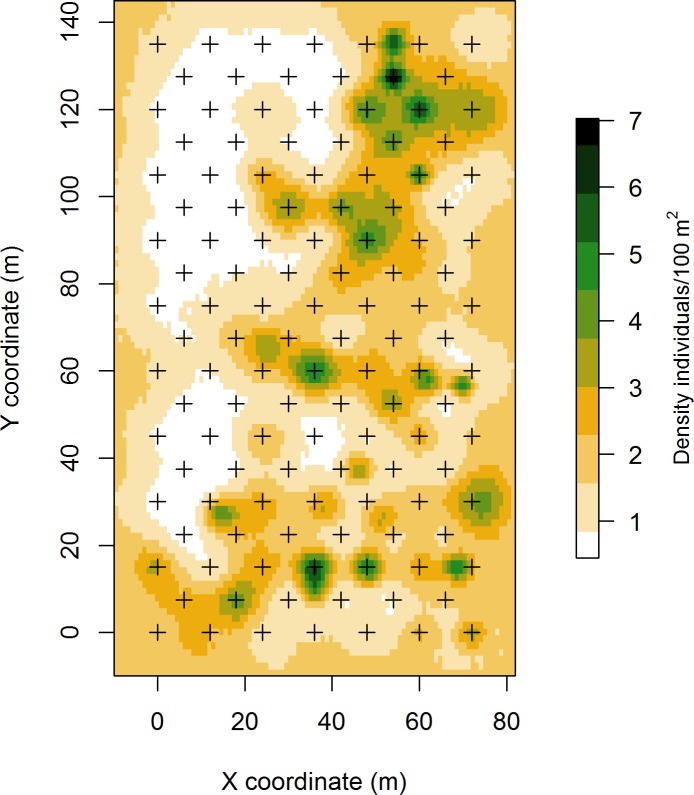
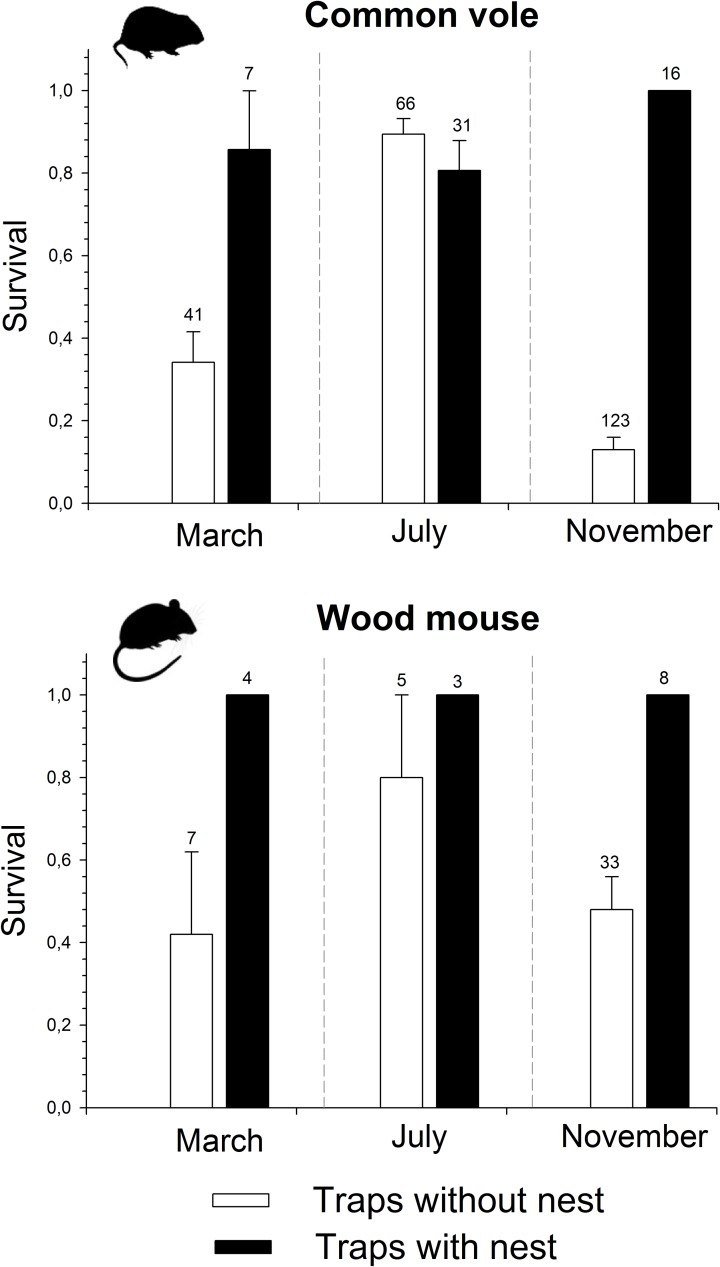
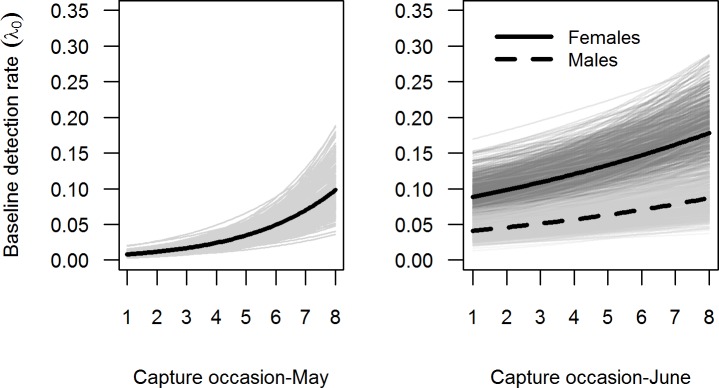
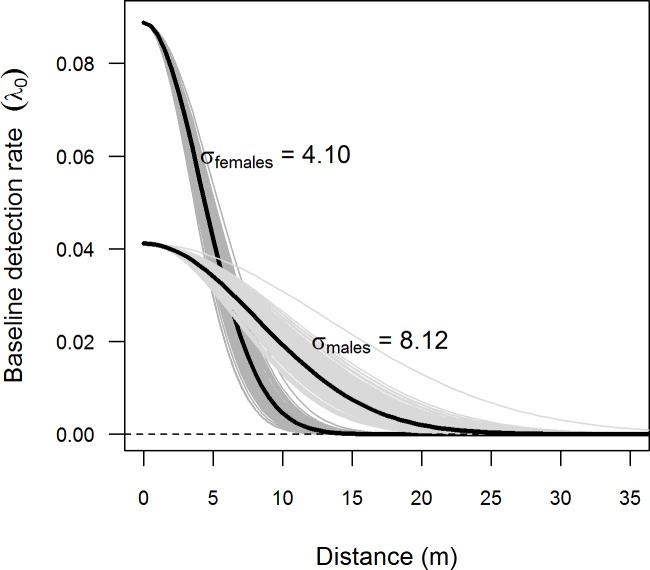
Spatial capture-recapture modelling (SCR) is a powerful analytical tool to estimate density and derive information on space use and behaviour of elusive animals. Yet, SCR has been seldom applied to the study of ecologically keystone small mammals. Here we highlight its potential and requirements with a case study on common voles (Microtus arvalis). First, we address mortality associated with live-trapping, which can be high in small mammals, and must be kept minimal. We designed and tested a nest box coupled with a classic Sherman trap and show that it allows a 5-fold reduction of mortality in traps. Second, we address the need to adjust the trapping grid to the individual home range to maximize spatial recaptures. In May-June 2016, we captured and tagged with transponders 227 voles in a 1.2-ha area during two monthly sessions. Using a Bayesian SCR with a multinomial approach, we estimated: (1) the baseline detection rate and investigated variation according to sex, time or behaviour (aversion/attraction after a previous capture); (2) the parameter sigma that describes how detection probability declines as a function of the distance to an individual´s activity centre, and investigated variation according to sex; and (3) density and population sex-ratio. We show that reducing the maximum distance between traps from 12 to 9.6m doubled spatial recaptures and improved model predictions. Baseline detection rate increased over time (after overcoming a likely aversion to entering new odourless traps) and was greater for females than males in June. The sigma parameter of males was twice that of females, indicating larger home ranges. Density estimates were of 142.92±38.50 and 168.25±15.79 voles/ha in May and June, respectively, with 2-3 times more females than males. We highlight the potential and broad applicability that SCR offers and provide specific recommendations for using it to study small mammals like voles.
空间捕捉-再捕获建模 (SCR) 是一种强大的分析工具,可用于估计密度,并获取有关难以捉摸的动物的空间使用和行为信息。然而,SCR 在生态关键小型哺乳动物的研究中很少被应用。在这里,我们通过一个普通田鼠(Microtus arvalis)的案例研究来强调其潜力和要求。首先,我们解决了与活捕相关的死亡率问题,这在小型哺乳动物中可能很高,必须将其降至最低。我们设计并测试了一个与经典 Sherman 陷阱相结合的巢箱,并表明它可以将死亡率降低 5 倍。其次,我们需要根据个体的家域调整陷阱网格,以最大限度地增加空间再捕获。2016 年 5 月至 6 月,我们在两个月的时间内,在 1.2 公顷的区域内捕获并使用转发器标记了 227 只田鼠。我们使用贝叶斯 SCR 与多项方法相结合,估计了:(1)基线检测率,并根据性别、时间或行为(在之前的捕获后回避/吸引)进行了变化;(2)描述检测概率随个体活动中心距离下降的参数 sigma,并根据性别进行了变化;(3)密度和种群性别比。我们表明,将陷阱之间的最大距离从 12 米减少到 9.6 米,可以使空间再捕获增加一倍,并改善模型预测。基线检测率随着时间的推移而增加(在克服了对进入新的无味陷阱的可能回避之后),6 月时雌性的检测率高于雄性。雄性的 sigma 参数是雌性的两倍,表明其家域较大。5 月和 6 月的密度估计值分别为 142.92±38.50 和 168.25±15.79 只/公顷,雌性的数量是雄性的 2-3 倍。我们强调了 SCR 提供的潜力和广泛适用性,并提供了使用 SCR 研究田鼠等小型哺乳动物的具体建议。