Tourani Mahdieh
Faculty of Environmental Sciences and Natural Resource Management Norwegian University of Life Sciences Ås Norway.
Ecol Evol. 2021 Dec 21;12(1):e8468. doi: 10.1002/ece3.8468. eCollection 2022 Jan.
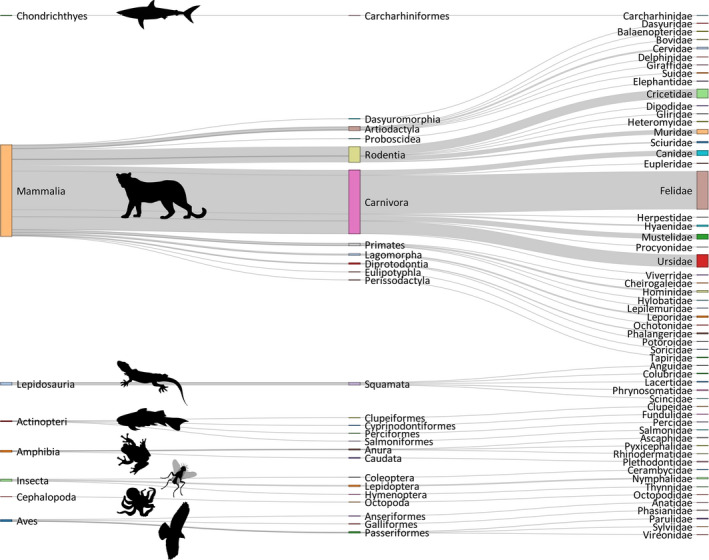
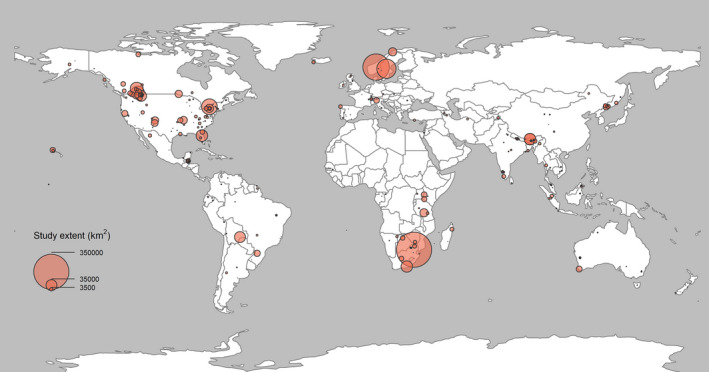
First described by Efford (2004), spatial capture-recapture (SCR) has become a popular tool in ecology. Like traditional capture-recapture, SCR methods account for imperfect detection when estimating ecological parameters. In addition, SCR methods use the information inherent in the spatial configuration of individual detections, thereby allowing spatially explicit estimation of population parameters, such as abundance, survival, and recruitment. Paired with advances in noninvasive survey methods, SCR has been applied to a wide range of species across different habitats, allowing for population- and landscape-level inferences with direct consequences for conservation and management. I conduct a literature review of SCR studies published since the first description of the method and provide an overview of their scope in terms of the ecological questions answered with this tool, taxonomic groups targeted, geography, spatio-temporal extent of analyses, and data collection methods. In addition, I review approaches for analytical implementation and provide an overview of parameters targeted by SCR studies and conclude with current limitations and future directions in SCR methods.
空间捕获再捕获(SCR)方法最早由埃福德(2004年)描述,现已成为生态学中一种流行的工具。与传统的捕获再捕获方法一样,SCR方法在估计生态参数时会考虑不完全检测的情况。此外,SCR方法利用个体检测空间配置中固有的信息,从而能够对种群参数进行空间明确的估计,如丰度、存活率和补充率。与非侵入性调查方法的进展相结合,SCR已应用于不同栖息地的广泛物种,从而能够进行种群和景观水平的推断,对保护和管理产生直接影响。我对自该方法首次描述以来发表的SCR研究进行了文献综述,并从使用该工具回答的生态问题、目标分类群、地理范围、分析的时空范围以及数据收集方法等方面概述了这些研究的范围。此外,我回顾了分析实施方法,并概述了SCR研究针对的参数,最后总结了SCR方法当前的局限性和未来方向。