Brain and Cognition, Faculty of Psychology and Educational Sciences, KU Leuven, Leuven, 3000, Belgium.
Neuromotor Rehabilitation, Biomedical Sciences, KU Leuven, Leuven, 3000, Belgium.
Neuroimage. 2019 Apr 15;190:289-302. doi: 10.1016/j.neuroimage.2018.06.012. Epub 2018 Jun 7.
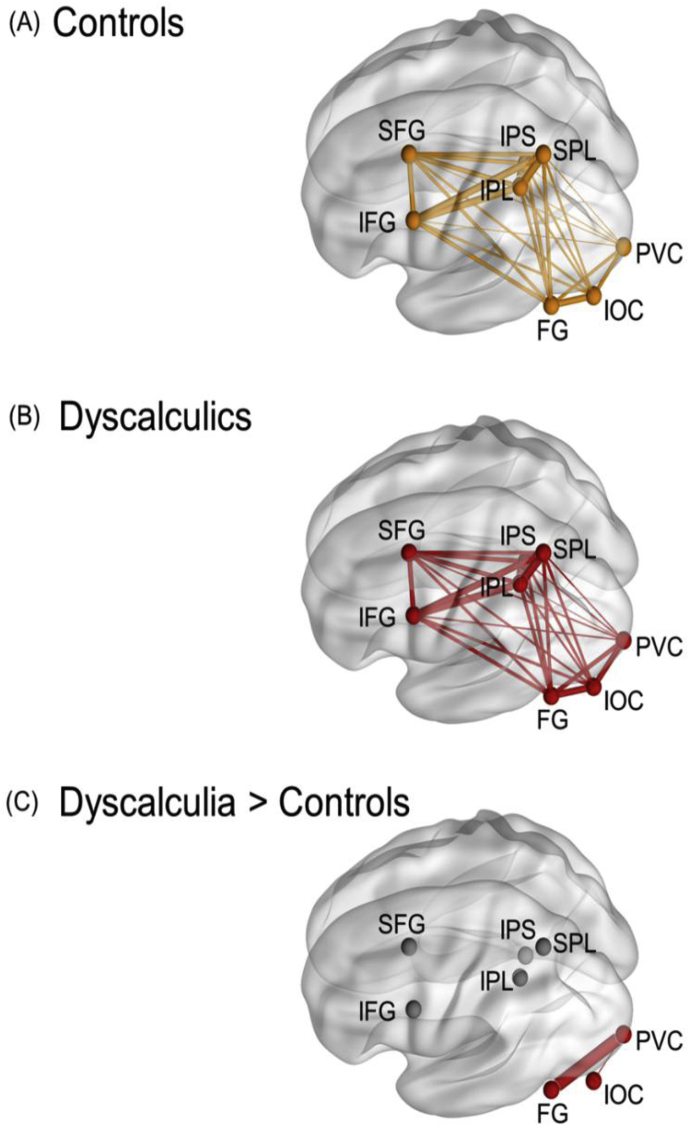
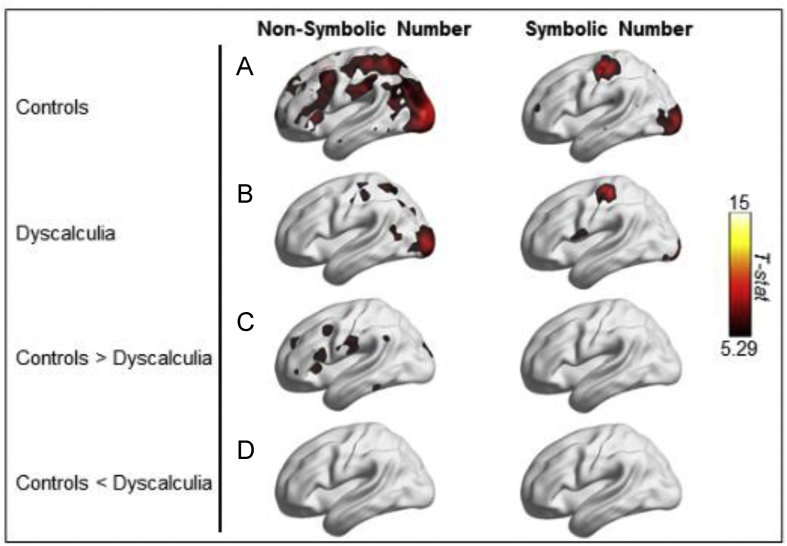
Two hypotheses have been proposed about the etiology of neurodevelopmental learning disorders, such as dyslexia and dyscalculia: representation impairments and disrupted access to representations. We implemented a multi-method brain imaging approach to directly investigate these representation and access hypotheses in dyscalculia, a highly prevalent but understudied neurodevelopmental disorder in learning to calculate. We combined several magnetic resonance imaging methods and analyses, including univariate and multivariate analyses, functional and structural connectivity. Our sample comprised 24 adults with dyscalculia and 24 carefully matched controls. Results showed a clear deficit in the non-symbolic magnitude representations in parietal, temporal and frontal regions, as well as hyper-connectivity in visual brain regions in adults with dyscalculia. Dyscalculia in adults was thereby related to both impaired number representations and altered connectivity in the brain. We conclude that dyscalculia is related to impaired number representations as well as altered access to these representations.
两种假说被提出用于解释神经发育性学习障碍(如阅读障碍和计算障碍)的病因:表象损伤和表象获取障碍。我们采用多模态脑成像方法,直接研究计算障碍(一种在学习计算过程中高发但研究不足的神经发育障碍)中的这些表象和获取假说。我们结合了多种磁共振成像方法和分析,包括单变量和多变量分析、功能和结构连接。我们的样本包括 24 名计算障碍患者和 24 名精心匹配的对照者。结果显示,计算障碍患者在顶叶、颞叶和额叶区域的非符号数量表象上存在明显缺陷,以及在视觉脑区存在过度连接。成人计算障碍与数量表象受损以及大脑连接改变有关。我们的结论是,计算障碍与数量表象受损以及表象获取障碍有关。