Iuculano Teresa, Rosenberg-Lee Miriam, Richardson Jennifer, Tenison Caitlin, Fuchs Lynn, Supekar Kaustubh, Menon Vinod
Department of Psychiatry and Behavioral Sciences, Stanford University, Stanford, California 94305, USA.
Department of Special Education, Vanderbilt University, Nashville, Tennessee 37203, USA.
Nat Commun. 2015 Sep 30;6:8453. doi: 10.1038/ncomms9453.
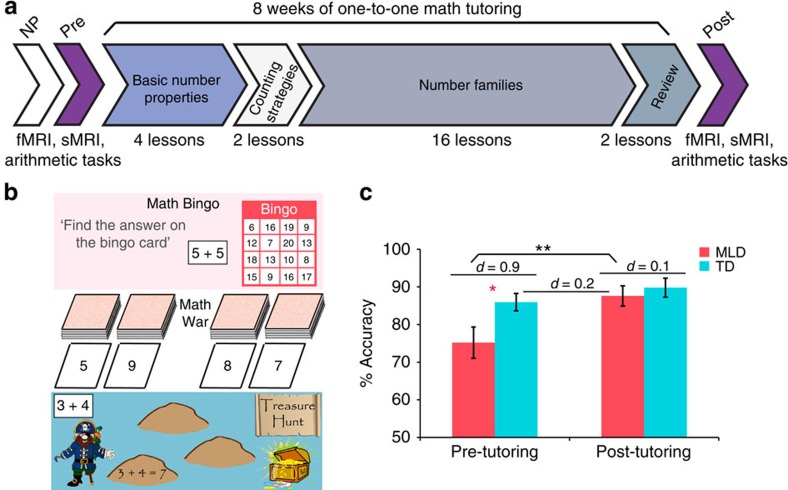
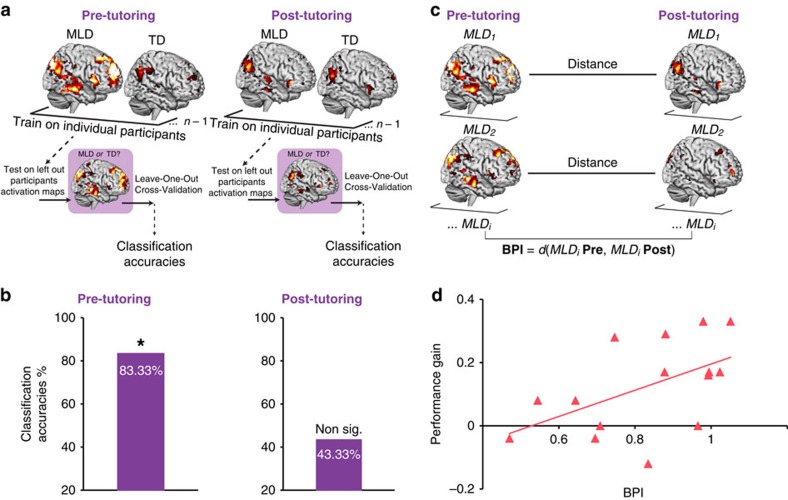
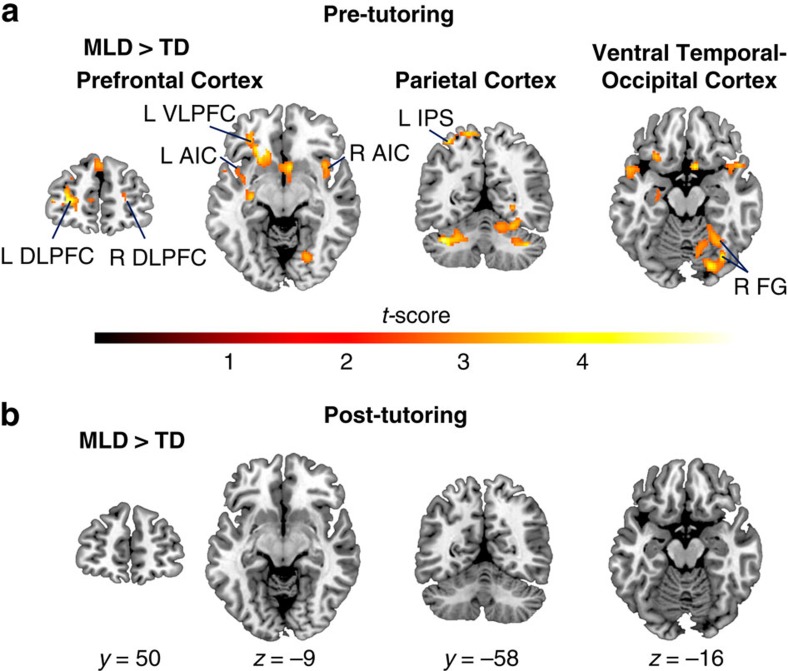
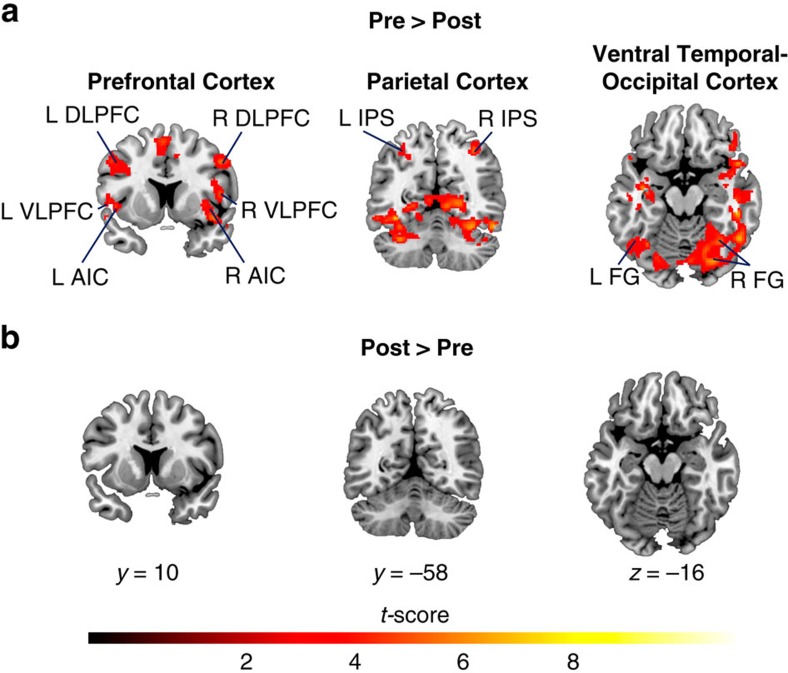
Competency with numbers is essential in today's society; yet, up to 20% of children exhibit moderate to severe mathematical learning disabilities (MLD). Behavioural intervention can be effective, but the neurobiological mechanisms underlying successful intervention are unknown. Here we demonstrate that eight weeks of 1:1 cognitive tutoring not only remediates poor performance in children with MLD, but also induces widespread changes in brain activity. Neuroplasticity manifests as normalization of aberrant functional responses in a distributed network of parietal, prefrontal and ventral temporal-occipital areas that support successful numerical problem solving, and is correlated with performance gains. Remarkably, machine learning algorithms show that brain activity patterns in children with MLD are significantly discriminable from neurotypical peers before, but not after, tutoring, suggesting that behavioural gains are not due to compensatory mechanisms. Our study identifies functional brain mechanisms underlying effective intervention in children with MLD and provides novel metrics for assessing response to intervention.
在当今社会,数字能力至关重要;然而,高达20%的儿童表现出中度至重度数学学习障碍(MLD)。行为干预可能有效,但成功干预背后的神经生物学机制尚不清楚。在这里,我们证明,为期八周的一对一认知辅导不仅能改善MLD儿童的不良表现,还能引起大脑活动的广泛变化。神经可塑性表现为顶叶、前额叶和颞枕腹侧区域分布式网络中异常功能反应的正常化,这些区域支持成功的数字问题解决,并且与成绩提高相关。值得注意的是,机器学习算法表明,MLD儿童的大脑活动模式在辅导前与神经典型同龄人有显著差异,但辅导后则无差异,这表明行为改善并非归因于补偿机制。我们的研究确定了MLD儿童有效干预背后的功能性脑机制,并提供了评估干预反应的新指标。