From the State Key Laboratory of Emerging Infectious Diseases.
Departments of Microbiology and.
J Biol Chem. 2018 Jul 27;293(30):11709-11726. doi: 10.1074/jbc.RA118.001897. Epub 2018 Jun 10.
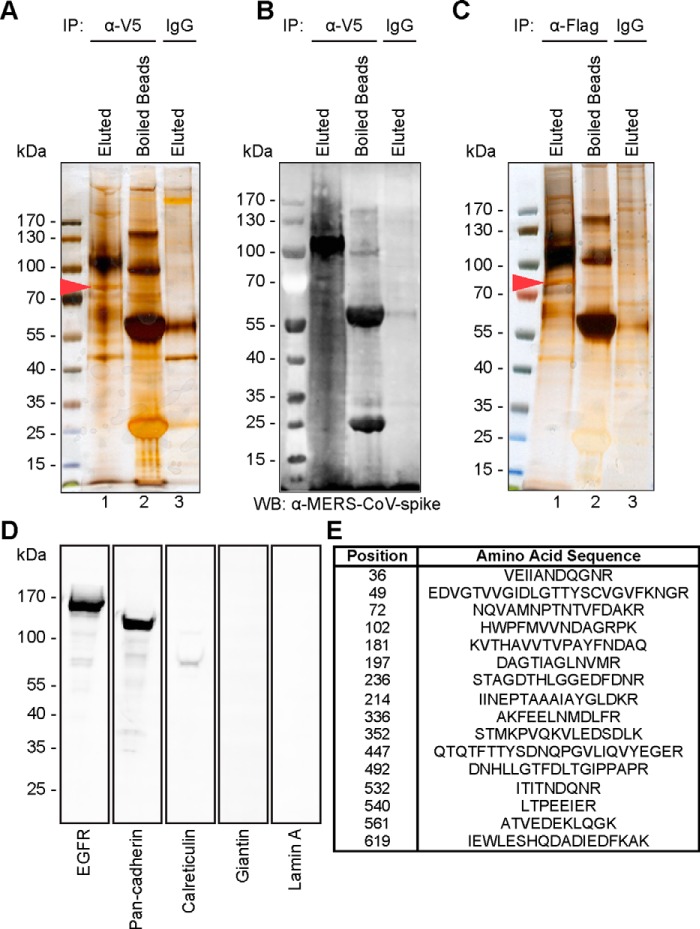
Coronavirus tropism is predominantly determined by the interaction between coronavirus spikes and the host receptors. In this regard, coronaviruses have evolved a complicated receptor-recognition system through their spike proteins. Spikes from highly related coronaviruses can recognize distinct receptors, whereas spikes of distant coronaviruses can employ the same cell-surface molecule for entry. Moreover, coronavirus spikes can recognize a broad range of cell-surface molecules in addition to the receptors and thereby can augment coronavirus attachment or entry. The receptor of Middle East respiratory syndrome coronavirus (MERS-CoV) is dipeptidyl peptidase 4 (DPP4). In this study, we identified membrane-associated 78-kDa glucose-regulated protein (GRP78) as an additional binding target of the MERS-CoV spike. Further analyses indicated that GRP78 could not independently render nonpermissive cells susceptible to MERS-CoV infection but could facilitate MERS-CoV entry into permissive cells by augmenting virus attachment. More importantly, by exploring potential interactions between GRP78 and spikes of other coronaviruses, we discovered that the highly conserved human GRP78 could interact with the spike protein of bat coronavirus HKU9 (bCoV-HKU9) and facilitate its attachment to the host cell surface. Taken together, our study has identified GRP78 as a host factor that can interact with the spike proteins of two , the lineage C MERS-CoV and the lineage D bCoV-HKU9. The capacity of GRP78 to facilitate surface attachment of both a human coronavirus and a phylogenetically related bat coronavirus exemplifies the need for continuous surveillance of the evolution of animal coronaviruses to monitor their potential for human adaptations.
冠状病毒的嗜性主要由冠状病毒的刺突和宿主受体之间的相互作用决定。在这方面,冠状病毒通过其刺突蛋白进化出了复杂的受体识别系统。高度相关的冠状病毒的刺突可以识别不同的受体,而遥远的冠状病毒的刺突可以利用相同的细胞表面分子进行进入。此外,冠状病毒的刺突除了受体之外,还可以识别广泛的细胞表面分子,从而增强冠状病毒的附着或进入。中东呼吸综合征冠状病毒(MERS-CoV)的受体是二肽基肽酶 4(DPP4)。在这项研究中,我们确定膜相关的 78kDa 葡萄糖调节蛋白(GRP78)是 MERS-CoV 刺突的另一个结合靶标。进一步的分析表明,GRP78 本身不能使非许可细胞对 MERS-CoV 感染敏感,但可以通过增强病毒附着来促进 MERS-CoV 进入许可细胞。更重要的是,通过探索 GRP78 与其他冠状病毒刺突之间的潜在相互作用,我们发现高度保守的人源 GRP78 可以与蝙蝠冠状病毒 HKU9(bCoV-HKU9)的刺突蛋白相互作用,并促进其附着在宿主细胞表面。总之,我们的研究确定了 GRP78 是一种宿主因子,可以与谱系 C 的 MERS-CoV 和谱系 D 的 bCoV-HKU9 的刺突蛋白相互作用。GRP78 促进两种冠状病毒(一种人类冠状病毒和一种系统发育上相关的蝙蝠冠状病毒)表面附着的能力说明了需要不断监测动物冠状病毒的进化,以监测它们适应人类的潜力。