Yan Yan, Dominguez Sky, Fisher Daniel W, Dong Hongxin
Department of Psychiatry & Behavioral Sciences, Northwestern University, Feinberg School of Medicine, 303 East Chicago Avenue, Chicago, IL 60611, USA.
Department of Physiology, Zunyi Medical University, Zunyi Guizhou 563099, China.
Neurobiol Stress. 2018 Mar 26;8:120-126. doi: 10.1016/j.ynstr.2018.03.002. eCollection 2018 Feb.
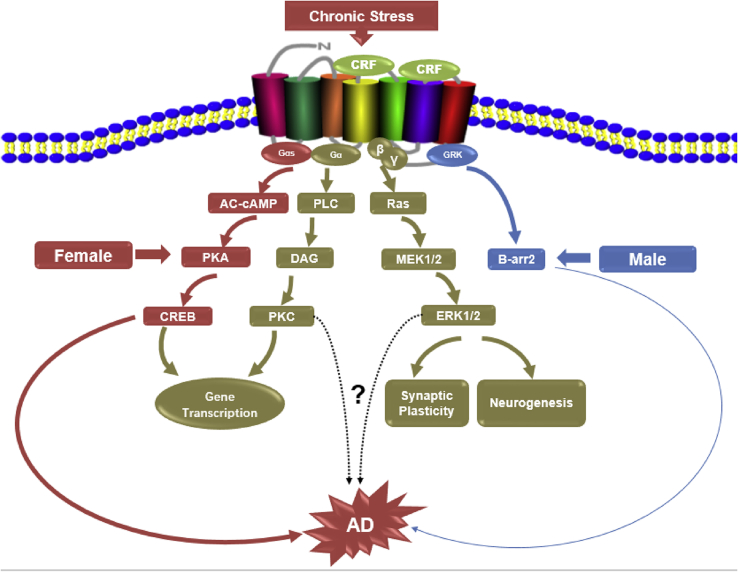
Clinical studies indicate that Alzheimer's disease (AD) disproportionately affects women in both disease prevalence and severity, but the mechanisms underlying this sex divergence are unknown. Though some have suggested this difference in risk is a reflection of known differences in longevity between men and women, mounting clinical and preclinical evidence supports women also having intrinsic susceptibilities towards the disease. While a number of potential risk factors have been hypothesized to affect these differences in risks, none have been definitively verified. In this review, we discuss a novel hypothesis whereby women's susceptibility to chronic stress also mediates increased risk for AD. As stress is a risk factor for AD, and women are twice as likely to develop mood disorders where stress is a major etiology, it is possible that sex dimorphisms in stress responses contribute to the increase in women with AD. In line with this, sex divergence in biochemical responses to stress have been noted along the hypothalamic-pituitary-adrenal (HPA) axis and among known molecular effectors of AD, with crosstalk between these processes also being likely. In addition, activation of the cortical corticotrophin-releasing factor receptor 1 (CRF1) signaling pathway leads to distinct female-biased increases in molecules associated with AD pathogenesis. Therefore, the different biochemical responses to stress between women and men may represent an intrinsic, sex-dependent risk factor for AD.
临床研究表明,阿尔茨海默病(AD)在疾病患病率和严重程度方面对女性的影响尤为显著,但这种性别差异背后的机制尚不清楚。尽管有人认为这种风险差异反映了男性和女性在寿命方面的已知差异,但越来越多的临床和临床前证据表明,女性对该疾病也存在内在易感性。虽然已经假设有许多潜在风险因素会影响这些风险差异,但尚未得到明确证实。在这篇综述中,我们讨论了一种新的假说,即女性对慢性应激的易感性也介导了AD风险的增加。由于压力是AD的一个风险因素,而女性患情绪障碍的可能性是男性的两倍,压力是主要病因,因此应激反应中的性别二态性可能导致患AD的女性增加。与此一致的是,在下丘脑-垂体-肾上腺(HPA)轴以及已知的AD分子效应器中,已注意到对应激的生化反应存在性别差异,这些过程之间也可能存在相互作用。此外,皮质促肾上腺皮质激素释放因子受体1(CRF1)信号通路的激活导致与AD发病机制相关的分子出现明显的女性偏向性增加。因此,男性和女性对应激的不同生化反应可能代表了AD的一种内在的、性别依赖性风险因素。