Cimmino Roberta, Barone Carmela M A, Claps Salvatore, Varricchio Ettore, Rufrano Domenico, Caroprese Mariangela, Albenzio Marzia, De Palo Pasquale, Campanile Giuseppe, Neglia Gianluca
Italian Buffalo Breeders Association, V. Petrarca 42/44, 81100, Caserta, Italy.
Department of AgriculturalSciences, Federico II University, Via Università 133, 80055, Portici, Naples, Italy.
BMC Vet Res. 2018 Jun 11;14(1):181. doi: 10.1186/s12917-018-1513-1.
Diet supplementation with polyphenols is a novel strategy to improve meat quality in livestock, by preventing oxidative deterioration of lipids and protein. Polyphenols have beneficial effects on both human and animal health and can be obtained from several sources, such as olive mill wastewaters (OMWW). These are severe environmental pollutants and therefore may be recycled and utilized in other sectors. The aim of this study was to evaluate growth performance, meat characteristics, fatty acid composition, antioxidant status, different forms of myoglobin and malondialdehyde formation in kids who received a diet supplemented with polyphenols obtained from OMWW. Weaned goat kids (n = 18) were divided into two homogenous groups: control (C) group (n = 9) received a fattening standard diet while the other group (n = 9) received the same diet, supplemented with 3.2 mg/day of polyphenols powder extract (PE group). Average daily gain (ADG) was calculated 10 days apart throughout the study. After 78 days, the kids were slaughtered and pH and carcass yield were evaluated. Longissimus thoracis et lumborum muscle was collected and utilized for chemical analysis, meat quality evaluation and oxidative stability.
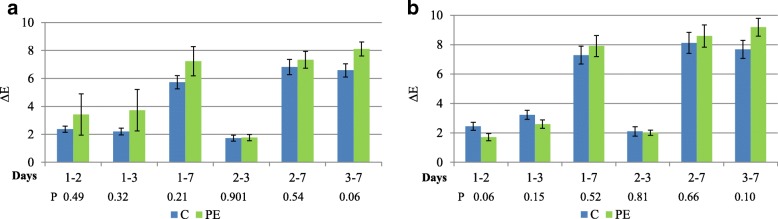
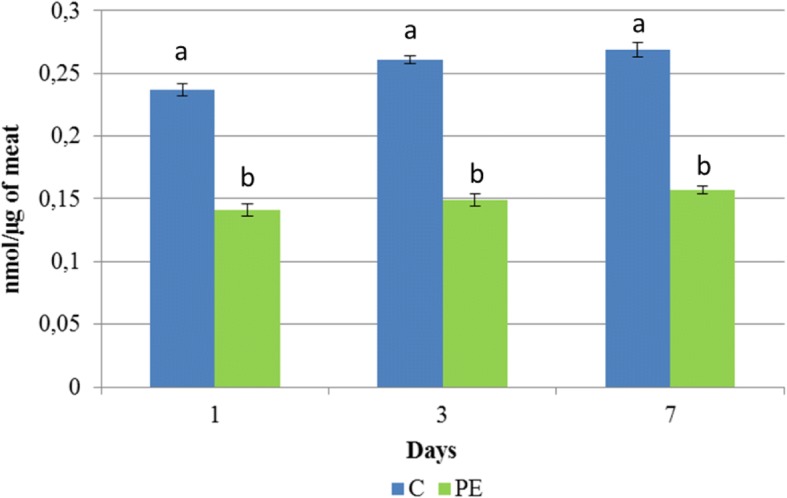
No differences were recorded in ADG, carcass weight, pH and dressing between the two groups. Furthermore a similar meat proximate composition, texture and color was observed. Dietary polyphenols supplementation significantly (P < 0.01) decreased short chains (<C12:0) (2.93 + 0.50 and 0.35 + 0.40 g/100 g of fatty acids, for C and PE Group, respectively), and saturated (49.22 ± 2.39 and 39.51 ± 1.95 g/100 g, in C and PE Group, respectively) fatty acids. Furthermore, a higher (P < 0.05) proportion of monounsaturated (34.35 ± 2.84 and 42.22 ± 2.32 g/100 g, in C and PE Group, respectively) fatty acids was recorded. Malondialdehyde formation was significantly (P < 0.05) lower in PE compared to C Group (0.25 ± 0.005 and 0.15 ± 0.005, in C and PE Group, respectively).
Polyphenols dietary supplementation has positive effects on kid meat, improving fatty acid profile and reducing malondialdehyde contents. Furthermore the utilization of OMWW as the source of polyphenols may represent an innovative strategy to re-utilize agri-food industry wastes.
通过防止脂质和蛋白质的氧化变质,用多酚补充饮食是改善家畜肉质的一种新策略。多酚对人类和动物健康都有有益影响,并且可以从多种来源获得,如橄榄油厂废水(OMWW)。这些是严重的环境污染物,因此可以回收并用于其他领域。本研究的目的是评估在接受从OMWW中提取的多酚补充饮食的羔羊中,其生长性能、肉的特性、脂肪酸组成、抗氧化状态、不同形式的肌红蛋白和丙二醛的形成情况。断奶山羊羔(n = 18)被分为两个同质组:对照组(C组,n = 9)接受育肥标准饮食,而另一组(n = 9)接受相同饮食,并补充3.2毫克/天的多酚粉末提取物(PE组)。在整个研究过程中,每隔10天计算平均日增重(ADG)。78天后,宰杀羔羊并评估pH值和胴体产量。采集胸腰最长肌用于化学分析、肉质评估和氧化稳定性测定。
两组之间在ADG、胴体重量、pH值和屠宰率方面没有差异。此外,观察到肉的近似组成、质地和颜色相似。饮食中补充多酚显著(P < 0.01)降低了短链脂肪酸(<C12:0)(C组和PE组分别为2.93 + 0.50和0.35 + 0.40克/100克脂肪酸)以及饱和脂肪酸(C组和PE组分别为49.22 ± 2.39和39.51 ± 1.95克/100克)。此外,记录到单不饱和脂肪酸的比例更高(P < 0.05)(C组和PE组分别为34.35 ± 2.84和42.22 ± 2.32克/100克)。与C组相比,PE组中丙二醛的形成显著(P < 0.05)更低(C组和PE组分别为0.25 ± 0.005和0.15 ± 0.005)。
饮食中补充多酚对羔羊肉有积极影响,改善了脂肪酸谱并降低了丙二醛含量。此外,利用OMWW作为多酚来源可能代表了一种重新利用农业食品工业废弃物的创新策略。