Programa de Pós-Graduação em Ecologia e Evolução, Instituto de Ciências Biológicas, Departamento de Ecologia, Universidade Federal de Goiás, Goiânia, Goiás, 74001-970, Brazil.
Graduate Program in Biology, Department of Biology, Concordia University, Loyola Campus, 7141 Sherbrooke Street West, Montréal, QC, H2R 2K7, Canada.
BMC Ecol. 2018 Jun 11;18(1):18. doi: 10.1186/s12898-018-0174-z.
Diversity patterns result from ecological to evolutionary processes operating at different spatial and temporal scales. Species trait variation determine the spatial scales at which organisms perceive the environment. Despite this knowledge, the coupling of all these factors to understand how diversity is structured is still deficient. Here, we review the role of ecological and evolutionary processes operating across different hierarchically spatial scales to shape diversity patterns of bats-the second largest mammal order and the only mammals with real flight capability.
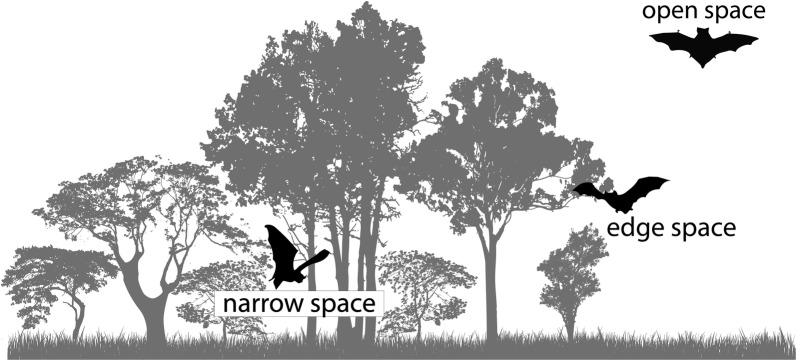
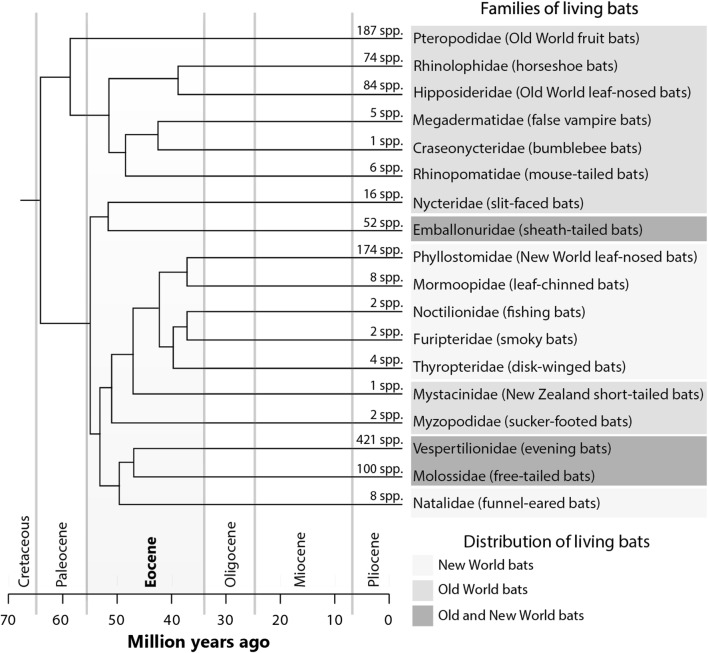
We observed that flight development and its provision of increased dispersal ability influenced the diversification, life history, geographic distribution, and local interspecific interactions of bats, differently across multiple spatial scales. Niche packing combined with different flight, foraging and echolocation strategies and differential use of air space allowed the coexistence among bats as well as for an increased diversity supported by the environment. Considering distinct bat species distributions across space due to their functional characteristics, we assert that understanding such characteristics in Chiroptera improves the knowledge on ecological processes at different scales. We also point two main knowledge gaps that limit progress on the knowledge on scale-dependence of ecological and evolutionary processes in bats: a geographical bias, showing that research on bats is mainly done in the New World; and the lack of studies addressing the mesoscale (i.e. landscape and metacommunity scales).
We propose that it is essential to couple spatial scales and different zoogeographical regions along with their functional traits, to address bat diversity patterns and understand how they are distributed across the environment. Understanding how bats perceive space is a complex task: all bats can fly, but their perception of space varies with their biological traits.
多样性模式是由在不同时空尺度上运行的生态和进化过程决定的。物种特征的变化决定了生物体感知环境的空间尺度。尽管有了这些知识,但将所有这些因素结合起来理解多样性是如何构成的仍然是不足的。在这里,我们回顾了在不同层次的空间尺度上运行的生态和进化过程是如何塑造蝙蝠多样性模式的,蝙蝠是第二大哺乳动物目,也是唯一具有真正飞行能力的哺乳动物。
我们观察到,飞行的发展及其提供的增强的扩散能力,在不同的时空尺度上,对蝙蝠的多样化、生活史、地理分布和种间相互作用产生了不同的影响。生态位的填充,加上不同的飞行、觅食和回声定位策略,以及对空气空间的不同利用,使得蝙蝠能够共存,同时也支持了更多的环境多样性。考虑到不同蝙蝠物种在空间上的分布是由于它们的功能特征,我们断言,了解这些特征在翼手目动物中的作用,可以提高对不同尺度上生态过程的认识。我们还指出了两个主要的知识差距,这些差距限制了对蝙蝠生态和进化过程的尺度依赖性的认识的进展:一个是地理偏见,表明对蝙蝠的研究主要集中在新世界;另一个是缺乏研究解决中尺度(即景观和元社区尺度)的问题。
我们认为,必须将空间尺度和不同的动物地理区域及其功能特征结合起来,以解决蝙蝠的多样性模式,并了解它们是如何在环境中分布的。理解蝙蝠如何感知空间是一个复杂的任务:所有的蝙蝠都能飞,但它们对空间的感知因生物特征而异。