Department of Obstetrics and Gynecology, Korea University College of Medicine, Seoul, Korea.
Big Data Steering Department, National Health Insurance Service, Seoul, Korea.
J Korean Med Sci. 2018 May 11;33(24):e170. doi: 10.3346/jkms.2018.33.e170. eCollection 2018 Jun 11.
Although preterm delivery is the most common cause of infant morbidity and mortality, an obvious cause cannot be found in most cases. Preterm delivery is known to be the most important risk factor for preterm birth in a subsequent pregnancy. We aimed to evaluate the recurrence rate of premature births for subsequent pregnancies in women with a history of a preterm birth.
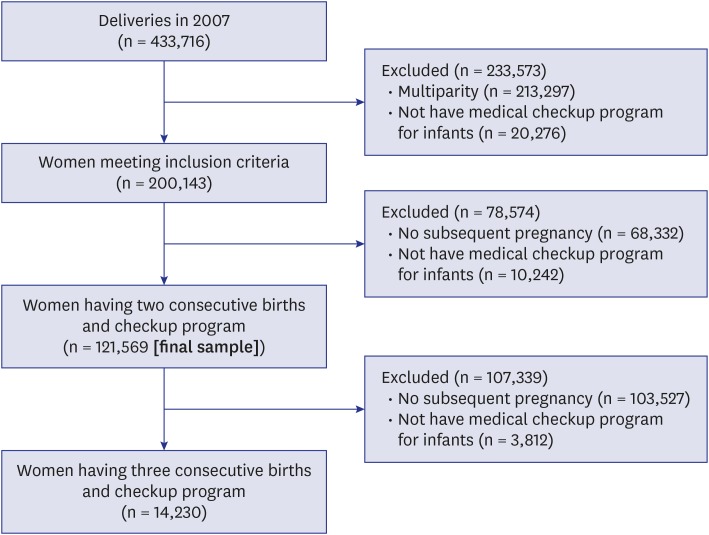
Study data were collected from the Korea National Health Insurance (KNHI) claims database and data from a national health-screening program for infants and children. We enrolled women who had their first delivery between January 1, 2007 and December 31, 2007 and a subsequent delivery before 2014.
Preterm delivery had a significant higher risk of preterm birth in a subsequent singleton pregnancy. The risk of preterm birth at second pregnancy was 2.2% in women whose first delivery at ≥ 37 weeks and 18.6% in women whose first delivery at < 37 weeks (relative risks [RR], 8.64; 95% confidence interval [CI], 7.94-9.40). In the analysis of the third pregnancy, we compared women with an initial term birth followed by preterm birth and women with an initial preterm birth followed by a subsequent term birth. A history of a just preceding preterm birth at < 37 weeks was the most relevant factor for recurrence of preterm delivery in a subsequent pregnancy (26.6%, RR, 4.01; 95% CI, 2.45-6.58).
We found that the prognosis of a third pregnancy was more closely related to the outcome of the second pregnancy to that of the first pregnancy.
虽然早产是婴儿发病和死亡的最常见原因,但大多数情况下都无法找到明显的原因。早产已知是后续妊娠早产的最重要危险因素。我们旨在评估有早产史的女性后续妊娠早产的复发率。
研究数据来自韩国国家健康保险(KNHI)索赔数据库和全国婴幼儿健康筛查计划的数据。我们招募了 2007 年 1 月 1 日至 2007 年 12 月 31 日之间首次分娩且在 2014 年之前再次分娩的女性。
早产在后续单胎妊娠中早产的风险显著增加。在首次分娩≥37 周的女性中,第二次妊娠早产的风险为 2.2%,在首次分娩<37 周的女性中为 18.6%(相对风险 [RR],8.64;95%置信区间 [CI],7.94-9.40)。在第三次妊娠的分析中,我们比较了首次足月分娩后早产和首次早产后随后足月分娩的女性。与先前早产史(<37 周)相关的是后续妊娠早产复发的最相关因素(26.6%,RR,4.01;95%CI,2.45-6.58)。
我们发现,第三次妊娠的预后与第二次妊娠与第一次妊娠的结果更为密切相关。