Post Stephanie, Karashchuk Galina, Wade John D, Sajid Waseem, De Meyts Pierre, Tatar Marc
Department of Molecular Biology, Cell Biology and Biochemistry, Brown University, Providence, RI, United States.
Department of Ecology and Evolutionary Biology, Brown University, Providence, RI, United States.
Front Endocrinol (Lausanne). 2018 May 28;9:245. doi: 10.3389/fendo.2018.00245. eCollection 2018.
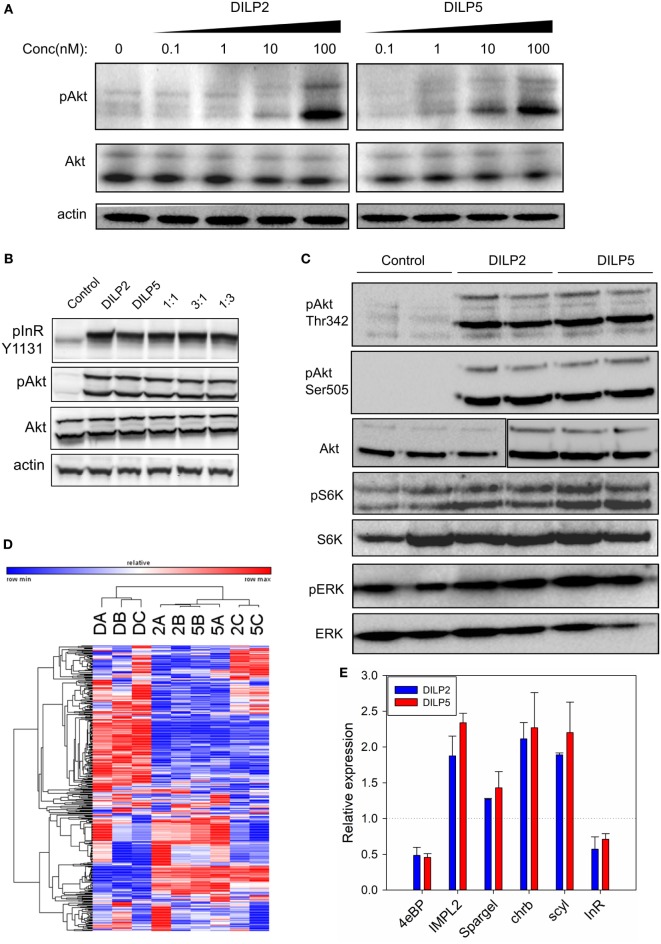
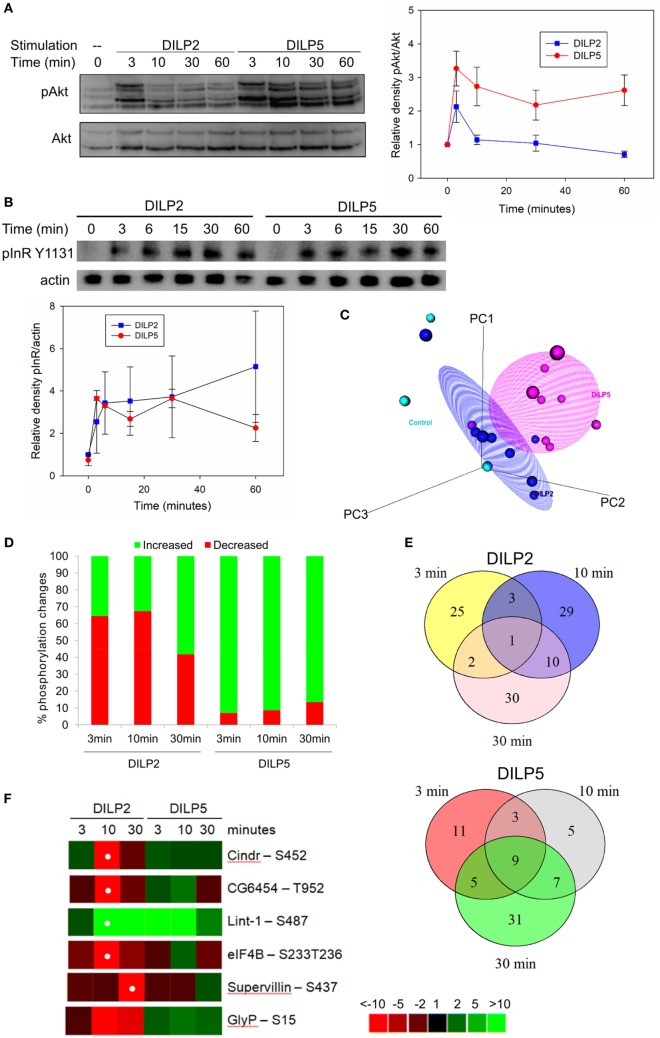
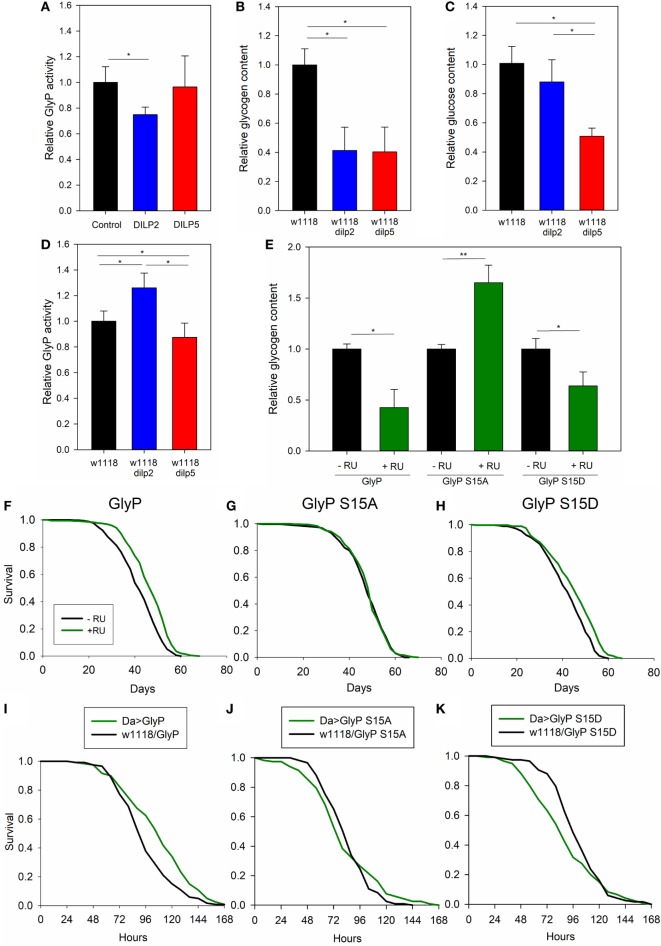
Insulin and IGF signaling (IIS) is a complex system that controls diverse processes including growth, development, metabolism, stress responses, and aging. IIS is propagated by eight insulin-like peptides (DILPs), homologs of both mammalian insulin and IGFs, with various spatiotemporal expression patterns and functions. DILPs 1-7 are thought to act through a single insulin/IGF receptor, InR, but it is unclear how the DILPs thereby mediate a range of physiological phenotypes. We determined the distinct cell signaling effects of DILP2 and DILP5 stimulation upon S2 cells. DILP2 and DILP5 induced similar transcriptional patterns but differed in signal transduction kinetics. DILP5 induced sustained phosphorylation of Akt, while DILP2 produced acute, transient Akt phosphorylation. Accordingly, we used phosphoproteomic analysis to identify distinct patterns of non-genomic signaling induced by DILP2 and DILP5. Across all treatments and replicates, 5,250 unique phosphopeptides were identified, representing 1,575 proteins. Among these peptides, DILP2, but not DILP5, dephosphorylated Ser15 on glycogen phosphorylase (GlyP), and DILP2, but not DILP5, was subsequently shown to repress enzymatic GlyP activity in S2 cells. The functional consequences of this difference were evaluated in adult mutants: null adults have elevated GlyP enzymatic activity relative to wild type, while mutants have reduced GlyP activity. In flies with intact insulin genes, overexpression extended lifespan in a Ser15 phosphorylation-dependent manner. In mutants, that are otherwise long-lived, longevity was repressed by expression of phosphonull that is enzymatically inactive. Overall, DILP2, unlike DILP5, signals to affect longevity in part through its control of phosphorylation to deactivate glycogen phosphorylase, a central modulator of glycogen storage and gluconeogenesis.
胰岛素和胰岛素样生长因子信号传导(IIS)是一个复杂的系统,它控制着包括生长、发育、代谢、应激反应和衰老在内的多种过程。IIS由八种胰岛素样肽(DILPs)介导,这些肽是哺乳动物胰岛素和胰岛素样生长因子的同源物,具有各种时空表达模式和功能。DILPs 1 - 7被认为通过单一的胰岛素/胰岛素样生长因子受体InR起作用,但尚不清楚DILPs如何介导一系列生理表型。我们确定了DILP2和DILP5刺激S2细胞后不同的细胞信号效应。DILP2和DILP5诱导了相似的转录模式,但信号转导动力学不同。DILP5诱导Akt的持续磷酸化,而DILP2产生急性、短暂的Akt磷酸化。因此,我们使用磷酸化蛋白质组分析来鉴定由DILP2和DILP5诱导的非基因组信号传导的不同模式。在所有处理和重复实验中,共鉴定出5250个独特的磷酸肽,代表1575种蛋白质。在这些肽中,DILP2而非DILP5使糖原磷酸化酶(GlyP)上的Ser15去磷酸化,随后发现DILP2而非DILP5在S2细胞中抑制GlyP的酶活性。在成年突变体中评估了这种差异的功能后果:与野生型相比,无效突变体的GlyP酶活性升高,而突变体的GlyP活性降低。在胰岛素基因完整的果蝇中,过表达以Ser15磷酸化依赖的方式延长寿命。在原本长寿的突变体中,无酶活性的磷酸化缺失型的表达会抑制寿命。总体而言,与DILP5不同,DILP2部分通过控制磷酸化来使糖原磷酸化酶失活从而影响寿命,糖原磷酸化酶是糖原储存和糖异生的核心调节因子。