Department of Molecular Biology, Cell Biology and Biochemistry, Brown University, Providence, Rhode Island.
Department of Ecology and Evolutionary Biology, Brown University, Providence, Rhode Island.
Aging Cell. 2019 Feb;18(1):e12863. doi: 10.1111/acel.12863. Epub 2018 Dec 3.
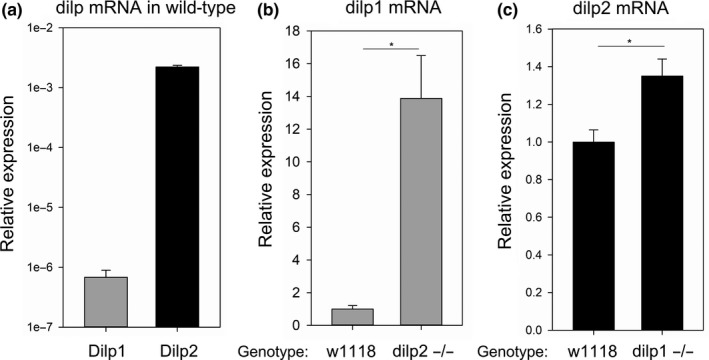
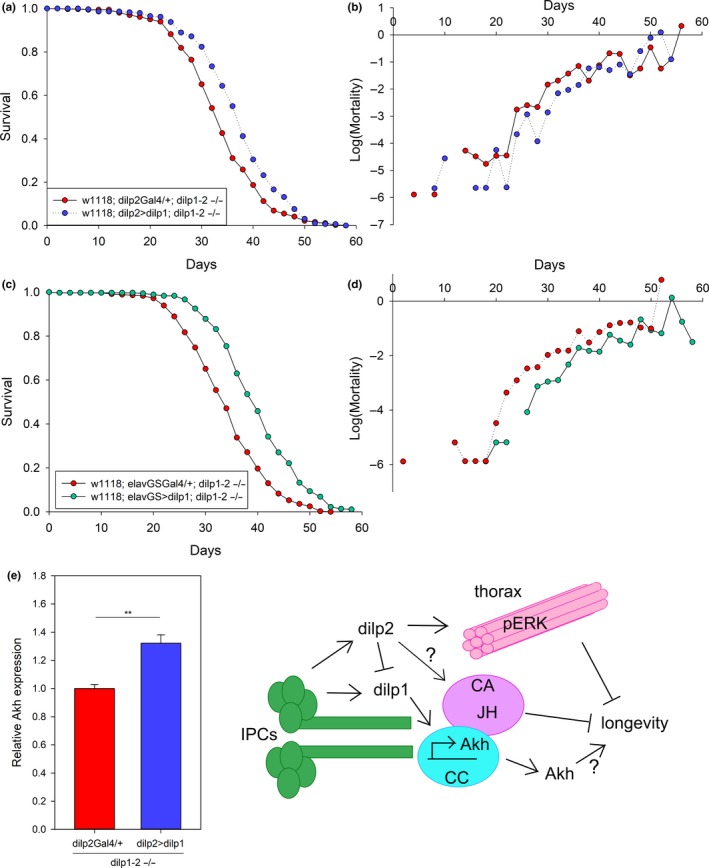
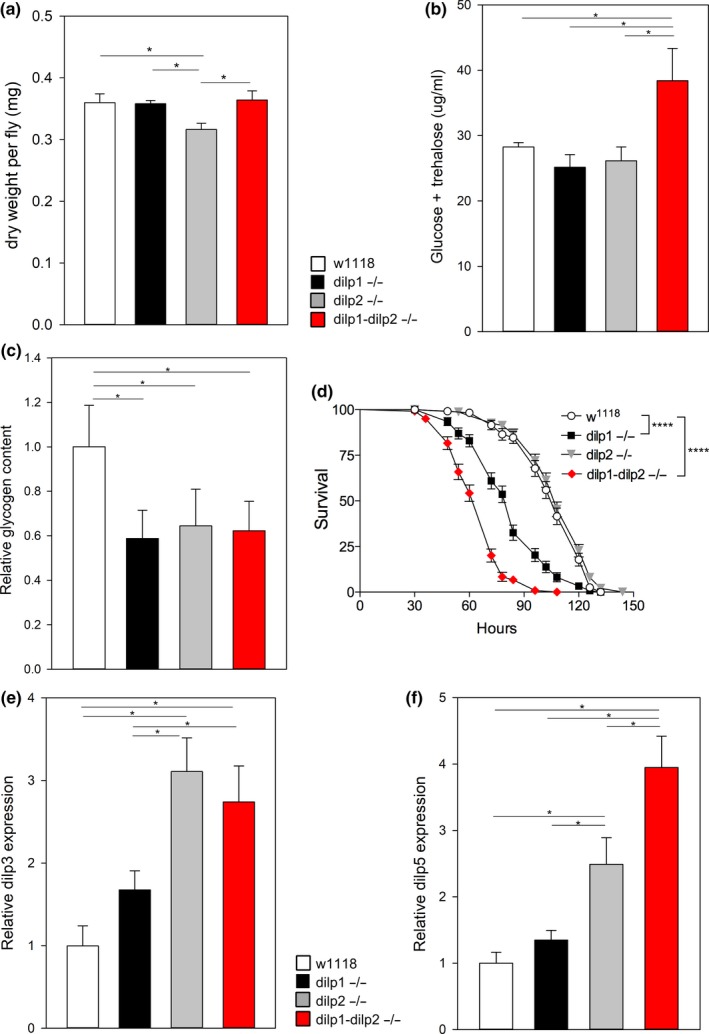
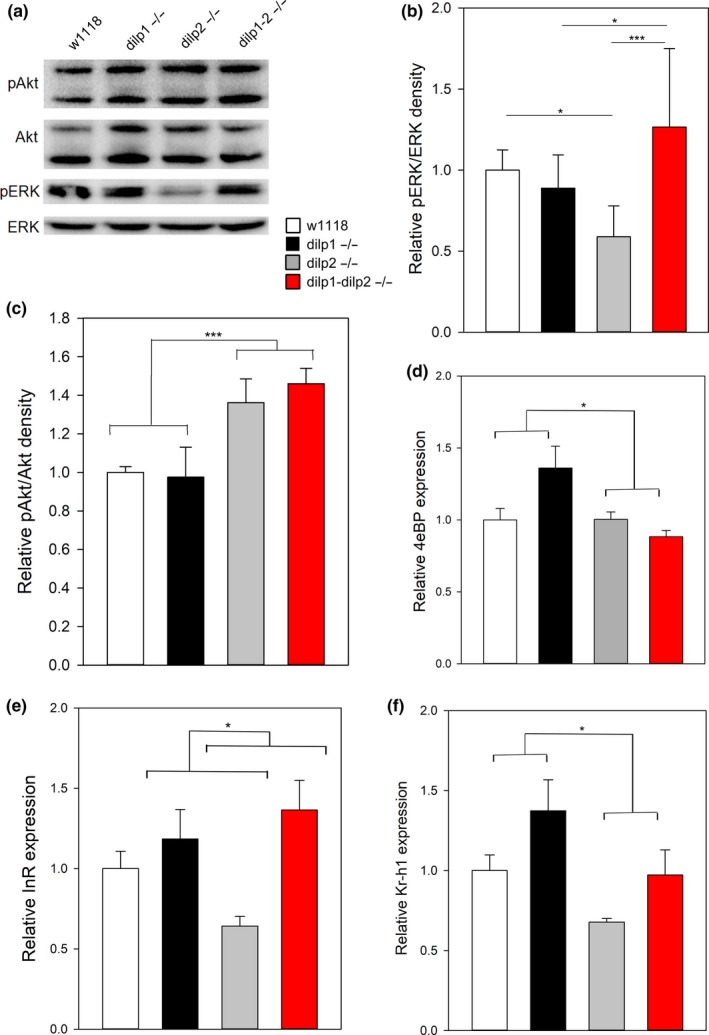
Insulin/IGF signaling (IIS) regulates essential processes including development, metabolism, and aging. The Drosophila genome encodes eight insulin/IGF-like peptide (dilp) paralogs, including tandem-encoded dilp1 and dilp2. Many reports show that longevity is increased by manipulations that decrease DILP2 levels. It has been shown that dilp1 is expressed primarily in pupal stages, but also during adult reproductive diapause. Here, we find that dilp1 is also highly expressed in adult dilp2 mutants under nondiapause conditions. The inverse expression of dilp1 and dilp2 suggests these genes interact to regulate aging. Here, we study dilp1 and dilp2 single and double mutants to describe epistatic and synergistic interactions affecting longevity, metabolism, and adipokinetic hormone (AKH), the functional homolog of glucagon. Mutants of dilp2 extend lifespan and increase Akh mRNA and protein in a dilp1-dependent manner. Loss of dilp1 alone has no impact on these traits, whereas transgene expression of dilp1 increases lifespan in dilp1 - dilp2 double mutants. On the other hand, dilp1 and dilp2 redundantly or synergistically interact to control circulating sugar, starvation resistance, and compensatory dilp5 expression. These interactions do not correlate with patterns for how dilp1 and dilp2 affect longevity and AKH. Thus, repression or loss of dilp2 slows aging because its depletion induces dilp1, which acts as a pro-longevity factor. Likewise, dilp2 regulates Akh through epistatic interaction with dilp1. Akh and glycogen affect aging in Caenorhabditis elegans and Drosophila. Our data suggest that dilp2 modulates lifespan in part by regulating Akh, and by repressing dilp1, which acts as a pro-longevity insulin-like peptide.
胰岛素/胰岛素样生长因子信号(IIS)调节包括发育、代谢和衰老等基本过程。果蝇基因组编码 8 种胰岛素/胰岛素样肽(dilp)类似物,包括串联编码的 dilp1 和 dilp2。许多报道表明,通过降低 DILP2 水平的操作可以延长寿命。已经表明 dilp1 主要在蛹期表达,但在成年生殖滞育期间也表达。在这里,我们发现 dilp1 在非滞育条件下的 adult dilp2 突变体中也高度表达。dilp1 和 dilp2 的反式表达表明这些基因相互作用以调节衰老。在这里,我们研究了 dilp1 和 dilp2 的单突变体和双突变体,以描述影响寿命、代谢和肾上腺素能激素(AKH)的上位性和协同相互作用,AKH 是胰高血糖素的功能同源物。dilp2 突变体延长寿命,并以依赖于 dilp1 的方式增加 Akh mRNA 和蛋白。单独缺失 dilp1 对这些特征没有影响,而 dilp1 的转基因表达增加了 dilp1-dilp2 双突变体的寿命。另一方面,dilp1 和 dilp2 以冗余或协同的方式相互作用,以控制循环糖、饥饿抗性和补偿性 dilp5 表达。这些相互作用与 dilp1 和 dilp2 影响寿命和 AKH 的模式无关。因此,抑制或缺失 dilp2 会减缓衰老,因为其耗竭会诱导 dilp1,后者作为一种长寿促进因子发挥作用。同样,dilp2 通过与 dilp1 的上位性相互作用来调节 Akh。Akh 和糖原影响秀丽隐杆线虫和果蝇的衰老。我们的数据表明,dilp2 通过调节 Akh 和抑制作为长寿胰岛素样肽的 dilp1 来部分调节寿命。