Raffaeli Genny, Ghirardello Stefano, Vanzati Mara, Baracetti Chiara, Canesi Francesco, Conigliaro Federica, Gentilino Valerio, Macchini Francesco, Fumagalli Monica, Ciralli Fabrizio, Pesenti Nicola, Passera Sofia, Neri Simona, Franzini Stefania, Leva Ernesto, Plevani Laura, Mosca Fabio, Cavallaro Giacomo
Neonatal Intensive Care Unit, Department of Clinical Sciences and Community Health, Fondazione IRCCS Ca' Granda Ospedale Maggiore Policlinico, Università degli Studi di Milano, Milan, Italy.
Betamed Perfusion Service, Rome, Italy.
Front Pediatr. 2018 May 29;6:151. doi: 10.3389/fped.2018.00151. eCollection 2018.
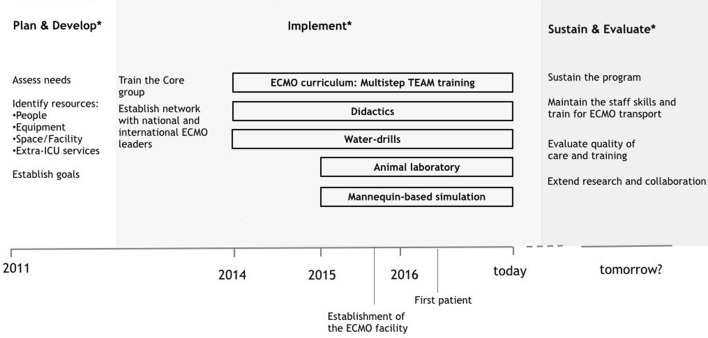
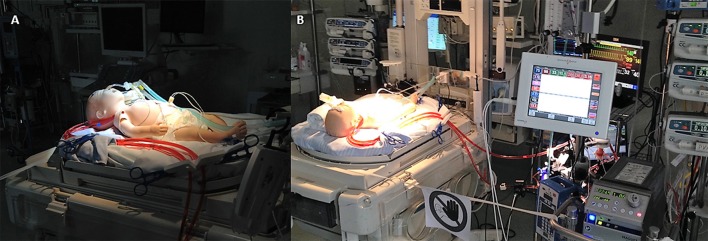
Extracorporeal membrane oxygenation (ECMO) is a complex life-saving support for acute cardio-respiratory failure, unresponsive to medical treatment. Emergency events on ECMO are rare but require immediate and proficient management. Multidisciplinary ECMO team members need to acquire and maintain over time cognitive, technical and behavioral skills, to safely face life-threatening clinical scenarios. A multistep educational program was delivered in a 4-year period to 32 ECMO team members, based on guidelines from the Extracorporeal Life Support Organization. A first traditional module was provided through didactic lectures, hands-on water drills, and laboratory animal training. The second phase consisted of a multi-edition high-fidelity simulation-based training on a modified neonatal mannequin (SimNewB®). In each session, participants were called to face, in small groups, ten critical scenarios, followed by debriefing time. Trainees underwent a pre-test for baseline competency assessment. Once completed the full training program, a post-test was administered. Pre- and post-test scores were compared. Trainees rated the educational program through survey questionnaires. 28 trainees (87.5%) completed the full educational program. ECMO staff skills improved from a median pre-test score of 7.5/18 (IQR = 6-11) to 14/18 (IQR = 14-16) at post-test ( < 0.001, Wilcoxon rank test). All trainees highly rated the educational program and its impact on their practice. They reported high-fidelity simulations to be beneficial to novice learners as it increased self-confidence in ECMO-emergencies (according to 100% of surveyed), theoretical knowledge (61.5%) and team-work/communicative skills (58%). The multistep ECMO team training increased staff' knowledge, technical skills, teamwork, and self-confidence, allowing the successful development of a neonatal respiratory ECMO program. Conventional training was perceived as relevant in the early phase of the program development, while the active learning emerged to be more beneficial to master ECMO knowledge, specific skills, and team performance.
体外膜肺氧合(ECMO)是一种用于治疗急性心肺功能衰竭且对药物治疗无反应的复杂的救命支持手段。ECMO上的紧急情况很少见,但需要立即进行专业处理。多学科ECMO团队成员需要随着时间的推移获得并保持认知、技术和行为技能,以安全应对危及生命的临床情况。基于体外生命支持组织的指南,在4年时间里为32名ECMO团队成员提供了一个多步骤的教育项目。第一个传统模块通过理论讲座、实际操作水模拟训练和实验动物培训来提供。第二阶段包括在改良的新生儿模型(SimNewB®)上进行的多版本高保真模拟训练。在每次培训中,参与者被要求分组面对十个关键场景,随后是汇报时间。学员们进行了基线能力评估的预测试。完成整个培训项目后,进行了后测试。比较了预测试和后测试的分数。学员们通过调查问卷对教育项目进行了评价。28名学员(87.5%)完成了整个教育项目。ECMO工作人员的技能从预测试的中位数7.5/18(四分位间距=6-11)提高到后测试的14/18(四分位间距=14-16)(<0.001,Wilcoxon秩和检验)。所有学员都对教育项目及其对他们实践的影响给予了高度评价。他们报告说高保真模拟对新手学习者有益,因为它增加了对ECMO紧急情况的自信心(根据100%的受访者)、理论知识(61.5%)和团队合作/沟通技能(58%)。多步骤的ECMO团队培训提高了工作人员的知识、技术技能、团队合作和自信心,使得新生儿呼吸ECMO项目得以成功开展。传统培训在项目开发的早期阶段被认为是相关的,而主动学习对于掌握ECMO知识、特定技能和团队表现似乎更有益。