Macchini Francesco, Leva Ernesto, Gentilino Valerio, Morandi Anna, Rothenberg Steven Scot
Department of Pediatric Surgery, Fondazione IRCCS Ca' Granda Ospedale Maggiore Policlinico, Milan, Italy.
Department of Clinical Sciences and Community Health, University of Milan, Milan, Italy.
Front Pediatr. 2021 Feb 16;9:630518. doi: 10.3389/fped.2021.630518. eCollection 2021.
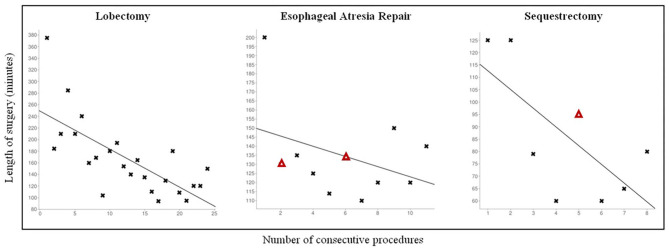
Thoracoscopy represents the most challenging area of pediatric minimally invasive surgery due to its technical difficulty. A standardized training program would be advisable. The aim of this study is to evaluate the results of our surgical training. A retrospective, single-center, cohort study was performed. The following four-step program was tested: (1) theoretical part; (2) experimental training; (3) training in centers of reference; (4) personal operative experience. Particular attention was focused on the choice of mentor. Times and modality of adherence to the program were evaluated. The effectiveness and safety of the training were evaluated according to the surgical results of esophageal atresia (EA/TEF) repair and resection of congenital lung malformations (CLM). The study was conducted from January 2014 to May 2020. Attending surgeons with previous experience in neonatal and pediatric laparoscopy were selected for the training program after being evaluated by the head of Department. The training program was fully completed in 2 years. Twenty-four lobectomies, 9 sequestrectomies, 2 bronchogenic cyst resections and 20 EA/TEF repair were performed. Thoracoscopy was always feasible and effective, with no conversion. The operative times progressively decreased. Only three minor complications were recorded, all treated conservatively. A standardized training program is highly desirable to learn how to safely perform advanced pediatric thoracoscopy. The 4-steps design seems a valid educational option. The choice of the mentor is crucial. An experience-based profile for pediatric surgeons who may teach thoracoscopy is advisable.
由于技术难度大,胸腔镜检查是小儿微创手术中最具挑战性的领域。因此,制定一个标准化的培训计划是可取的。本研究的目的是评估我们外科培训的效果。我们进行了一项回顾性、单中心队列研究。测试了以下四步计划:(1)理论部分;(2)实验培训;(3)在参考中心的培训;(4)个人手术经验。特别关注导师的选择。评估了遵守该计划的时间和方式。根据食管闭锁(EA/TEF)修复和先天性肺畸形(CLM)切除的手术结果评估培训的有效性和安全性。该研究于2014年1月至2020年5月进行。在经过科室主任评估后,选择有新生儿和小儿腹腔镜手术经验的主治外科医生参加培训计划。培训计划在2年内全部完成。共进行了24例肺叶切除术、9例肺隔离症切除术、2例支气管囊肿切除术和20例EA/TEF修复术。胸腔镜检查始终可行且有效,无一例中转开胸。手术时间逐渐缩短。仅记录到3例轻微并发症,均经保守治疗。非常需要一个标准化的培训计划来学习如何安全地进行高级小儿胸腔镜检查。四步设计似乎是一个有效的教育选择。导师的选择至关重要。建议为可能教授胸腔镜检查的小儿外科医生制定基于经验的简介。