University of Western Australia, Perth Western Australia, Australia.
Telethon Kids Institute, University of Western Australia, Perth Western Australia, Australia.
PLoS One. 2018 Jun 13;13(6):e0197394. doi: 10.1371/journal.pone.0197394. eCollection 2018.
Young people with Down syndrome experience varying abilities in activities of daily living, cognitive functioning, behaviour and social skills. The aim of this research was to investigate, from a carer's perspective, the factors that influenced the quality of life of these young people.
Families of young people with Down syndrome (n = 197), aged 16-31 years, living in Western Australia, took part in a questionnaire study regarding young person daily functioning, family characteristics, medical background and quality of life measured by the Kidscreen 27-item scale. Kidscreen-10 total score was used as an outcome in the investigation of determinants with higher scores indicating better quality of life.
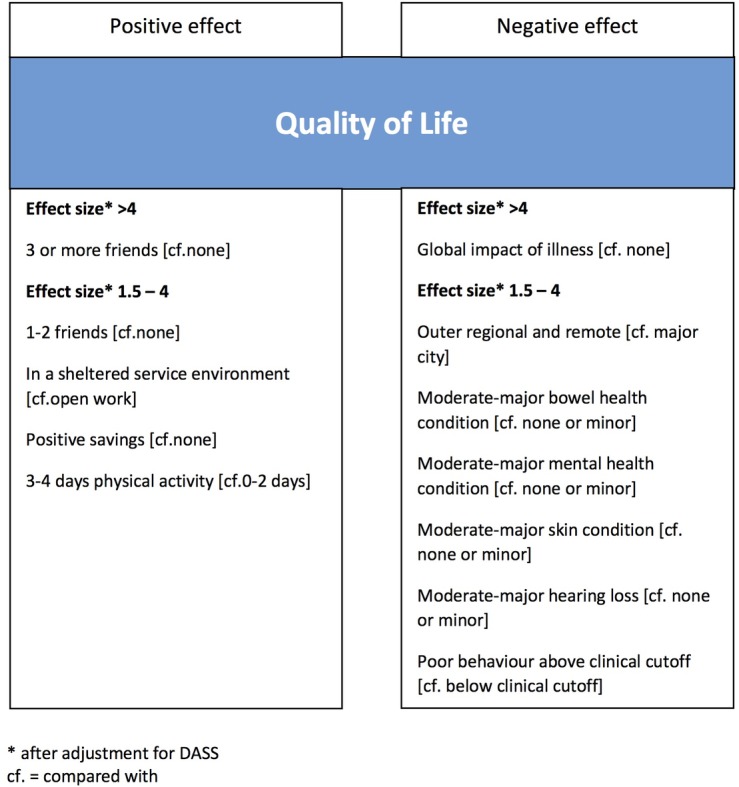
After adjustment for confounders including carer's mental health measured by the Depression and Anxiety Scale (DASS), global impact of illness as well as impact of mental health and bowel conditions were all negatively associated with the young person's quality of life. Young people who had three or more friends had better quality of life than those with no friends. Scores were lower (reflecting poor quality of life) in individuals who had more behavioural problems but these relationships were attenuated after adjustment for confounders and DASS.
Overall, our findings revealed that quality of life of young people with Down syndrome was most negatively associated with burden of medical conditions, but also with lack of friendships. We were somewhat surprised to find the effect of medical problems on quality of life persisting into adolescence and adulthood where in general the burden of medical comorbidities is much less than in childhood.
唐氏综合征患者在日常生活活动、认知功能、行为和社交技能方面的能力存在差异。本研究旨在从照顾者的角度探讨影响这些年轻人生活质量的因素。
西澳大利亚州的 197 名年龄在 16-31 岁的唐氏综合征青年的家庭参加了一项问卷调查研究,内容涉及青年日常功能、家庭特征、医疗背景以及使用 Kidscreen 27 项量表评估的生活质量。Kidscreen-10 总分为调查的结果,得分越高表示生活质量越好。
在调整了抑郁和焦虑量表(DASS)评估的照顾者心理健康、疾病整体影响以及心理健康和肠道状况的影响等混杂因素后,年轻人的生活质量与以下因素呈负相关:患有三种或更多种疾病的朋友,以及行为问题较多的个体。然而,在调整了混杂因素和 DASS 后,这些关系减弱了。
总的来说,我们的研究结果表明,唐氏综合征患者的生活质量与医疗状况负担最负相关,但也与缺乏友谊有关。我们有些惊讶地发现,医疗问题对生活质量的影响会持续到青少年和成年期,因为在一般情况下,医疗合并症的负担比儿童时期要小得多。