Schlarmann Jörg Grosse, Metzing-Blau Sabine, Schnepp Wilfried
Institute of Nursing Science, Witten/Herdecke University, Stockumer StraSSe 12, 58453 Witten, Germany.
BMC Public Health. 2008 Dec 17;8:414. doi: 10.1186/1471-2458-8-414.
Young people below the age of 18, whose lives are affected by looking after a relative with a disability or long-term illness, are called young carers. Evidence based family oriented support for young carers and their families in Germany is currently being developed. To allow for scientific evaluation, an outcome criterion needs to be chosen. Until today, there are no assessment instruments available, which focus on young carer's specific demands and needs. As HRQOL seems to be an adequate alternative outcome criterion, an integrative review of the literature was carried out to verify this assumption.
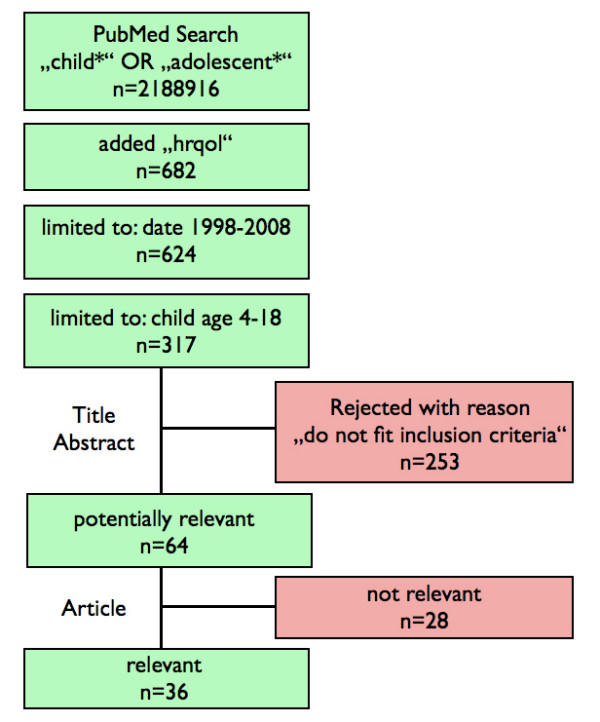
The aim of the integrative review was to get information about a) the concept and the common definition of HRQOL in children, b) preferable HRQOL assessment techniques in children, and c) the relevance of HRQOL measures for the population of young carers. An additional aim of the review was to give advice on which instrument fits best to assess young carer's HRQOL in Germany. Searches were conducted in PubMed in order to obtain papers reporting about a) the development or psychometric assessment of instruments measuring HRQOL in children and adolescents up to the age of 18, and b) on the conceptual framework of HRQOL in children.
HRQOL is a multidimensional construct covering physical, emotional, mental, social, and behavioural components of well-being and functioning as subjective perceived by a person depending on the cultural context and value system one is living in. Young carer's problems and needs are well covered by these common domains of HRQOL. Since no specific HRQOL-measures are available to address young carers, a generic one has to be chosen which a) has been created for use in children, b) allows self- and proxy-report, and c) has good psychometric testing results. Comparing four generic measures with currently best published psychometric testing results, items of the KIDSCREEN cover young carer's specific problems most accurate.
The KIDSCREEN questionnaires seems adequate to evaluate the intervention as their items cover young carer's needs and problems most accurate.
18岁以下那些生活受到照顾残疾或长期患病亲属影响的年轻人被称为年轻照顾者。目前德国正在开发基于证据的面向家庭的年轻照顾者及其家庭支持项目。为了进行科学评估,需要选择一个结果标准。到目前为止,还没有专注于年轻照顾者特定需求的评估工具。由于健康相关生活质量(HRQOL)似乎是一个合适的替代结果标准,因此进行了一项文献综合综述以验证这一假设。
该文献综合综述的目的是获取有关以下方面的信息:a)儿童HRQOL的概念和通用定义;b)儿童中更可取的HRQOL评估技术;c)HRQOL测量对于年轻照顾者群体的相关性。该综述的另一个目的是就哪种工具最适合评估德国年轻照顾者的HRQOL提供建议。在PubMed中进行搜索,以获取报告以下内容的论文:a)18岁及以下儿童和青少年HRQOL测量工具的开发或心理测量评估;b)儿童HRQOL的概念框架。
HRQOL是一个多维结构,涵盖幸福和功能的身体、情感、心理、社会和行为成分,由一个人根据其所处的文化背景和价值体系主观感知。年轻照顾者的问题和需求在HRQOL的这些常见领域中得到了很好的涵盖。由于没有专门用于解决年轻照顾者问题的HRQOL测量工具,因此必须选择一种通用工具,该工具:a)是为儿童使用而创建的;b)允许自我报告和代理报告;c)具有良好的心理测量测试结果。将四种通用测量工具与目前发表的最佳心理测量测试结果进行比较,KIDSCREEN的项目最准确地涵盖了年轻照顾者的特定问题。
KIDSCREEN问卷似乎足以评估干预措施,因为其项目最准确地涵盖了年轻照顾者的需求和问题。