Dr. Li Dak Sum & Yip Yio Chin Center for Stem Cell and Regenerative Medicine, Zhejiang University-University of Edinburgh Institute, Zhejiang University, Hangzhou, Zhejiang 310058, China; Key Laboratory of Tissue Engineering and Regenerative Medicine of Zhejiang Province, Hangzhou, Zhejiang 310058, China.
Dr. Li Dak Sum & Yip Yio Chin Center for Stem Cell and Regenerative Medicine, Zhejiang University-University of Edinburgh Institute, Zhejiang University, Hangzhou, Zhejiang 310058, China; Key Laboratory of Tissue Engineering and Regenerative Medicine of Zhejiang Province, Hangzhou, Zhejiang 310058, China; Department of Orthopeadics, The Second Affiliated Hospital, School of Medicine, Zhejiang University, Hangzhou, Zhejiang 310058, China.
EBioMedicine. 2018 Jun;32:223-233. doi: 10.1016/j.ebiom.2018.06.002. Epub 2018 Jun 11.
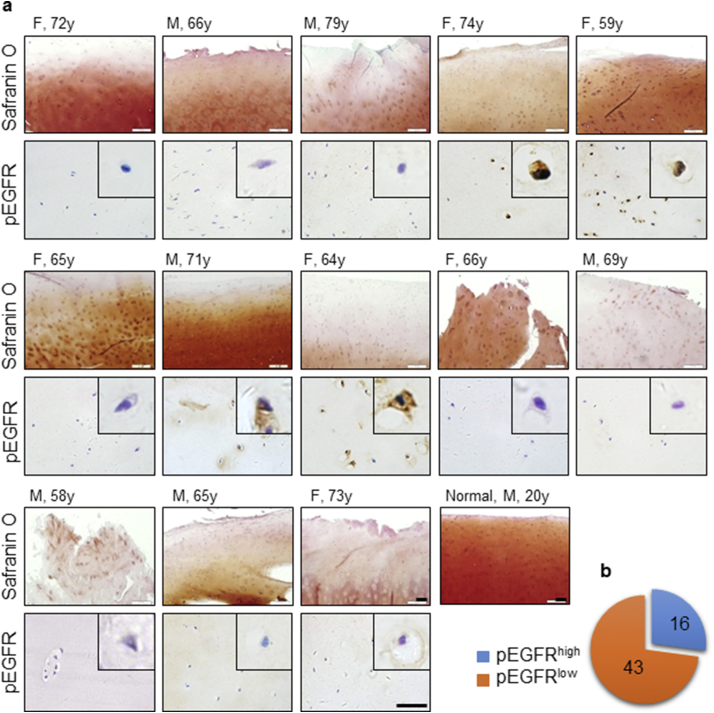
Osteoarthritis (OA) is a leading cause of physical disability among aging populations, with no available drugs able to efficiently restore the balance between cartilage matrix synthesis and degradation. Also, OA has not been accurately classified into subpopulations, hindering the development toward personalized precision medicine. In the present study, we identified a subpopulation of OA patients displaying high activation level of epidermal growth factor receptor (EGFR). With Col2a1-creER; Egfr mice, it was found that the activation of EGFR, indicated by EGFR phosphorylation (pEGFR), led to the destruction of joints. Excitingly, EGFR inhibition prohibited cartilage matrix degeneration and promoted cartilage regeneration. The Food and Drug Administration (FDA)-approved drug gefitinib could efficiently inhibit EGFR functions in OA joints and restore cartilage structure and function in the mouse model as well as the clinical case report. Overall, our findings suggested the concept of the EGFR activated OA subpopulation and illustrated the mechanism of EGFR signaling in regulating cartilage homeostasis. Gefitinib could be a promising disease-modifying drug for this OA subpopulation treatment.
骨关节炎(OA)是老龄化人群中导致身体残疾的主要原因,目前尚无有效的药物能够有效地恢复软骨基质合成与降解之间的平衡。此外,OA 尚未被准确地分为亚群,这阻碍了向个性化精准医学的发展。在本研究中,我们鉴定出了一个 OA 患者亚群,其表皮生长因子受体(EGFR)呈现高激活水平。利用 Col2a1-creER;Egfr 小鼠,我们发现 EGFR 的激活(由 EGFR 磷酸化(pEGFR)表示)导致关节破坏。令人兴奋的是,EGFR 抑制可防止软骨基质退化,并促进软骨再生。美国食品和药物管理局(FDA)批准的药物吉非替尼可有效抑制 OA 关节中的 EGFR 功能,并在小鼠模型以及临床病例报告中恢复软骨结构和功能。总体而言,我们的研究结果提出了 EGFR 激活的 OA 亚群的概念,并说明了 EGFR 信号在调节软骨动态平衡中的作用机制。吉非替尼可能是治疗这种 OA 亚群的一种有前途的疾病修饰药物。