Ghaderpoori Mansour, Najafpoor Ali Asghar, Ghaderpoury Afshin, Shams Mahmoud
Department of Environmental Health Engineering, School of Health and Nutrition, Lorestan University of Medical Sciences, Khorramabad, Iran.
Nutritional Health Research Center, Lorestan University of Medical Sciences, Khorramabad, Iran.
Data Brief. 2018 Apr 21;18:1596-1601. doi: 10.1016/j.dib.2018.04.045. eCollection 2018 Jun.
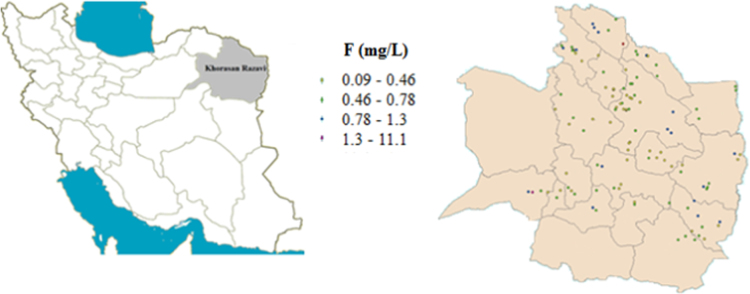
While fluoride (F) is an essential anion to keep the human body healthy, high F intake could lead to serious health problems. The monitoring of F in drinking water as the main route of F intake, is a key factor in preventing its negative health consequences. Here, we present the F levels in drinking water distribution networks of Khorasan Razavi province in Iran which collected during 2016-2017. The non-cancer human risk attributed to F in municipal and rural regions, also, estimated by calculating the chronic daily intake (CDI) and hazard quotient (HQ) for adults and children. Samples taken from drinking water distribution network in 112 different locations across the Khorasan Razavi and the F concentration determined using standard SPADNS Method. Having a minimum of 0.09 and 0.16 and a maximum of 1.7 and 1.1 mg L, the mean F level in municipal and rural samples were 0.74 and 0.59 mg L, respectively. The mean CDI values for F in municipal samples were 1.3×10, 3.34×10, and 8.56×10 mg kgday, for men, women, and children, respectively. The CDI for rural samples were 1.51×10, 3.88×10, and 9.96×10 mg kgday, for men, women, and children, respectively. The mean HQ of F for men, women, and children in municipal and rural samples were 2.17×10, 5.56×10, and 1.43×10, and 2.44×10, 6.26×10 and 1.61×10, respectively. Locations with a HQ>1, needs appropriate strategies for reducing the F level in drinking water to prevent the potential health risks.
虽然氟化物(F)是维持人体健康所必需的阴离子,但高氟摄入会导致严重的健康问题。监测作为氟摄入主要途径的饮用水中的氟,是预防其对健康产生负面影响的关键因素。在此,我们展示了2016 - 2017年期间在伊朗呼罗珊拉扎维省饮用水分配网络中的氟含量。还通过计算成人和儿童的慢性每日摄入量(CDI)和危害商(HQ),估算了城市和农村地区因氟导致的非癌症人类风险。从呼罗珊拉扎维省112个不同地点的饮用水分配网络中采集样本,并使用标准的SPADNS方法测定氟浓度。城市和农村样本中氟的最低含量分别为0.09和0.16,最高含量分别为1.7和1.1 mg/L,平均氟含量分别为0.74和0.59 mg/L。城市样本中男性、女性和儿童的氟平均CDI值分别为1.3×10、3.34×10和8.56×10 mg/kg·天。农村样本中男性、女性和儿童的CDI分别为1.51×10、3.88×10和9.96×10 mg/kg·天。城市和农村样本中男性、女性和儿童的氟平均HQ分别为2.17×10、5.56×10和1.43×10,以及2.44×10、6.2×10和1.61×10。HQ>1的地点需要采取适当策略降低饮用水中的氟含量,以预防潜在的健康风险。