The First Sector of Department of Thyroid Breast Surgery, Northern Branch of Jingmen No. 1 People's Hospital, Jingmen, Hubei 448000, P.R. China.
The Second Sector of Department of Thyroid Breast Surgery, Southern Branch of Jingmen No. 1 People's Hospital, Jingmen, Hubei 448000, P.R. China.
Mol Med Rep. 2018 Aug;18(2):1345-1352. doi: 10.3892/mmr.2018.9119. Epub 2018 Jun 1.
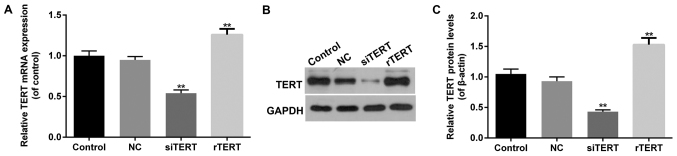
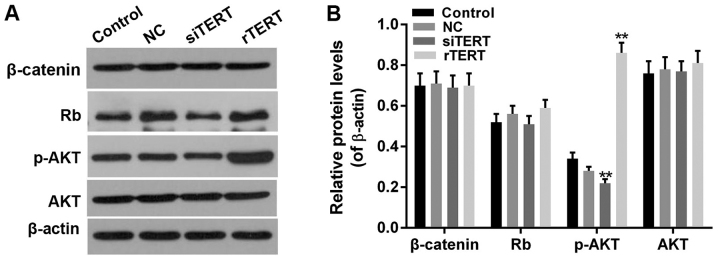
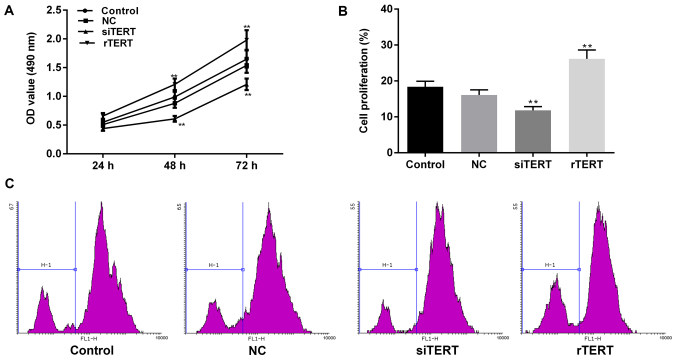
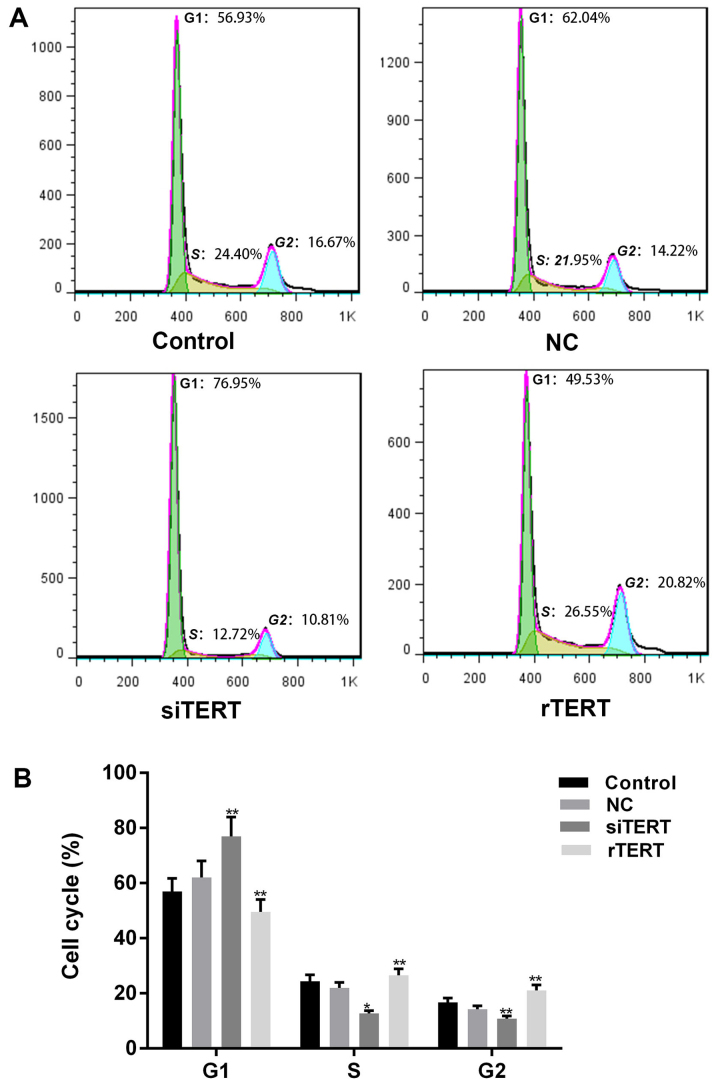
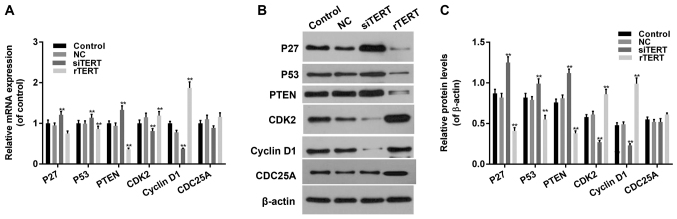
Thyroid carcinoma is the most common endocrine malignant tumor in the world, and so, there is a requirement to develop novel molecular targets for thyroid cancer diagnosis and treatment. Telomerase reverse transcriptase (TERT) was revealed to promote cell proliferation in a number of types of cell. To evaluate whether and how TERT functioned on papillary thyroid cancer (PTC) cell proliferation, the present study constructed TERT over‑expression [recombined (r)TERT plasmid group] and interference [small interfering RNA (si)‑TERT group] models by liposome transfection respectively to study the molecular mechanisms. The transfection efficiency was first detected by reverse transcription‑quantitative polymerase chain reaction (RT‑qPCR) and western blotting to analyze TERT levels compared with the negative control (NC) and control groups. Then MTT and carboxyfluorescein diacetate succinimidyl ester assays were performed to determine living cell proliferation and total cell proliferation respectively. Propidium iodide assay was used to detect alterations in cell cycle progression. RT‑qPCR and western blotting were performed to detect associated factor variation. The results demonstrated that, following the generation of TERT overexpression or silencing PTC cells, the living cells and also total cell proliferation increased significantly in the rTERT group, and decreased significantly in siTERT group, when compared with the NC and control groups. The cell cycle was accelerated in the rTERT group, and blocked in the G1/S transition in the siTERT group. The mRNA and protein levels of P27, P53 and phosphatase and tensin homolog (PTEN) decreased significantly in the rTERP group and increased in the siTERP group, while cyclin dependent kinase 2 and Cyclin D1 increased significantly in the rTERP group and decreased in the siTERP group. The expression of cell division cycle 25A did not alter significantly. The protein levels of β‑catenin and retinoblastoma were also unaltered. Protein kinase B (AKT) was detected once activated by TERT, and there were increased phosphorylated (p)‑AKT protein levels in the rTERT group, and decreased p‑AKT protein levels in the siTERT group. In conclusion, TERT could induce thyroid carcinoma cell proliferation mainly through the PTEN/AKT signaling pathway.
甲状腺癌是世界上最常见的内分泌恶性肿瘤,因此,需要开发新的分子靶点用于甲状腺癌的诊断和治疗。端粒酶逆转录酶(TERT)被揭示能促进多种类型细胞的增殖。为了评估 TERT 是否以及如何影响甲状腺癌(PTC)细胞的增殖,本研究通过脂质体转染分别构建了 TERT 过表达[重组(r)TERT 质粒组]和干扰[小干扰 RNA(si)-TERT 组]模型,以研究分子机制。首先通过逆转录-定量聚合酶链反应(RT-qPCR)和蛋白质印迹法检测转染效率,分析与阴性对照(NC)和对照组相比 TERT 水平。然后通过 MTT 和羧基荧光素二乙酸琥珀酰亚胺酯试验分别测定活细胞增殖和总细胞增殖。碘化丙啶试验用于检测细胞周期进程的变化。通过 RT-qPCR 和蛋白质印迹法检测相关因子的变化。结果表明,在生成 TERT 过表达或沉默 PTC 细胞后,rTERT 组的活细胞和总细胞增殖显著增加,而 siTERT 组则显著减少,与 NC 和对照组相比。rTERT 组的细胞周期加速,siTERT 组在 G1/S 期转换受阻。rTERT 组 P27、P53 和磷酸酶和张力蛋白同源物(PTEN)的 mRNA 和蛋白水平显著降低,而 siTERP 组 P27、P53 和磷酸酶和张力蛋白同源物(PTEN)的 mRNA 和蛋白水平显著增加,rTERP 组细胞周期蛋白依赖性激酶 2 和细胞周期蛋白 D1 显著增加,而 siTERP 组细胞周期蛋白依赖性激酶 2和细胞周期蛋白 D1 显著减少。细胞分裂周期 25A 的表达没有明显改变。β-连环蛋白和视网膜母细胞瘤的蛋白水平也没有改变。检测到 TERT 激活蛋白激酶 B(AKT)一次,rTERT 组的磷酸化(p)-AKT 蛋白水平升高,siTERT 组的 p-AKT 蛋白水平降低。总之,TERT 可主要通过 PTEN/AKT 信号通路诱导甲状腺癌细胞增殖。