Department of Urology, Linyi People's Hospital, Linyi, Shandong 276000, P.R. China.
Mol Med Rep. 2018 Aug;18(2):1305-1310. doi: 10.3892/mmr.2018.9152. Epub 2018 Jun 11.
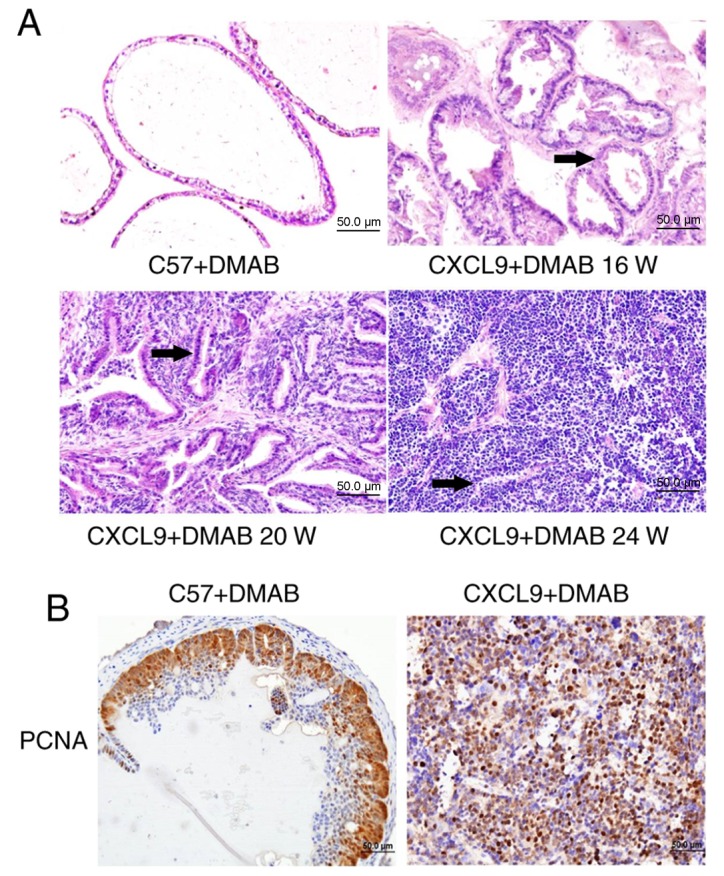
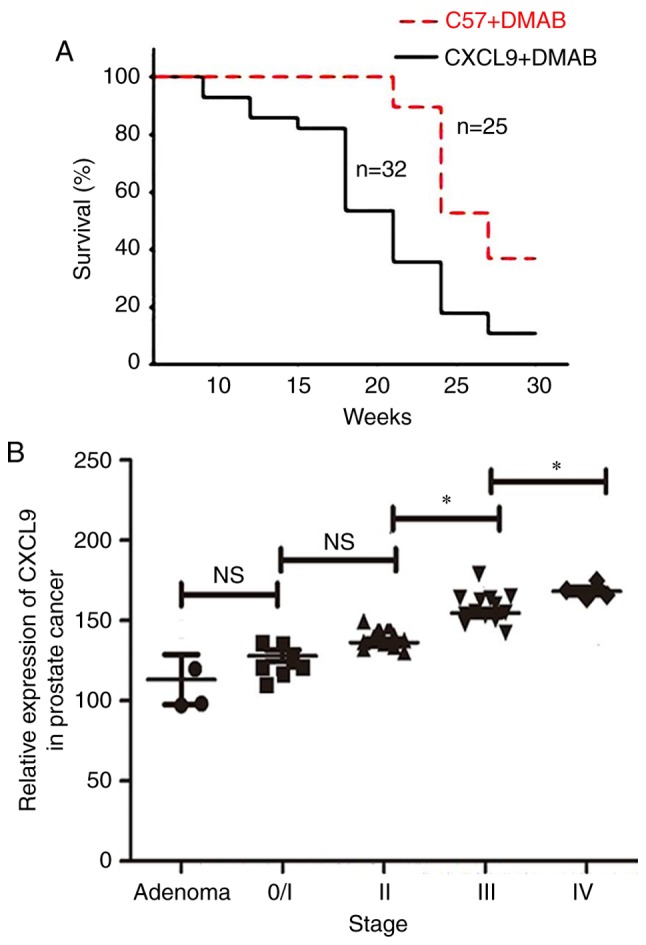
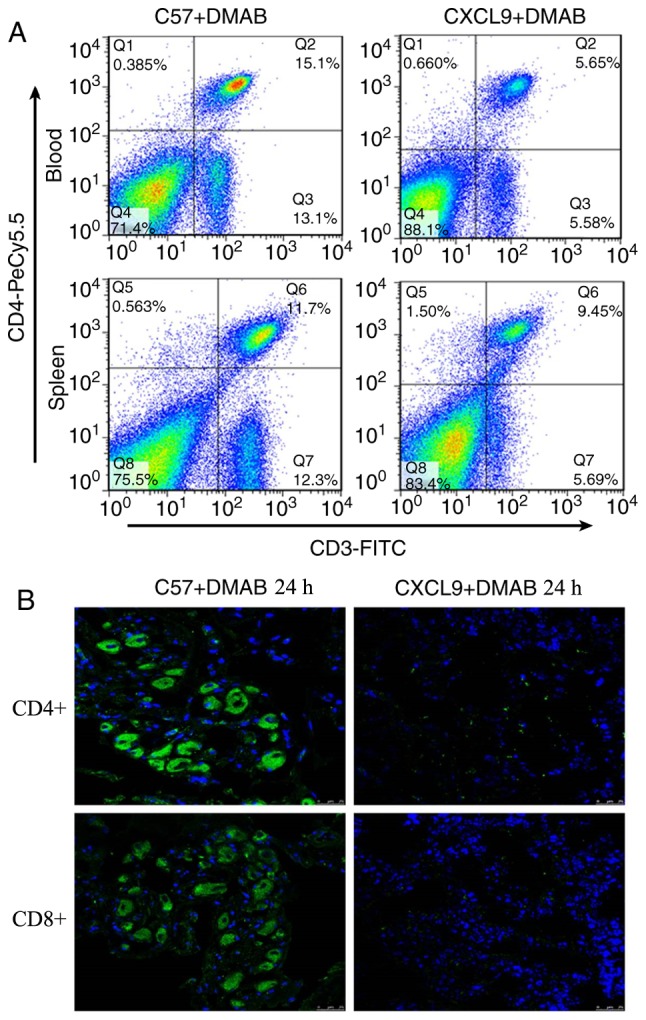
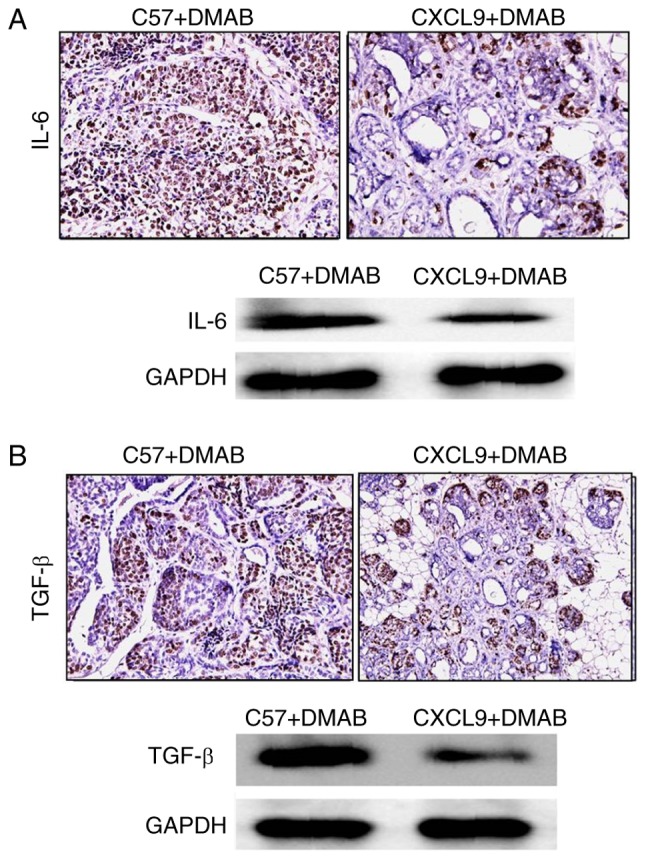
Chemokines have been demonstrated to serve an important role in a variety of diseases, particularly in tumor progression. There have been numerous studies that have reported that T cells serve major roles in tumor progression. However, the function of CXC motif chemokine ligand 9 (CXCL9) in prostate cancer remains unknown. The present study aimed to investigate the role of CXCL9 in prostate cancer. A prostate cancer mouse model was generated by treating C57/BL‑6 and B6.Cg‑Selplgtm1Fur/J mice with 3,2'‑dimethyl 4‑aminobiphenyl (DMAB). Hematoxylin and eosin staining detected the histopathological alterations of mouse prostate tissues. Immunohistochemistry (IHC) staining determined cell proliferation of the mice. Flow cytometry was used to detect the alterations of T cells in C57+DMAB or CXCL9+DMAB mice. Immunofluorescence revealed that there was positive expression of interleukin‑6 (IL‑6) and transforming growth factor (TGF)‑β in the mouse tissues. The survival rates of C57+DMAB and CXCL9+DMAB mice was analyzed. The association of CXCL9 expression and clinical stages was also evaluated. Results revealed that prostate cancer pathology and cell proliferation in CXCL9+DMAB mice were significantly greater compared with the C57+DMAB mice. Compared with C57+DMAB mice, the number of T cells in peripheral blood and spleen of CXCL9+DMAB mice was significantly reduced. IHC demonstrated that the expression of IL‑6 and TGF‑β was significantly downregulated in the CXCL9+DMAB mice. The survival rate of CXCL9+DMAB mice was significantly decreased compared with the C57+DMAB mice. In addition, reverse transcription‑quantitative polymerase chain reaction analysis demonstrated that CXCL9 mRNA expression in clinical samples was positively associated with clinical pathological stages of prostate cancer. In conclusion, CXCL9 may promote prostate cancer progression via inhibition of cytokines from T cells.
趋化因子在多种疾病中发挥着重要作用,特别是在肿瘤进展中。有大量研究报道 T 细胞在肿瘤进展中起主要作用。然而,CXC 基序趋化因子配体 9(CXCL9)在前列腺癌中的功能尚不清楚。本研究旨在探讨 CXCL9 在前列腺癌中的作用。通过用 3,2'-二甲基 4-氨基联苯(DMAB)处理 C57/BL-6 和 B6.Cg-Selplgtm1Fur/J 小鼠,建立前列腺癌小鼠模型。苏木精和伊红染色检测小鼠前列腺组织的组织病理学改变。免疫组织化学(IHC)染色检测小鼠细胞增殖。流式细胞术用于检测 C57+DMAB 或 CXCL9+DMAB 小鼠 T 细胞的变化。免疫荧光法显示小鼠组织中白细胞介素 6(IL-6)和转化生长因子(TGF)-β呈阳性表达。分析 C57+DMAB 和 CXCL9+DMAB 小鼠的存活率。还评估了 CXCL9 表达与临床分期的关系。结果显示,与 C57+DMAB 小鼠相比,CXCL9+DMAB 小鼠的前列腺癌病理和细胞增殖明显增加。与 C57+DMAB 小鼠相比,CXCL9+DMAB 小鼠外周血和脾脏中的 T 细胞数量明显减少。IHC 显示 CXCL9+DMAB 小鼠的 IL-6 和 TGF-β 表达明显下调。与 C57+DMAB 小鼠相比,CXCL9+DMAB 小鼠的存活率明显降低。此外,逆转录-定量聚合酶链反应分析显示,临床样本中 CXCL9 mRNA 表达与前列腺癌的临床病理分期呈正相关。综上所述,CXCL9 可能通过抑制 T 细胞细胞因子促进前列腺癌的进展。