Department of Nephrology, Graduate School of Medical and Dental Sciences, Tokyo Medical and Dental University, 1-5-45 Yushima, Bunkyo, Tokyo, 113-8519, Japan.
Sci Rep. 2018 Jun 14;8(1):9101. doi: 10.1038/s41598-018-27414-0.
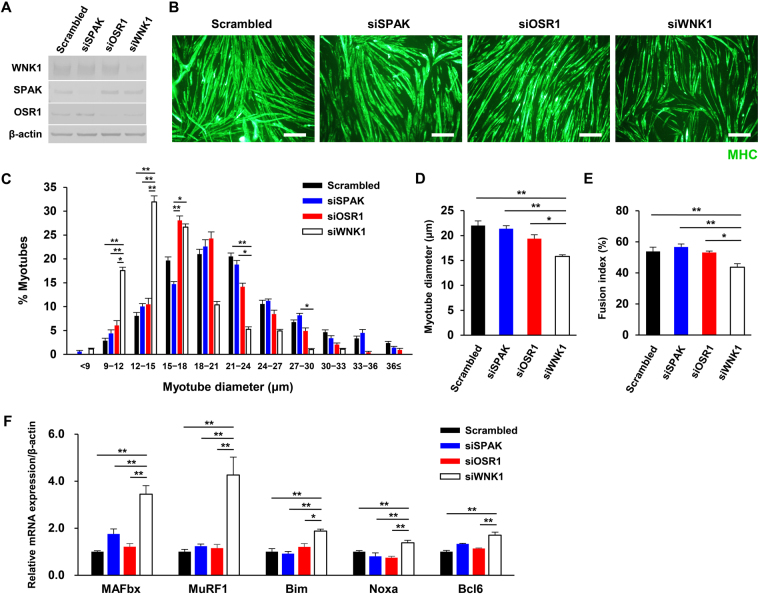
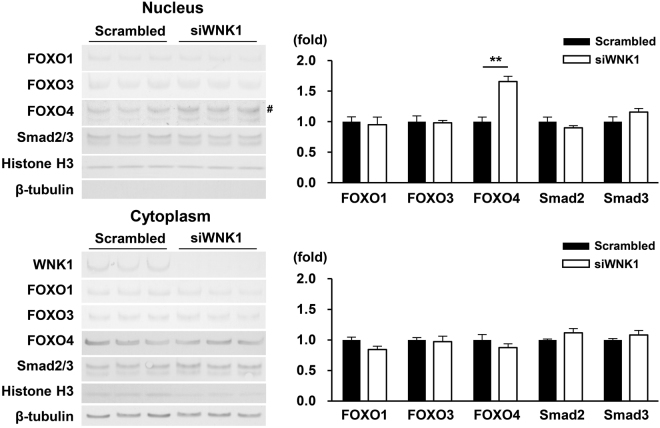
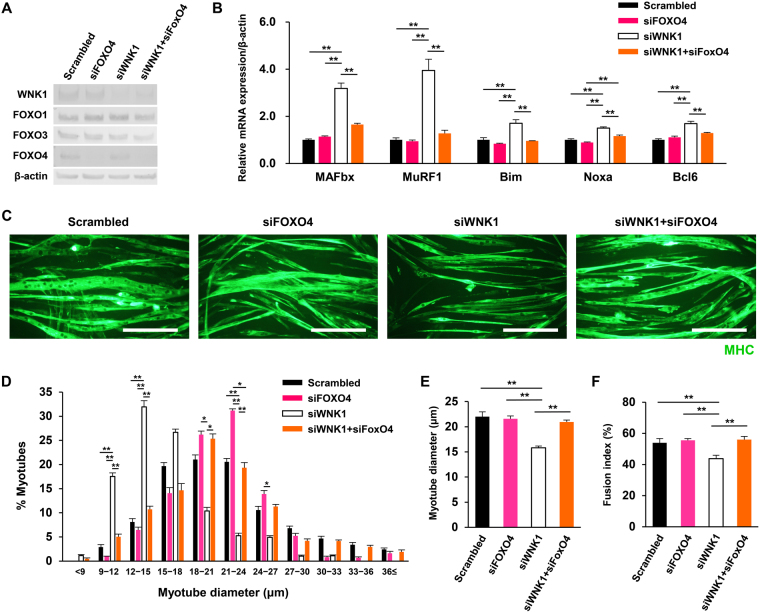
With-no-lysine (K) (WNK) kinases, which are mutated in the inherited form of hypertension pseudohypoaldosteronism type II, are essential regulators of membrane ion transporters. Here, we report that WNK1 positively regulates skeletal muscle cell hypertrophy via mediating the function of the pro-longevity transcription factor forkhead box protein O4 (FOXO4) independent of the conventional WNK signaling pathway linking SPS/STE20-related proline-alanine-rich kinase (SPAK)/oxidative stress response kinase 1 (OSR1) to downstream effector ion transporters. Small interfering RNA (siRNA)-mediated silencing of WNK1, but not SPAK/OSR1 kinases, induced myotube atrophy and remarkable increases in the mRNA expression of the muscle atrophy ubiquitin ligases MAFbx and MuRF1 in C2C12 mouse skeletal muscle cells. WNK1 silencing also increased FOXO4 nuclear localization, and co-transfection of Foxo4-targeted siRNA completely reversed the myotube atrophy and upregulation of atrogene transcription induced by WNK1 silencing. We further illustrated that WNK1 protein abundance in skeletal muscle was increased by chronic voluntary wheel running exercise (hypertrophic stimulus) and markedly decreased by adenine-induced chronic kidney disease (atrophic stimulus) in mice. These findings suggest that WNK1 is involved in the physiological regulation of mammalian skeletal muscle hypertrophy and atrophy via interactions with FOXO4. The WNK1-FOXO4 axis may be a potential therapeutic target in human diseases causing sarcopenia.
无赖氨酸激酶(WNK),在遗传性假性醛固酮增多症 II 型中发生突变,是膜离子转运体的重要调节因子。在这里,我们报告 WNK1 通过调节长寿转录因子叉头框蛋白 O4(FOXO4)的功能来正向调节骨骼肌细胞肥大,而不依赖于将 SPS/STE20 相关脯氨酸-丙氨酸丰富激酶(SPAK)/氧化应激反应激酶 1(OSR1)连接到下游效应离子转运体的传统 WNK 信号通路。小干扰 RNA(siRNA)介导的 WNK1 沉默,但不是 SPAK/OSR1 激酶,诱导肌管萎缩和骨骼肌细胞中肌肉萎缩泛素连接酶 MAFbx 和 MuRF1 的 mRNA 表达显著增加。WNK1 沉默还增加了 FOXO4 的核定位,而 Foxo4 靶向 siRNA 的共转染完全逆转了 WNK1 沉默引起的肌管萎缩和肌萎缩基因转录的上调。我们进一步表明,在小鼠中,慢性自愿轮式跑步运动(肥大刺激)增加了骨骼肌中 WNK1 蛋白的丰度,而腺嘌呤诱导的慢性肾病(萎缩刺激)则显著降低了骨骼肌中 WNK1 蛋白的丰度。这些发现表明,WNK1 通过与 FOXO4 的相互作用参与了哺乳动物骨骼肌肥大和萎缩的生理调节。WNK1-FOXO4 轴可能是导致骨骼肌减少症的人类疾病的潜在治疗靶点。