Laboratory of Genetic Breeding, Reproduction and Precision Livestock Farming, School of Animal Science and Nutritional Engineering, Wuhan Polytechnic University, Wuhan 430023, China.
Hubei Provincial Center of Technology Innovation for Domestic Animal Breeding, Wuhan Polytechnic University, Wuhan 430023, China.
Genes (Basel). 2024 Mar 13;15(3):359. doi: 10.3390/genes15030359.
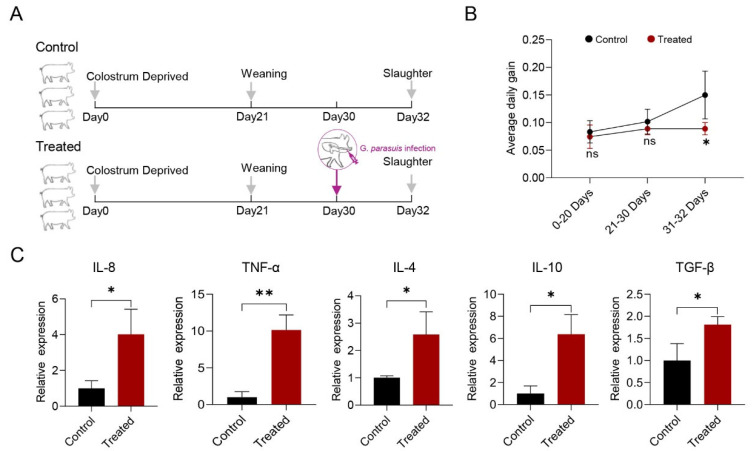
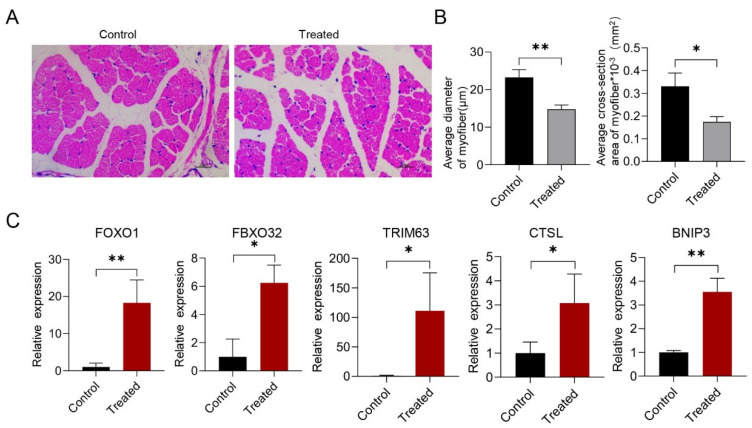
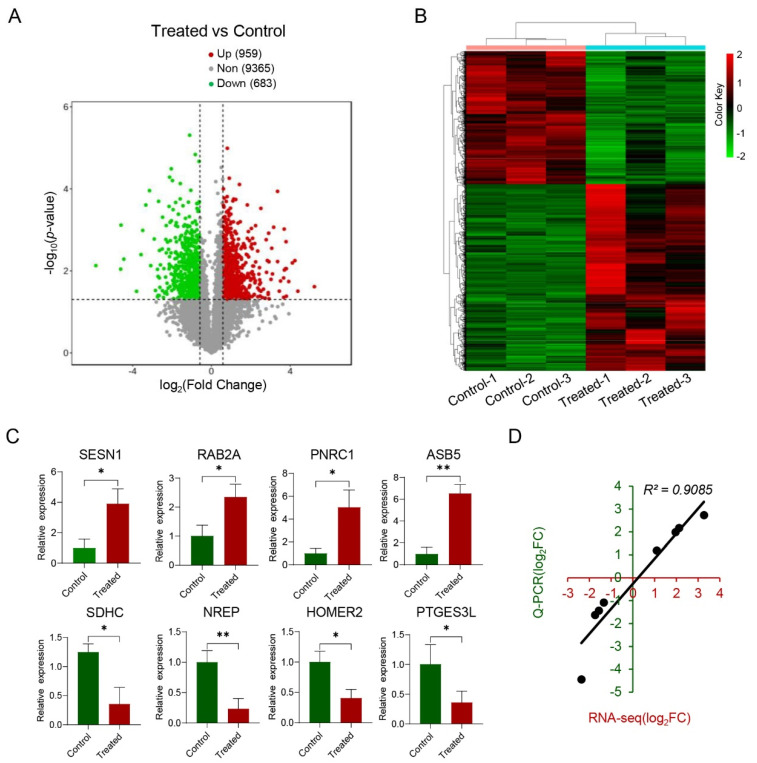
() causes systemic infection in pigs, but its effects on skeletal muscle and underlying mechanisms are poorly understood. We investigated infection in colostrum-deprived piglets, observing decreased daily weight gain and upregulation of inflammatory factors in skeletal muscle. Muscle fiber area and diameter were significantly reduced in the treated group ( = 3) compared to the control group ( = 3), accompanied by increased expression of , , , , and . Based on mRNA and microRNA (miRNA) sequencing, we identified 1642 differentially expressed (DE) mRNAs and 19 known DE miRNAs in skeletal muscle tissues between the two groups. We predicted target genes with opposite expression patterns to the 19 miRNAs and found significant enrichment and activation of the FoxO signaling pathway. We found that the upregulated core effectors and were targeted by downregulated ssc-miR-486, ssc-miR-370, ssc-miR-615, and ssc-miR-224. Further investigation showed that their downstream upregulated genes involved in protein degradation were also targeted by the downregulated ssc-miR-370, ssc-miR-615, ssc-miR-194a-5p, and ssc-miR-194b-5p. These findings suggest that infection causes skeletal muscle atrophy in piglets through accelerated protein degradation mediated by the "miRNAs-" axis, while further research is necessary to validate the regulatory relationships. Our results provide new insights into the understanding of systemic inflammation growth mechanisms caused by and the role of miRNAs in bacterial infection pathogenesis.
猪繁殖与呼吸综合征病毒感染会导致全身感染,但它对骨骼肌的影响及其潜在机制尚不清楚。我们研究了在初乳剥夺的仔猪中感染猪繁殖与呼吸综合征病毒的情况,观察到仔猪日增重下降和骨骼肌中炎症因子的上调。与对照组(n=3)相比,治疗组(n=3)的肌纤维面积和直径显著减小,同时 、 、 、 和 的表达增加。基于 mRNA 和 microRNA(miRNA)测序,我们在两组骨骼肌组织中鉴定出 1642 个差异表达(DE)mRNA 和 19 个已知的 DEmiRNA。我们预测了与 19 个 miRNA 表达模式相反的靶基因,并发现 FoxO 信号通路显著富集和激活。我们发现上调的核心效应物 和 是下调的 ssc-miR-486、ssc-miR-370、ssc-miR-615 和 ssc-miR-224 的靶基因。进一步的研究表明,它们下游上调的参与蛋白降解的基因也被下调的 ssc-miR-370、ssc-miR-615、ssc-miR-194a-5p 和 ssc-miR-194b-5p 靶向。这些发现表明,猪繁殖与呼吸综合征病毒感染通过“miRNAs-”轴介导的加速蛋白降解导致仔猪骨骼肌萎缩,而进一步的研究有必要验证这些调控关系。我们的研究结果为理解 感染引起的全身炎症生长机制以及 miRNA 在细菌感染发病机制中的作用提供了新的见解。