Turku Centre for Biotechnology, University of Turku and Åbo Akademi University, Turku, Finland.
Department of Medicine, University of Turku and Division of Medicine, Turku University Hospital, Turku, Finland.
Sci Rep. 2018 Jun 15;8(1):9209. doi: 10.1038/s41598-018-27265-9.
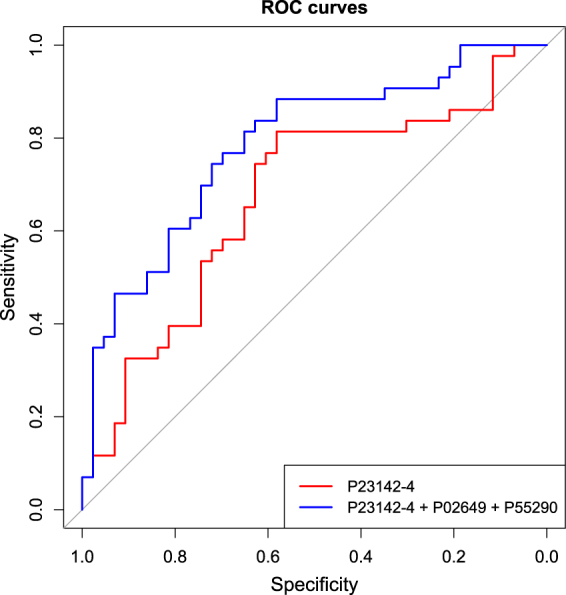
To evaluate the presence of serum protein biomarkers associated with the early phases of formation of carotid atherosclerotic plaques, label-free quantitative proteomics analyses were made for serum samples collected as part of The Cardiovascular Risk in Young Finns Study. Samples from subjects who had an asymptomatic carotid artery plaque detected by ultrasound examination (N = 43, Age = 30-45 years) were compared with plaque free controls (N = 43) (matched for age, sex, body weight and systolic blood pressure). Seven proteins (p < 0.05) that have been previously linked with atherosclerotic phenotypes were differentially abundant. Fibulin 1 proteoform C (FBLN1C), Beta-ala-his-dipeptidase (CNDP1), Cadherin-13 (CDH13), Gelsolin (GSN) and 72 kDa type IV collagenase (MMP2) were less abundant in cases, whereas Apolipoproteins C-III (APOC3) and apolipoprotein E (APOE) were more abundant. Using machine learning analysis, a biomarker panel of FBLN1C, APOE and CDH13 was identified, which classified cases from controls with an area under receiver-operating characteristic curve (AUROC) value of 0.79. Furthermore, using selected reaction monitoring mass spectrometry (SRM-MS) the decreased abundance of FBLN1C was verified. In relation to previous associations of FBLN1C with atherosclerotic lesions, the observation could reflect its involvement in the initiation of the plaque formation, or represent a particular risk phenotype.
为了评估与颈动脉粥样硬化斑块形成早期相关的血清蛋白生物标志物的存在,对心血管风险在年轻芬兰人中的研究收集的血清样本进行了无标记定量蛋白质组学分析。将通过超声检查检测到无症状颈动脉斑块的受试者的样本(N=43,年龄 30-45 岁)与无斑块对照者(N=43)进行比较(匹配年龄、性别、体重和收缩压)。七种先前与动脉粥样硬化表型相关的蛋白质(p<0.05)差异丰富。纤维连接蛋白 1 蛋白水解物 C(FBLN1C)、β-丙氨酸-组氨酸二肽酶(CNDP1)、钙粘蛋白 13(CDH13)、凝胶蛋白(GSN)和 72 kDa 型 IV 胶原酶(MMP2)在病例中含量较低,而载脂蛋白 C-III(APOC3)和载脂蛋白 E(APOE)含量较高。使用机器学习分析,确定了一个由 FBLN1C、APOE 和 CDH13 组成的生物标志物面板,该面板通过接受者操作特征曲线(AUROC)值为 0.79 对病例进行了分类。此外,使用选择反应监测质谱(SRM-MS)验证了 FBLN1C 的丰度降低。鉴于先前 FBLN1C 与动脉粥样硬化病变的关联,这一观察结果可能反映了它在斑块形成的启动中的作用,或者代表了一种特定的风险表型。