Columbia University Department of Psychiatry, United States; New York State Psychiatric Institute, United States.
Columbia University Department of Psychiatry, United States; New York State Psychiatric Institute, United States.
J Subst Abuse Treat. 2018 Aug;91:57-68. doi: 10.1016/j.jsat.2018.06.001. Epub 2018 Jun 2.
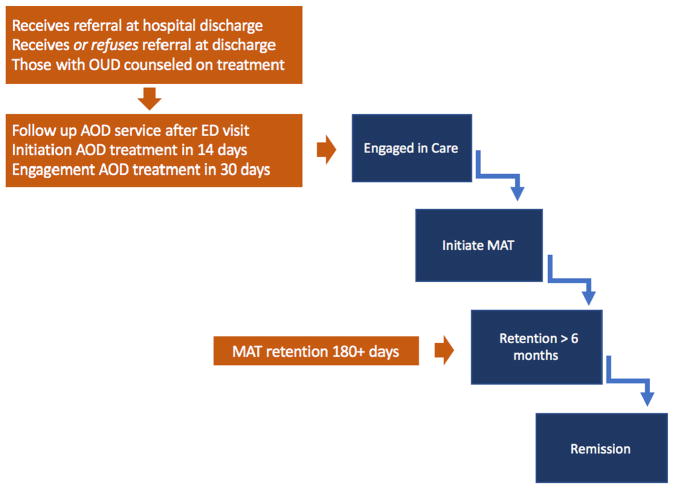
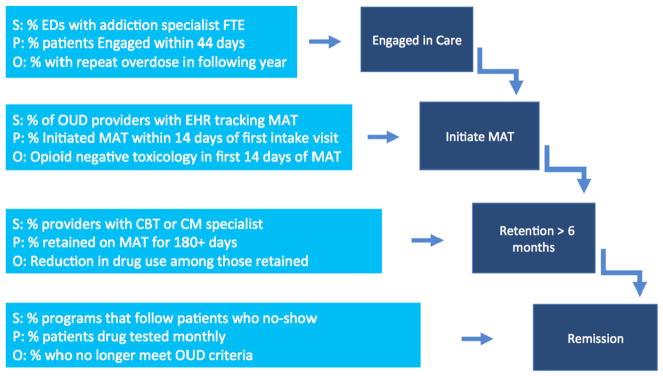
Despite increasing opioid overdose mortality, problems persist in the availability and quality of treatment for opioid use disorder (OUD). Three FDA-approved medications (methadone, buprenorphine, and naltrexone) have high quality evidence supporting their use, but most individuals with OUD do not receive them and many experience relapse following care episodes. Developing and organizing quality measures under a unified framework such as a Cascade of Care could improve system level practice and treatment outcomes. In this context, a review was performed of existing quality measures relevant to the treatment of OUD and the literature assessing the utility of these measures in community practice.
Systematic searches of two national quality measure clearinghouses (National Quality Forum and Agency for Healthcare Research and Quality) were performed for measures that can be applied to the treatment of OUD. Measures were categorized as structural, process, or outcome measures. Second stage searches were then performed within Ovid/Medline focused on published studies investigating the feasibility, reliability, and validity of identified measures, predictors of their satisfaction, and related clinical outcomes.
Seven quality measures were identified that are applicable to the treatment of OUD. All seven were process measures that assess patterns of service delivery. One recently approved measure addresses retention in medication-assisted treatment for patients with OUD. Twenty-nine published studies were identified that evaluate the quality measures, primarily focused on initiation and engagement in care for addiction treatment generally. Most measures and related studies do not specifically incorporate the evidence base for the treatment of OUD or assess patient level outcomes such as overdose.
Despite considerable progress, gaps exist in quality measures for OUD treatment. Development of a unified quality measurement framework such as an OUD Treatment Cascade will require further elaboration and refinement of existing measures across populations and settings. Such a framework could form the basis for applying strategies at clinical, organizational, and policy levels to expand access to quality care and reduce opioid-related mortality.
尽管阿片类药物过量死亡率不断上升,但在提供和治疗阿片类药物使用障碍(OUD)方面仍存在问题。三种经美国食品药品监督管理局批准的药物(美沙酮、丁丙诺啡和纳曲酮)具有支持其使用的高质量证据,但大多数 OUD 患者并未接受这些药物治疗,许多人在治疗后仍会复发。在统一的框架(如治疗级联)下制定和组织质量措施,可以改善系统层面的实践和治疗效果。在此背景下,对与 OUD 治疗相关的现有质量措施以及评估这些措施在社区实践中效用的文献进行了回顾。
对两个国家质量措施信息中心(国家质量论坛和医疗保健研究与质量局)进行了系统搜索,以寻找可用于治疗 OUD 的措施。这些措施被归类为结构、过程或结果措施。然后在 Ovid/Medline 中进行了第二阶段搜索,重点是调查已确定措施的可行性、可靠性和有效性、其满意度的预测因素以及相关临床结果的已发表研究。
确定了 7 种适用于 OUD 治疗的质量措施。这 7 种措施均为评估服务提供模式的过程措施。最近批准的一项措施涉及评估 OUD 患者药物辅助治疗的保留率。确定了 29 项评估质量措施的已发表研究,主要集中在一般成瘾治疗的起始和参与方面。大多数措施和相关研究并未特别纳入 OUD 治疗的证据基础,也未评估患者层面的结果,如过量。
尽管取得了相当大的进展,但 OUD 治疗的质量措施仍存在差距。制定统一的质量衡量框架,如 OUD 治疗级联,需要进一步完善和细化不同人群和环境下的现有措施。这样的框架可以为在临床、组织和政策层面应用策略提供基础,以扩大获得优质护理的机会并降低阿片类药物相关死亡率。