Gerdin Göran, Hedberg Marie, Hageskog Carl-Axel
Department of Sport Science, Linnaeus University, 351 95 Växjö, Sweden.
Sports (Basel). 2018 Apr 23;6(2):38. doi: 10.3390/sports6020038.
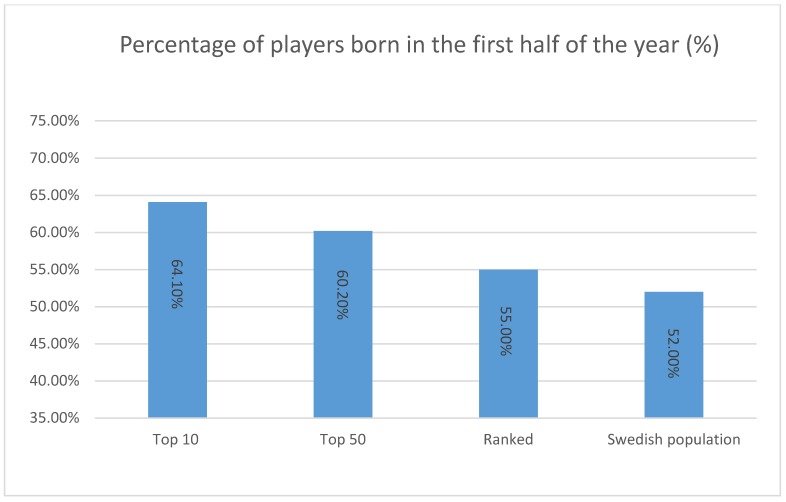
The relative age effect (RAE) has been extensively debated and researched in both popular media and academic discourse. This study examined RAE in Swedish tennis players born in 1998⁻2001. The study was conducted in 2015⁻2016 and includes all ranked Swedish tennis players ( = 1835) registered in the Swedish Tennis Association database from the year 2014. The results show that when the birth dates of the corresponding Swedish population and all the ranked players are compared, they show a moderate RAE; however, the higher up they are in the ranking system, the greater the RAE becomes. Top 10 players display an average of 64.1% being born in the first half of the year. Some gender differences were also found, with a greater proportion of both higher and lower ranked females being born in the first half of the year. In our discussion of the findings we raise several issues that need to be addressed to provide more equal opportunities for all junior players regardless of birth date. Resolving ongoing problems associated with RAE in competitive sports such as tennis is important both in term of prolonged participation in the sport and increased performance. Suggestions made in this article include recognising RAE when designing the format of competitions/tournaments, not using official rankings until the juniors get older, addressing RAE in a “gender sensitive” way, and conducting further in-depth studies in which RAE is understood/examined as being associated with environmental factors. Although these findings show the RAE effect in Swedish tennis players, thus pointing at the need for further consideration in terms of ranking and selection procedures to ensure equal opportunities for player development, the study also concludes by reasserting an emphasis on a holistic approach to player development in which coaches focus on the developmentally appropriate needs and potential of each individual player regardless of their biological age.
相对年龄效应(RAE)在大众媒体和学术讨论中都受到了广泛的辩论和研究。本研究调查了1998年至2001年出生的瑞典网球运动员的相对年龄效应。该研究于2015年至2016年进行,涵盖了2014年在瑞典网球协会数据库中注册的所有排名瑞典网球运动员(n = 1835)。结果表明,将相应瑞典人口和所有排名球员的出生日期进行比较时,呈现出适度的相对年龄效应;然而,他们在排名系统中的位置越高,相对年龄效应就越大。排名前十的球员中,平均有64.1%出生在上半年。研究还发现了一些性别差异,排名较高和较低的女性中,出生在上半年的比例都更大。在对研究结果的讨论中,我们提出了几个需要解决的问题,以便为所有青少年球员提供更平等的机会,而不论其出生日期如何。解决网球等竞技运动中与相对年龄效应相关的持续问题,对于延长运动员参与运动的时间和提高成绩都很重要。本文提出的建议包括在设计比赛/锦标赛形式时认识到相对年龄效应,在青少年年龄较大之前不使用官方排名,以“性别敏感”的方式处理相对年龄效应,以及进行进一步的深入研究,将相对年龄效应理解/研究为与环境因素相关。尽管这些发现显示了瑞典网球运动员中的相对年龄效应,从而表明在排名和选拔程序方面需要进一步考虑以确保球员发展的平等机会,但该研究最后重申强调采用整体方法进行球员发展,即教练关注每个球员与其发育阶段相适应的需求和潜力,而不论其生理年龄如何。