Godwin Charlie, Cook Matthew D, Willems Mark E T
Department of Sport and Exercise Sciences, University of Chichester, College Lane, Chichester, West Sussex PO19 6PE, UK.
Institute of Sport and Exercise Science, University of Worcester, Henwick Grove, Worcester WR2 6AJ, UK.
Sports (Basel). 2017 Sep 15;5(3):69. doi: 10.3390/sports5030069.
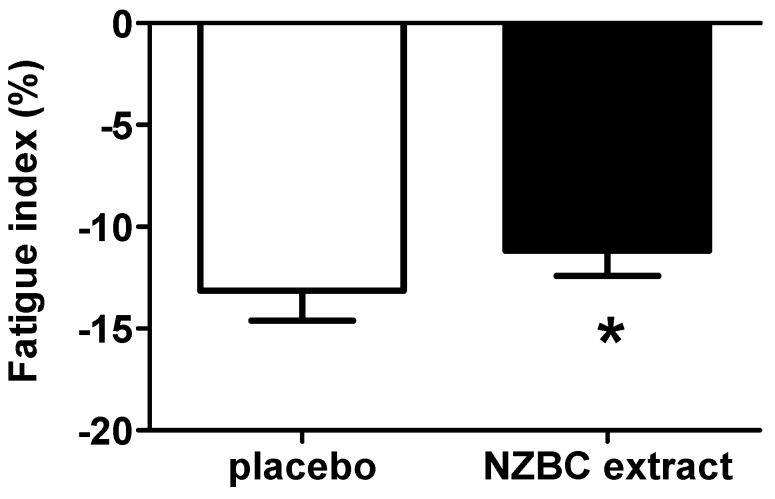
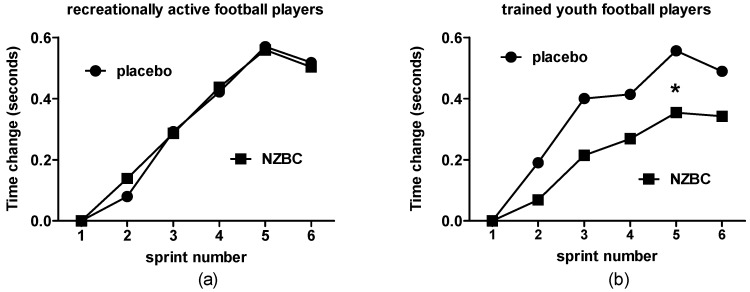
It was observed previously that New Zealand blackcurrant (NZBC) extract reduced slowing of the maximal 15 m sprint speed during the Loughborough Intermittent Shuttle Test. We examined the effect of NZBC extract on the performance of the Running Based Anaerobic Sprint Test (RAST, 6 × 35-m sprints with 10 seconds passive recovery) in trained youth and recreationally active football players. Fifteen recreationally active (University team) (age: 20 ± 1 years, height: 174 ± 19 cm, body mass: 80 ± 13 kg) and nine trained youth players (English professional club) (age: 17 ± 0 years, height: 178 ± 8 cm, body mass: 69 ± 9 kg, mean ± SD) participated in three testing sessions. Prior to the RASTs, participants consumed two capsules of NZBC extract (600 mg∙day CurraNZ) or placebo (P) for 7 days (double blind, randomised, cross-over design, wash-out at least 14 days). Ability difference between groups was shown by sprint 1 time. In the placebo condition, trained youth players had faster times for sprint 1 (5.00 ± 0.05 s) than recreationally active players (5.42 ± 0.08 s) ( < 0.01). In trained youth players, there was a trend for an effect of NZBC extract ( = 0.10) on the slowing of the sprint 1 time. NZBC extract reduced slowing of the sprint 5 time (P: 0.56 ± 0.22 s; NZBC: 0.35 ± 0.25, = 0.02) and this was not observed in recreationally active players (P: 0.57 ± 0.48 s; NZBC: 0.56 ± 0.33, = 0.90). For fatigue index, expressed as a % change in fastest sprint time, there was a strong trend to be lower in both trained youth and recreationally active players combined by NZBC extract (P: -13 ± 7%; NZBC: -11 ± 6%, = 0.06) with 12 participants (five trained youth) experiencing less fatigue. New Zealand blackcurrant extract seems to benefit repeated sprint performance only in trained football players.
先前观察到,在拉夫堡间歇穿梭测试中,新西兰黑加仑提取物可减少最大15米冲刺速度的减慢。我们研究了新西兰黑加仑提取物对训练有素的青少年和经常参加足球运动的运动员进行的基于跑步的无氧冲刺测试(RAST,6次35米冲刺,被动恢复10秒)表现的影响。15名经常参加足球运动的(大学球队)(年龄:20±1岁,身高:174±19厘米,体重:80±13千克)和9名训练有素的青少年球员(英国职业俱乐部)(年龄:17±0岁,身高:178±8厘米,体重:69±9千克,平均值±标准差)参加了三次测试。在进行RAST测试之前,参与者服用两粒新西兰黑加仑提取物胶囊(600毫克·天的CurraNZ)或安慰剂(P),持续7天(双盲、随机、交叉设计,洗脱期至少14天)。两组之间的能力差异通过第一次冲刺时间显示。在安慰剂组中,训练有素的青少年球员第一次冲刺的时间(5.00±0.05秒)比经常参加足球运动的球员(5.42±0.08秒)快(<0.01)。在训练有素的青少年球员中,新西兰黑加仑提取物对第一次冲刺时间减慢有一定影响趋势(P = 0.10)。新西兰黑加仑提取物减少了第五次冲刺时间的减慢(安慰剂组:0.56±0.22秒;新西兰黑加仑提取物组:0.35±0.25秒,P = 0.02),而在经常参加足球运动的球员中未观察到这种情况(安慰剂组:0.57±0.48秒;新西兰黑加仑提取物组:0.56±0.33秒,P = 0.90)。对于疲劳指数,以最快冲刺时间的百分比变化表示,在训练有素的青少年球员和经常参加足球运动的球员中,联合服用新西兰黑加仑提取物后有明显降低趋势(安慰剂组:-13±7%;新西兰黑加仑提取物组:-11±6%,P = 0.06),有12名参与者(5名训练有素的青少年球员)疲劳减轻。新西兰黑加仑提取物似乎仅对训练有素的足球运动员的重复冲刺表现有益。