Mahajan Lakshmi, Kaur Manjot, Gupta Ruchi, Aujla Kuljeet Singh, Singh Avtar, Kaur Ashreen
Department of Anaesthesia, SGRDIMSR, Amritsar, Punjab, India.
Department of Anaesthesia, DMC, Ludhiana, Punjab, India.
Indian J Anaesth. 2018 May;62(5):337-343. doi: 10.4103/ija.IJA_1_18.
Laryngoscopy and intubation cause sympathetic stimulation and arousal reactions. We evaluated the role of dexmedetomidine and magnesium sulphate on pressor responses to laryngoscopy and intubation as compared to placebo, when depth of anaesthesia was maintained at a constant bispectral index (BIS) range 40-50 (±5).
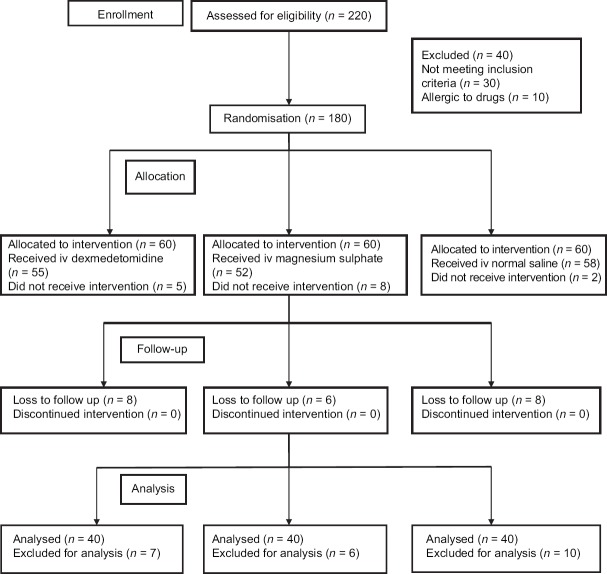
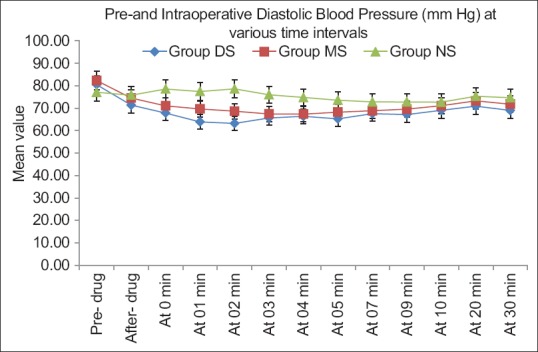
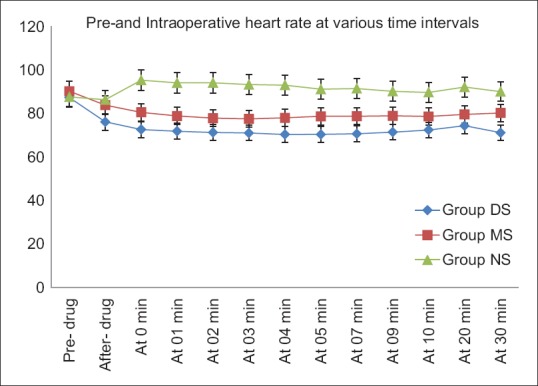
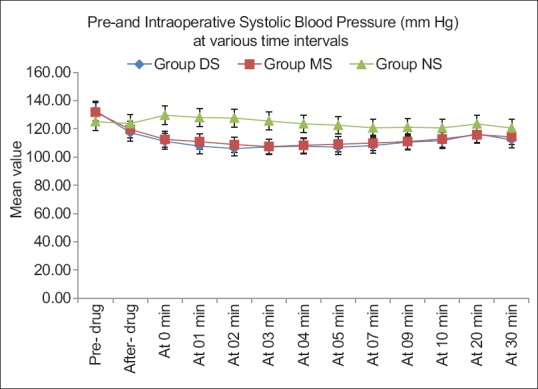
One hundred and twenty patients were randomised to receive either dexmedetomidine 1 μg/kg (Group DS), magnesium sulphate 30 mg/kg diluted in 100 ml saline (Group MS) or 100 ml normal saline (Group NS) 15 min before induction of anaesthesia in a double blind manner. After achieving BIS 40-50 (±5), laryngoscopy and intubation were performed. Heart rate (HR), systolic blood pressure (SBP) and diastolic blood pressure (DBP) were recorded pre-drug, after drug, at intubation, at intervals of 1 min till 5 min, then every 2 min till 10 min and every 10 min for 30 min. Statistical analysis was done using Chi-square test and one way analysis of variance.
SBP, DBP and HR fell in the DS and MS groups. No significant changes in BP were seen in the NS group at induction and after intubation. HR rose in the NS group ( < 0.001) at induction from 86.35 ± 9.05 to 95.35 ± 11.60 at 2 min. Patients in DS and MS groups had significantly lower HR, SBP and DBP at laryngoscopy and intubation.
At BIS levels 40-50 (±5) there was no pressor response to intubation in the NS Group. Dexmedetomidine and magnesium sulphate significantly reduced the heart rate and blood pressure from baseline.
喉镜检查及气管插管会引起交感神经兴奋和唤醒反应。我们评估了在麻醉深度维持在脑电双频指数(BIS)40 - 50(±5)的恒定范围内时,与安慰剂相比,右美托咪定和硫酸镁对喉镜检查及气管插管所致升压反应的作用。
120例患者被随机双盲分为三组,在麻醉诱导前15分钟分别接受右美托咪定1μg/kg(DS组)、硫酸镁30mg/kg用100ml生理盐水稀释(MS组)或100ml生理盐水(NS组)。在BIS达到40 - 50(±5)后,进行喉镜检查及气管插管。记录用药前、用药后、插管时、插管后1至5分钟每隔1分钟、5至10分钟每隔2分钟以及10至30分钟每隔10分钟的心率(HR)、收缩压(SBP)和舒张压(DBP)。采用卡方检验和单因素方差分析进行统计学分析。
DS组和MS组的SBP、DBP和HR下降。NS组在诱导和插管后血压无显著变化。NS组诱导时HR从86.35±9.05上升至2分钟时的95.35±11.60(P<0.001)。DS组和MS组患者在喉镜检查及气管插管时的HR、SBP和DBP显著较低。
在BIS水平为40 - 50(±5)时,NS组对插管无升压反应。右美托咪定和硫酸镁使心率和血压较基线水平显著降低。