Dhas Meshach M, Gayathri Balasubramaniam, Kuppusamy Anand, Mani Karthik, Pattu Harish
Department of Anaesthesiology, SRM MCH RC, Chengalpattu, Tamil Nadu, India.
Indian J Anaesth. 2023 Jul;67(7):633-637. doi: 10.4103/ija.ija_731_22. Epub 2023 Jul 14.
This study evaluates the effectiveness of long-acting antihypertensive drugs (clonidine and enalaprilat) in blunting the intubation response. Also, the study seeks to determine how effectively clonidine and enalaprilat can maintain stable haemodynamics during a change in position.
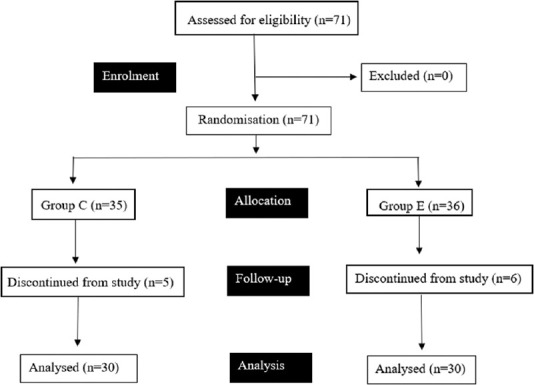
After ethical committee approval and trial registration, a double-blinded, randomised controlled trial was conducted with 71 consenting patients scheduled for elective spine surgery in a prone position under general anaesthesia. Group C received clonidine 2 μg/kg, and Group E received enalaprilat 1.25 mg diluted in normal saline as an intravenous infusion given over 10 min before induction of anaesthesia. The changes in heart rate (HR) and blood pressure (BP) in response to the infusion of the study drugs, induction, tracheal intubation and change in position were recorded. value <0.05 was considered significant. Statistical analysis was performed using Statistical Package for the Social Sciences (SPSS) version 25.
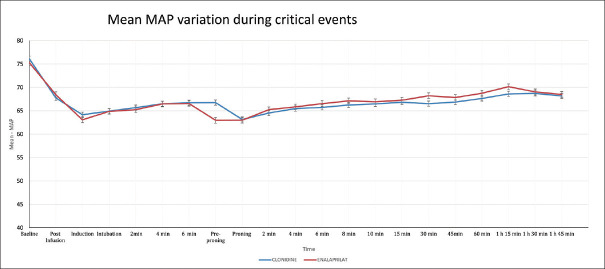
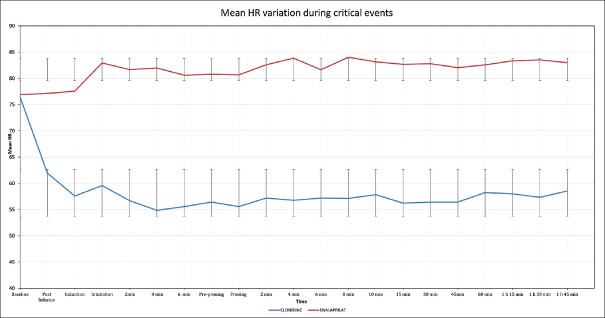
Clonidine infusion caused a significant fall in heart rate post-infusion and post-induction with propofol (p value <0.05). Both clonidine and enalaprilat caused a significant fall in mean arterial pressure (MAP) post-infusion and post-induction (p value <0.05). Clonidine effectively blunted the intubation response with no increase in HR and MAP following intubation. Enalaprilat caused a significant rise in HR in response to intubation. On proning, there was a significant fall in MAP in both groups.
Clonidine is effective in blunting the intubation response. Preoperative infusion of clonidine and enalaprilat causes hypotension during a change of position.
本研究评估长效抗高血压药物(可乐定和依那普利拉)在减轻插管反应方面的有效性。此外,该研究旨在确定可乐定和依那普利拉在体位改变期间维持血流动力学稳定的效果如何。
经伦理委员会批准并完成试验注册后,对71例同意接受全身麻醉下俯卧位择期脊柱手术的患者进行了双盲随机对照试验。C组接受2μg/kg可乐定,E组接受1.25mg依那普利拉用生理盐水稀释后在麻醉诱导前10分钟内静脉输注。记录输注研究药物、诱导、气管插管和体位改变时心率(HR)和血压(BP)的变化。p值<0.05被认为具有统计学意义。使用社会科学统计软件包(SPSS)25版进行统计分析。
输注可乐定后以及使用丙泊酚诱导后心率显著下降(p值<0.05)。可乐定和依那普利拉输注后以及诱导后平均动脉压(MAP)均显著下降(p值<0.05)。可乐定有效减轻了插管反应,插管后HR和MAP未升高。依那普利拉导致插管后HR显著升高。翻身俯卧时,两组MAP均显著下降。
可乐定可有效减轻插管反应。术前输注可乐定和依那普利拉会导致体位改变时出现低血压。