Liu Bao-Tao, Zhang Xiao-Yan, Wan Shu-Wei, Hao Jun-Jie, Jiang Rui-De, Song Feng-Jing
College of Veterinary Medicine, Qingdao Agricultural University, Qingdao, China.
Institute of Plant Protection, Qingdao Academy of Agricultural Sciences, Qingdao, China.
Front Microbiol. 2018 Jun 1;9:1147. doi: 10.3389/fmicb.2018.01147. eCollection 2018.
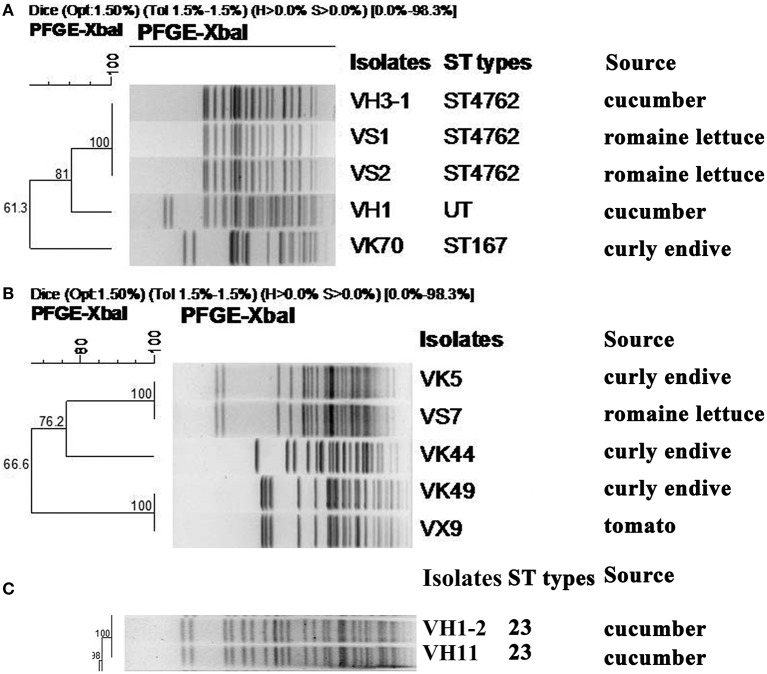
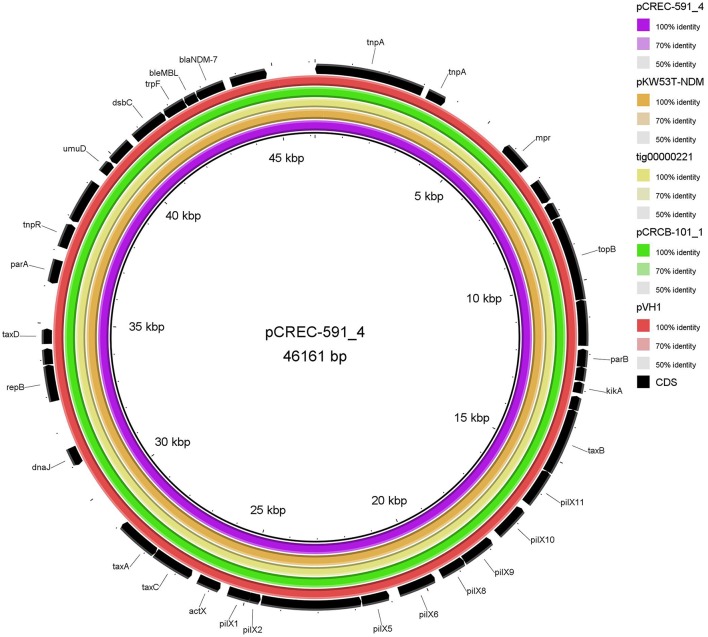
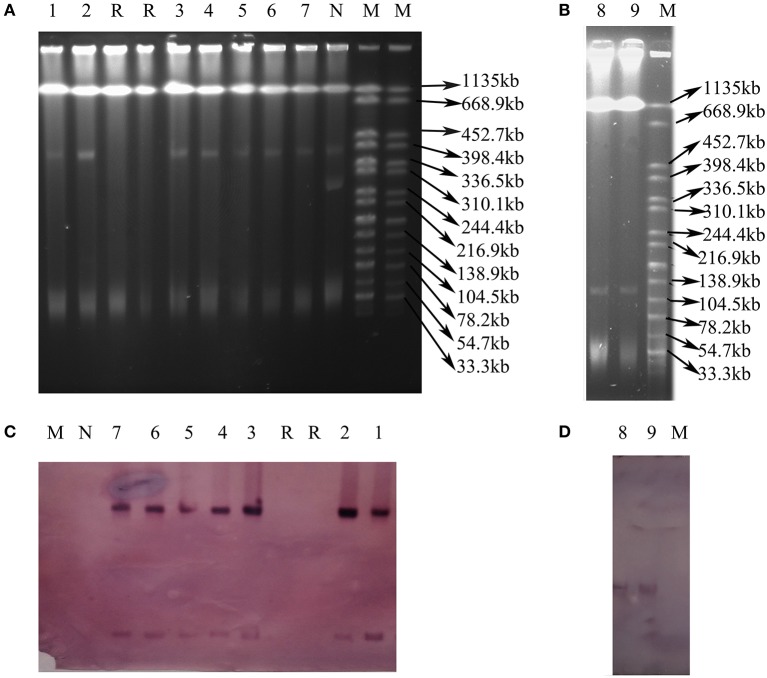
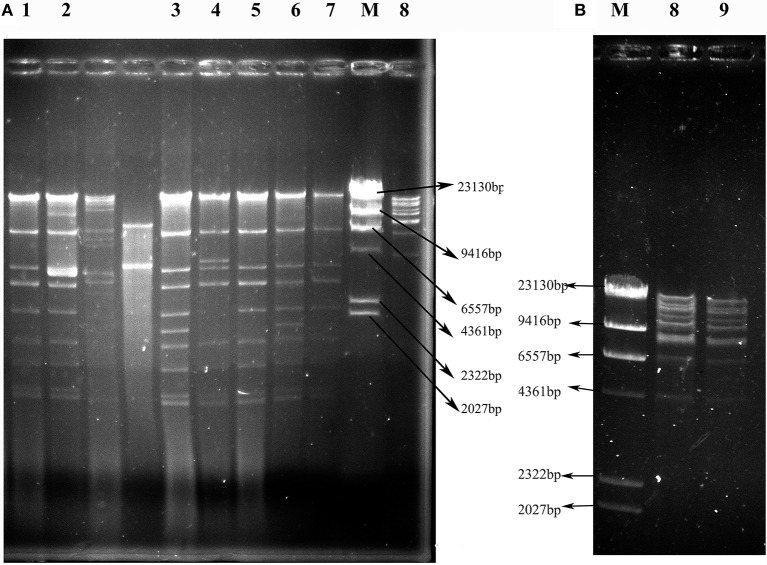
Vegetables harboring bacteria resistant to antibiotics are a growing food safety issue. However, data concerning carbapenem-resistant (CRE) in ready-to-eat fresh vegetables is still rare. In this study, 411 vegetable samples from 36 supermarkets or farmer's markets in 18 cities in China, were analyzed for CRE. Carbapenemase-encoding genes and other resistance genes were analyzed among the CRE isolates. Plasmids carrying carbapenemase genes were studied by conjugation, replicon typing, S1-PFGE southern blot, restriction fragment length polymorphism (RFLP), and sequencing. CRE isolates were also analyzed by pulsed-field gel electrophoresis (PFGE). Ten vegetable samples yielded one or more CRE isolates. The highest detection rate of CRE (14.3%, 4/28) was found in curly endive. Twelve CRE isolates were obtained and all showed multidrug resistance: , 5; , 5; and , 2. All and carried , while harbored . Notably, with and ST23 hypervirulent (hvKP) carrying were found in the same cucumber sample and clonal spread of , and isolates were all observed between vegetable types and/or cities. IncX3 plasmids carrying from and showed identical or highly similar RFLP patterns, and the sequenced IncX3 plasmid from cucumber was also identical or highly similar (99%) to the IncX3 plasmids from clinical patients reported in other countries, while in was mediated by similar F35:A-:B1 plasmids. Our results suggest that both clonal expansion and horizontal transmission of IncX3- or F35:A-:B1-type plasmids may mediate the spread of CRE in ready-to-eat vegetables in China. The presence of CRE in ready-to-eat vegetables is alarming and constitutes a food safety issue. To our knowledge, this is the first report of either the carrying , or harboring in vegetables. This is also the first report of ST23 carbapenem-resistant hvKP strain in vegetables.
携带抗生素耐药菌的蔬菜是一个日益严重的食品安全问题。然而,关于即食新鲜蔬菜中耐碳青霉烯类(CRE)的数据仍然很少。在本研究中,对来自中国18个城市36家超市或农贸市场的411份蔬菜样本进行了CRE分析。对CRE分离株分析了碳青霉烯酶编码基因和其他耐药基因。通过接合试验、复制子分型、S1-PFGE Southern印迹、限制性片段长度多态性(RFLP)和测序研究携带碳青霉烯酶基因的质粒。还通过脉冲场凝胶电泳(PFGE)对CRE分离株进行了分析。10份蔬菜样本产生了一株或多株CRE分离株。皱叶苦苣中CRE的检出率最高(14.3%,4/28)。获得了12株CRE分离株,均表现出多重耐药性: ,5株; ,5株; ,2株。所有 和 携带 ,而 携带 。值得注意的是,同一黄瓜样本中发现了携带 和ST23高毒力 (hvKP)的 ,并且在蔬菜类型和/或城市之间均观察到了 、 和 分离株的克隆传播。来自 和 的携带 的IncX3质粒显示出相同或高度相似的RFLP模式,并且来自黄瓜的测序IncX3质粒与其他国家报道的临床患者的IncX3质粒也相同或高度相似(99%),而 中的 由相似的F35:A-:B1质粒介导。我们的结果表明,IncX3-或F35:A-:B1型质粒的克隆扩增和水平传播可能介导了CRE在中国即食蔬菜中的传播。即食蔬菜中存在CRE令人担忧,并构成食品安全问题。据我们所知,这是蔬菜中携带 的 或携带 的 首次报道。这也是蔬菜中ST23碳青霉烯耐药hvKP菌株的首次报道。