Le Thanh-Thao, Nadimpalli Maya, Wu Jianyong, Heaney Christopher D, Stewart Jill R
Department of Environmental Sciences and Engineering, Gillings School of Global Public Health, University of North Carolina, Chapel Hill, NC, United States.
Department of Environmental Health and Engineering, Bloomberg School of Public Health, Johns Hopkins University, Baltimore, MD, United States.
Front Public Health. 2018 Jun 1;6:163. doi: 10.3389/fpubh.2018.00163. eCollection 2018.
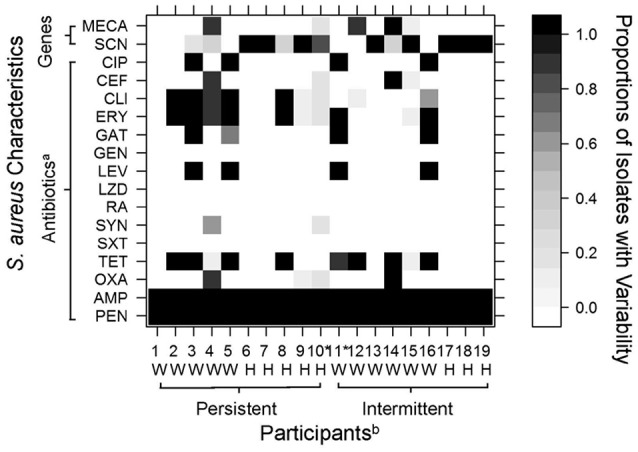
Evaluating carriage of , an opportunistic pathogen of humans and animals capable of causing antibiotic-resistant infections, is epidemiologically important. However, clinical and epidemiological surveillance studies of typically rely on characterizing one isolate per individual, which may not represent the actual population diversity in a carrier. The objective of this study was to determine if one isolate is sufficient for determining carrier status of particular strains or characteristics of in a healthy (non-hospitalized) human population. We compared types, genetic markers (A, ), and antibiotic resistance profiles of 10 isolates recovered from a single nasal swab for each of 19 participants (190 isolates total) selected from a cohort of industrial hog operation workers and their household members. Participants included both persistent ( = 10) and intermediate ( = 9) carriers of . Among the participants, 17 (89%) carried a single type intranasally and the other two carried dominant types. Less similarity was observed for genes encoded on mobile genetic elements (A, ) and antibiotic resistance profiles. Statistical modeling, based on receiving operating characteristic curves, suggests that three to five isolates may be necessary to accurately assign nasal carriage status for these more variable characteristics. Variability was observed for both persistent and intermediate carriers of . These results suggest that surveillance studies that rely on testing one isolate are likely to identify predominant types but may not fully capture more variable characteristics of , including antibiotic resistance. Surveillance studies that rely on testing one isolate may underestimate prevalence of nasal carriage of with these more variable characteristics.
评估一种人和动物的机会性病原体(能够引起耐抗生素感染)的携带情况在流行病学上具有重要意义。然而,对该病原体的临床和流行病学监测研究通常依赖于对每个个体的一个分离株进行特征描述,这可能无法代表携带者中实际的种群多样性。本研究的目的是确定从一名健康(非住院)人群中采集的单个鼻拭子所分离出的一个分离株是否足以确定特定菌株的携带者状态或该病原体的特征。我们比较了从19名参与者(共190个分离株)的单个鼻拭子中回收的10个该病原体分离株的类型、遗传标记(A、)和抗生素抗性谱,这些参与者选自一个工业养猪场工人及其家庭成员队列。参与者包括该病原体的持续携带者( = 10)和中间携带者( = 9)。在参与者中,17人(89%)鼻腔内携带单一的该病原体类型,另外两人携带优势的该病原体类型。在移动遗传元件上编码的基因(A、)和抗生素抗性谱方面观察到的相似性较低。基于接受操作特征曲线的统计建模表明,对于这些变化更大的特征,可能需要三到五个分离株才能准确确定鼻腔携带状态。在该病原体的持续携带者和中间携带者中均观察到了变异性。这些结果表明,依赖于检测一个该病原体分离株的监测研究可能会识别出主要的该病原体类型,但可能无法完全捕捉到该病原体更多的可变特征,包括抗生素抗性。依赖于检测一个分离株的监测研究可能会低估具有这些更多可变特征的该病原体鼻腔携带率。