Department of Orthopedics, University Medical Center Utrecht, Utrecht University, P.O. Box 85500, 3508 GA, Utrecht, The Netherlands.
Regenerative Medicine Center Utrecht, Uppsalalaan 8, 3584 CT, Utrecht, The Netherlands.
Adv Healthc Mater. 2019 Apr;8(7):e1800418. doi: 10.1002/adhm.201800418. Epub 2018 Jun 17.
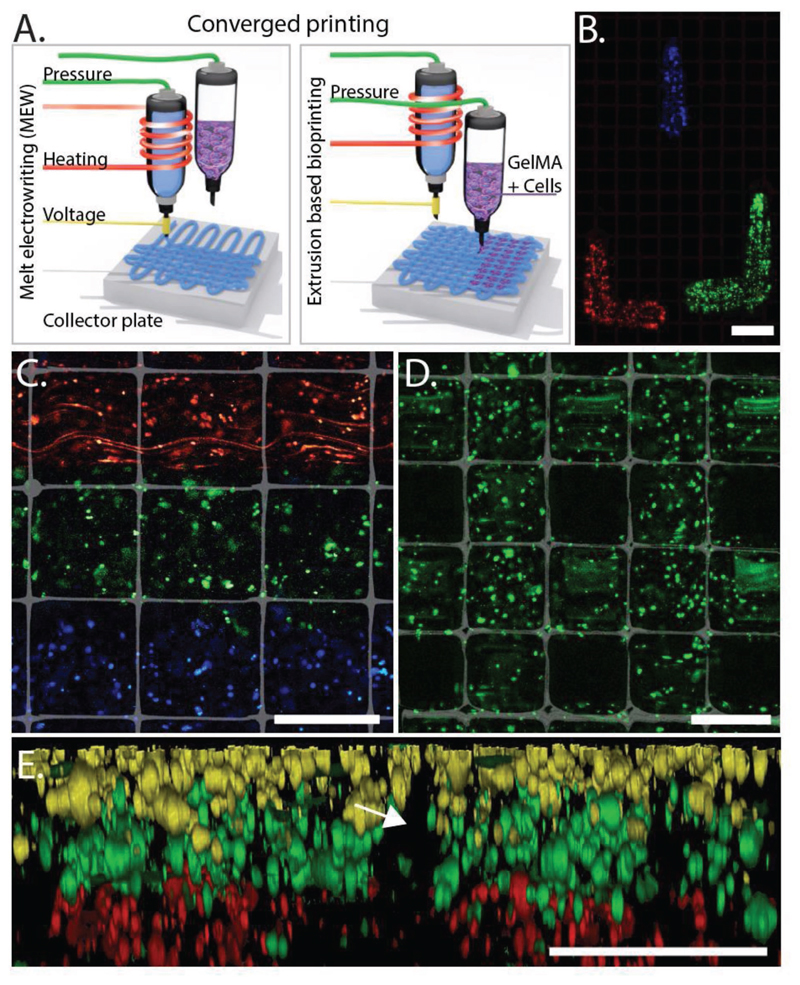
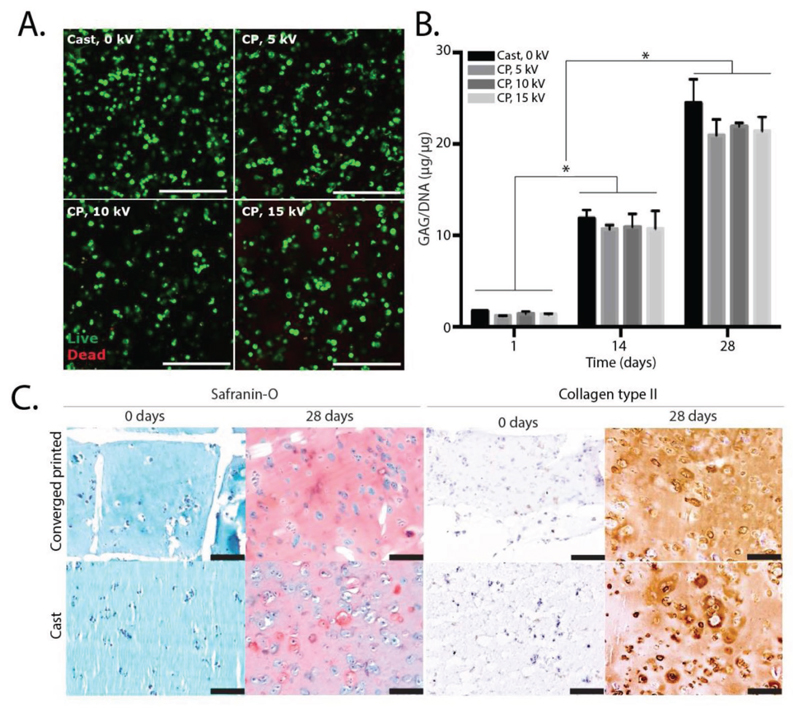
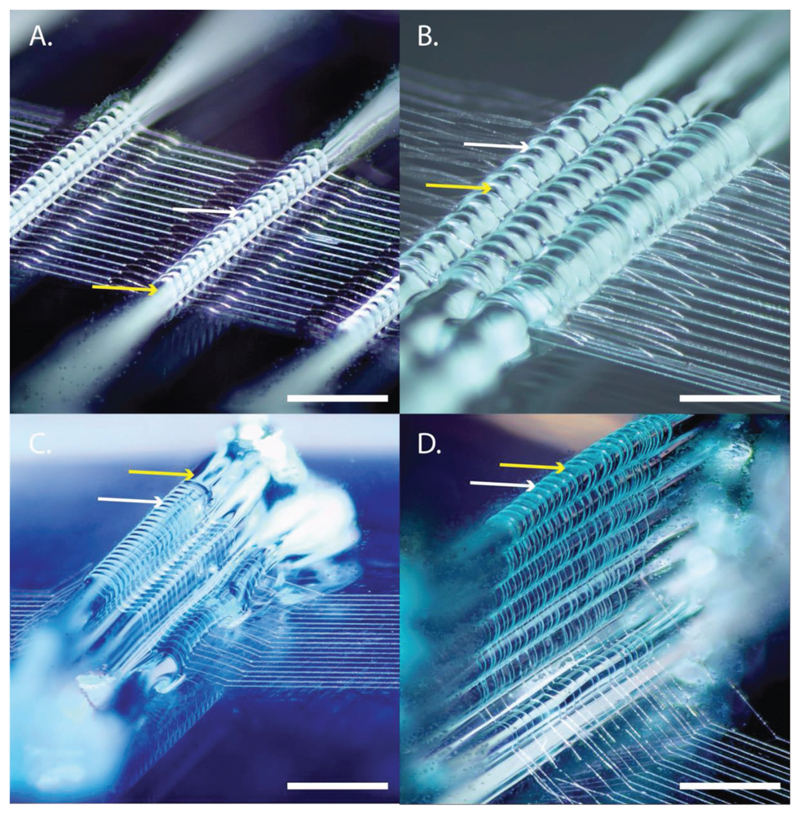
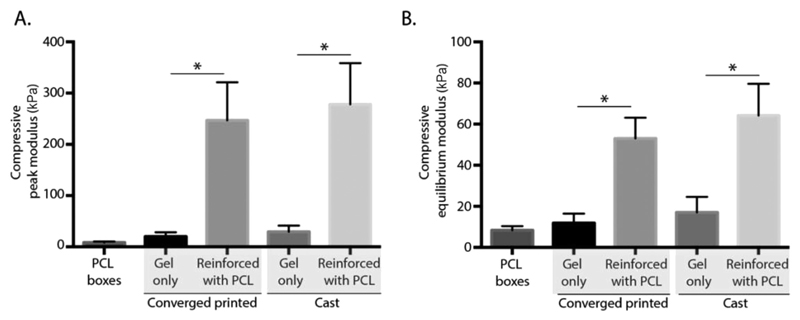
Fabrication of biomimetic tissues holds much promise for the regeneration of cells or organs that are lost or damaged due to injury or disease. To enable the generation of complex, multicellular tissues on demand, the ability to design and incorporate different materials and cell types needs to be improved. Two techniques are combined: extrusion-based bioprinting, which enables printing of cell-encapsulated hydrogels; and melt electrowriting (MEW), which enables fabrication of aligned (sub)-micrometer fibers into a single-step biofabrication process. Composite structures generated by infusion of MEW fiber structures with hydrogels have resulted in mechanically and biologically competent constructs; however, their preparation involves a two-step fabrication procedure that limits freedom of design of microfiber architectures and the use of multiple materials and cell types. How convergence of MEW and extrusion-based bioprinting allows fabrication of mechanically stable constructs with the spatial distributions of different cell types without compromising cell viability and chondrogenic differentiation of mesenchymal stromal cells is demonstrated for the first time. Moreover, this converged printing approach improves freedom of design of the MEW fibers, enabling 3D fiber deposition. This is an important step toward biofabrication of voluminous and complex hierarchical structures that can better resemble the characteristics of functional biological tissues.
仿生组织的制造有望用于再生因受伤或疾病而丧失或受损的细胞或器官。为了能够按需生成复杂的多细胞组织,需要改进设计和整合不同材料和细胞类型的能力。将两种技术结合在一起:基于挤出的生物打印,它能够打印包封细胞的水凝胶;和熔融电纺丝(MEW),它能够将对齐的(亚)微米纤维一步法制造过程中制造。通过将 MEW 纤维结构注入水凝胶中生成的复合结构具有机械和生物学上的相容性;然而,它们的制备涉及两步制造过程,限制了微纤维结构的设计自由度以及多种材料和细胞类型的使用。MEW 和基于挤出的生物打印的融合如何能够制造具有不同细胞类型的空间分布的机械稳定的构建体而不损害细胞活力和间充质基质细胞的软骨分化,这是首次得到证明。此外,这种融合的打印方法提高了 MEW 纤维的设计自由度,从而能够进行 3D 纤维沉积。这是向体积庞大且复杂的分层结构的生物制造迈出的重要一步,这些结构可以更好地模拟功能性生物组织的特征。