Pedersen Mangor, Omidvarnia Amir, Walz Jennifer M, Zalesky Andrew, Jackson Graeme D
The Florey Institute of Neuroscience and Mental Health, The University of Melbourne, Melbourne, Victoria, Australia.
Department of Psychiatry, Melbourne Neuropsychiatry Centre, The University of Melbourne, Victoria, Australia.
Netw Neurosci. 2017 Jun 1;1(2):100-115. doi: 10.1162/NETN_a_00006. eCollection 2017 Spring.
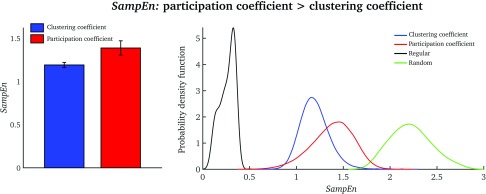
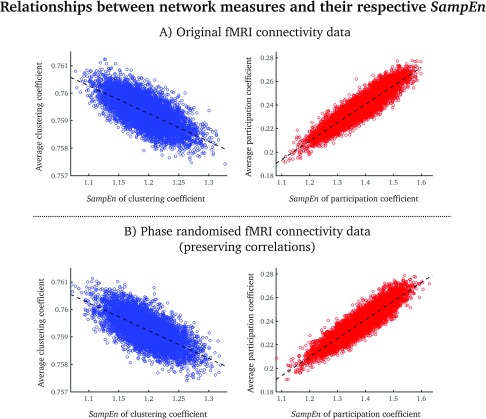
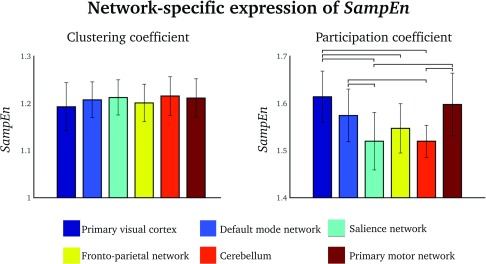
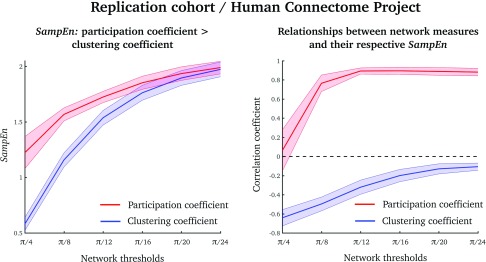
The brain operates in a complex way. The temporal complexity underlying macroscopic and spontaneous brain network activity is still to be understood. In this study, we explored the brain's complexity by combining functional connectivity, graph theory, and entropy analyses in 25 healthy people using task-free functional magnetic resonance imaging. We calculated the pairwise instantaneous phase synchrony between 8,192 brain nodes for a total of 200 time points. This resulted in graphs for which time series of clustering coefficients (the "cliquiness" of a node) and participation coefficients (the between-module connectivity of a node) were estimated. For these two network metrics, sample entropy was calculated. The procedure produced a number of results: (1) Entropy is higher for the participation coefficient than for the clustering coefficient. (2) The average clustering coefficient is negatively related to its associated entropy, whereas the average participation coefficient is positively related to its associated entropy. (3) The level of entropy is network-specific to the participation coefficient, but not to the clustering coefficient. High entropy for the participation coefficient was observed in the default-mode, visual, and motor networks. These results were further validated using an independent replication dataset. Our work confirms that brain networks are temporally complex. Entropy is a good candidate metric to explore temporal network alterations in diseases with paroxysmal brain disruptions, including schizophrenia and epilepsy.
大脑以复杂的方式运作。宏观和自发脑网络活动背后的时间复杂性仍有待了解。在本研究中,我们通过在25名健康受试者中结合功能连接、图论和熵分析,利用静息态功能磁共振成像来探究大脑的复杂性。我们计算了8192个脑节点之间共200个时间点的成对瞬时相位同步性。这产生了一些图谱,据此估计聚类系数(节点的“聚集性”)和参与系数(节点的模块间连接性)的时间序列。对于这两个网络指标,计算了样本熵。该过程产生了一些结果:(1)参与系数的熵高于聚类系数的熵。(2)平均聚类系数与其相关熵呈负相关,而平均参与系数与其相关熵呈正相关。(3)熵水平对于参与系数是网络特异性的,但对于聚类系数则不是。在默认模式、视觉和运动网络中观察到参与系数的高熵。这些结果使用独立的复制数据集进一步得到验证。我们的工作证实脑网络在时间上是复杂的。熵是探索包括精神分裂症和癫痫在内的阵发性脑功能紊乱疾病中时间网络改变的一个很好的候选指标。