Department of Psychology, School of Life and Health Sciences, Aston University, Aston Triangle, Birmingham B4 7ET, UK.
School of Sport, Exercise & Health Sciences, Loughborough University, Loughborough LE11 3TU, UK.
Int J Environ Res Public Health. 2018 Jun 15;15(6):1273. doi: 10.3390/ijerph15061273.
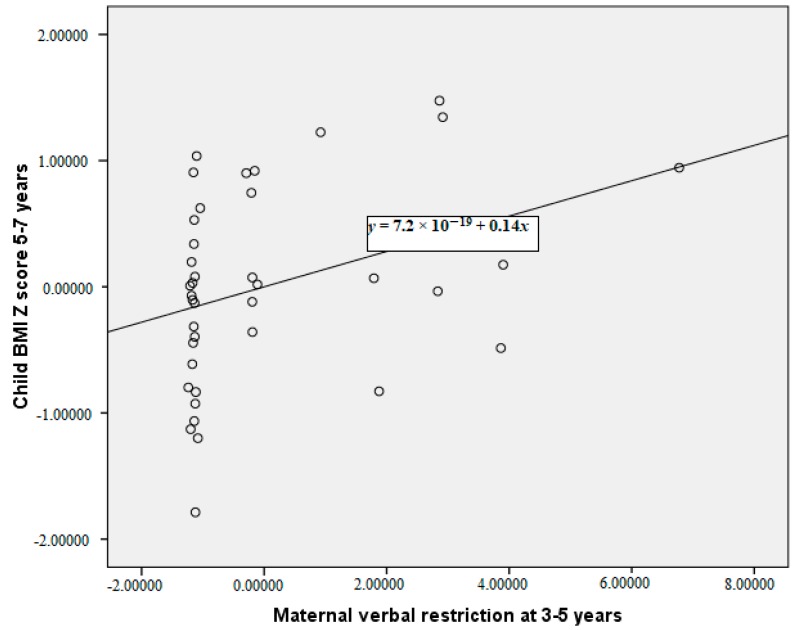
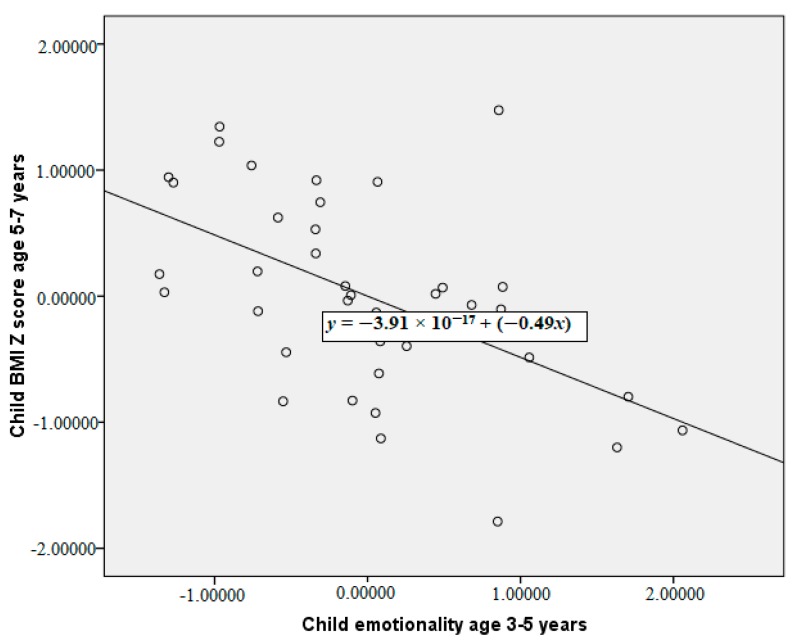
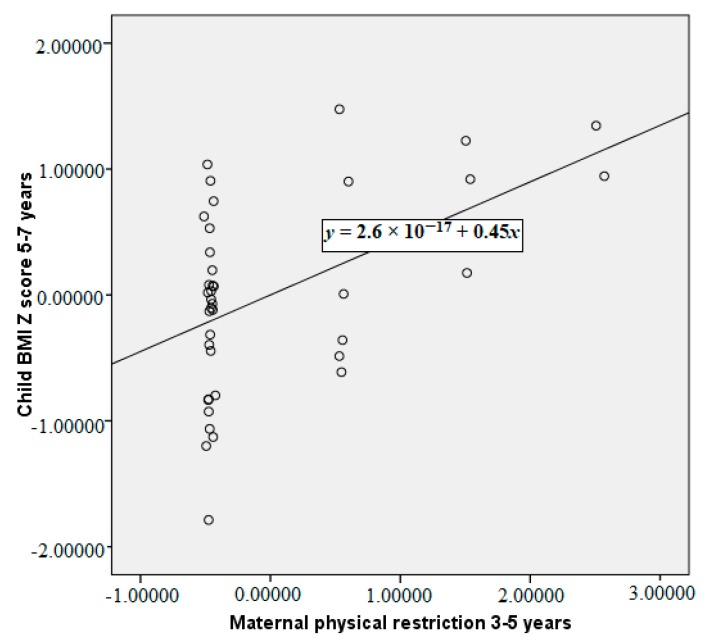
Overt parental restriction of food has previously been associated with child weight; however, most research has relied on self-reported feeding behaviour, or observations which give little opportunity to observe restriction of food. Using a novel lab-based observational technique to increase the opportunity to observe maternal feeding restriction, we explored the relationships between maternal restriction, child responses to restriction and child temperament with child body mass index (BMI) Z-scores over time. Sixty-two mother child dyads were recruited to the study when their children were aged 3⁻5 years and were followed up 2 years later ( = 39 dyads). Families were observed during a feeding interaction in the laboratory where cookies were offered with the main meal to increase the opportunity for maternal restriction of food. Feeding observations were coded and child temperament and BMI were measured. Controlling for current child BMI Z-scores, greater maternal verbal and physical restriction of food at 3⁻5 years was related to higher child BMI Z-scores at 5⁻7 years. More emotional children were less likely to experience restriction and less likely to accept attempts to restrict their food intake. Further research should consider children’s reactions to parental feeding behaviours in greater depth and explore how feeding practices interact with child temperament in the prediction of changes in child weight.
以往的研究表明,父母过度限制孩子进食与儿童体重有关;然而,大多数研究都依赖于自我报告的喂养行为,或者只能提供很少观察限制食物机会的观察结果。本研究采用一种新颖的基于实验室的观察技术来增加观察母亲喂养限制的机会,探索了母亲限制、儿童对限制的反应以及儿童气质与儿童体重指数(BMI)随时间变化的关系。当孩子 3-5 岁时,招募了 62 对母婴对子参与研究,并在 2 年后进行了随访(=39 对)。在实验室的喂养互动中观察家庭,在正餐中提供饼干以增加母亲对食物的限制机会。对喂养观察进行编码,并测量儿童气质和 BMI。控制当前儿童 BMI Z 分数,3-5 岁时母亲言语和身体对食物的限制越多,5-7 岁时儿童 BMI Z 分数越高。情绪更易波动的儿童不太可能受到限制,也不太可能接受限制其食物摄入的尝试。进一步的研究应该更深入地考虑儿童对父母喂养行为的反应,并探索喂养方式如何与儿童气质相互作用,从而预测儿童体重的变化。