Interdisciplinary Program for Bioengineering, Seoul National University Graduate School, Suite 321, Building 8, 101 Daehak-Ro, Jongno-Gu, Seoul, 03080, Republic of Korea.
Seoul National University Hospital Biomedical Research Institute, Suite 1203-1, 71 Daehak-ro, Jongno-gu, Seoul, 03082, Republic of Korea.
Biomed Eng Online. 2018 Jun 18;17(1):81. doi: 10.1186/s12938-018-0510-8.
Non-invasive continuous blood pressure monitors are of great interest to the medical community due to their value in hypertension management. Recently, studies have shown the potential of pulse pressure as a therapeutic target for hypertension, but not enough attention has been given to non-invasive continuous monitoring of pulse pressure. Although accurate pulse pressure estimation can be of direct value to hypertension management and indirectly to the estimation of systolic blood pressure, as it is the sum of pulse pressure and diastolic blood pressure, only a few inadequate methods of pulse pressure estimation have been proposed.
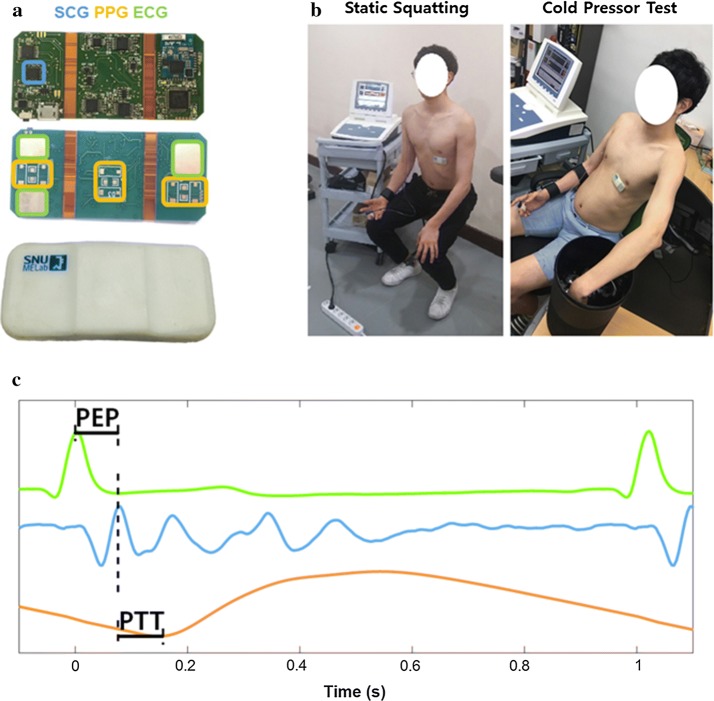
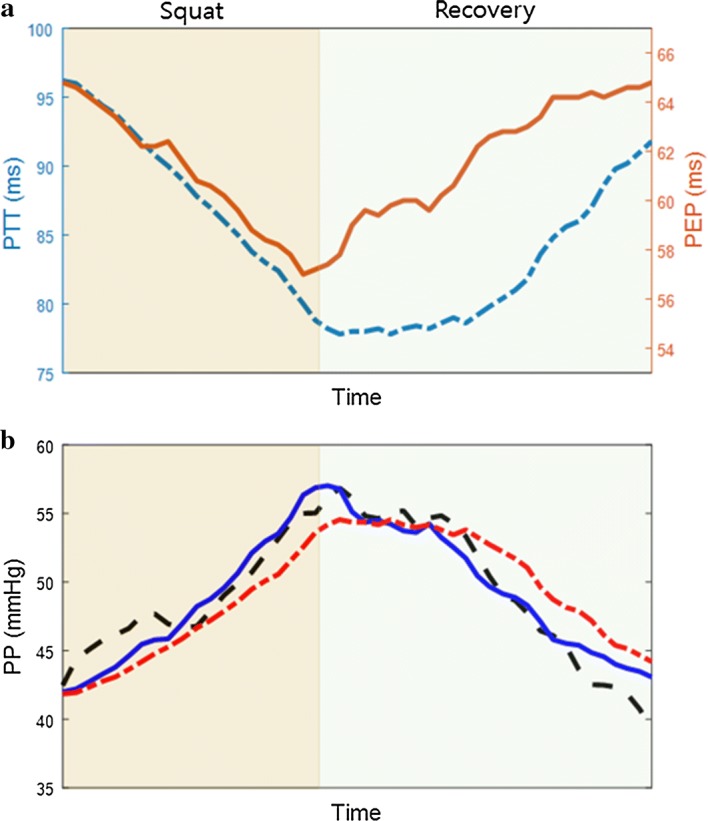
We present a novel, non-invasive blood pressure and pulse pressure estimation method based on pulse transit time and pre-ejection period. Pre-ejection period and pulse transit time were measured non-invasively using electrocardiogram, seismocardiogram, and photoplethysmogram measured from the torso. The proposed method used the 2-element Windkessel model to model pulse pressure with the ratio of stroke volume, approximated by pre-ejection period, and arterial compliance, estimated by pulse transit time. Diastolic blood pressure was estimated using pulse transit time, and systolic blood pressure was estimated as the sum of the two estimates. The estimation method was verified in 11 subjects in two separate conditions with induced cardiovascular response and the results were compared against a reference measurement and values obtained from a previously proposed method.
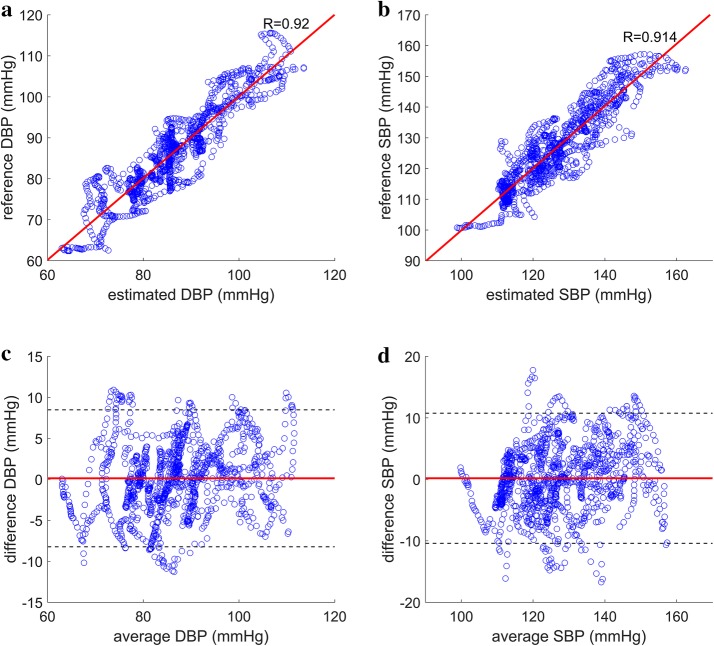
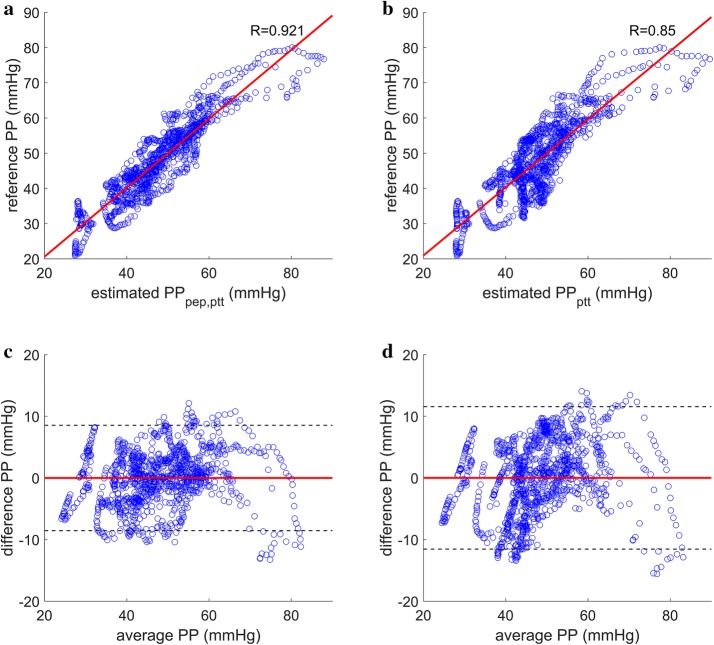
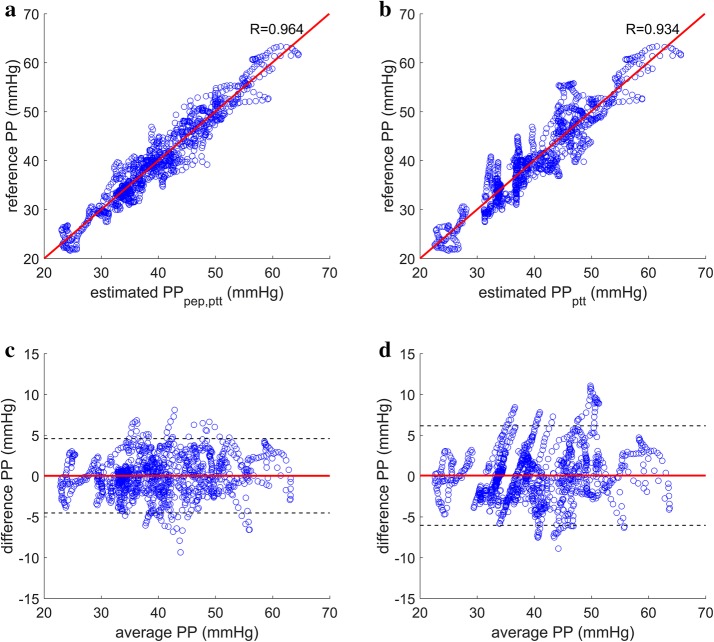
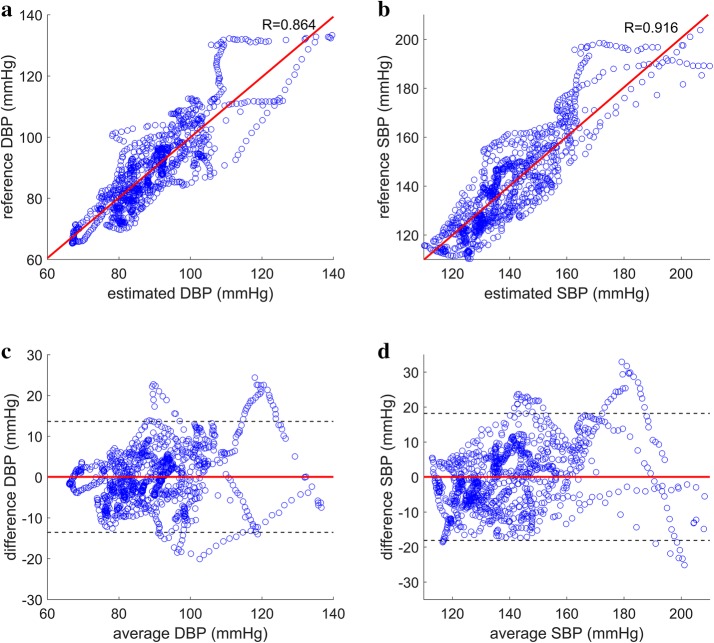
The proposed method yielded high agreement with the reference (pulse pressure correlation with reference R ≥ 0.927, diastolic blood pressure correlation with reference R ≥ 0.854, systolic blood pressure correlation with reference R ≥ 0.914) and high estimation accuracy in pulse pressure (mean root-mean-squared error ≤ 3.46 mmHg) and blood pressure (mean root-mean-squared error ≤ 6.31 mmHg for diastolic blood pressure and ≤ 8.41 mmHg for systolic blood pressure) over a wide range of hemodynamic changes.
The proposed pulse pressure estimation method provides accurate estimates in situations with and without significant changes in stroke volume. The proposed method improves upon the currently available systolic blood pressure estimation methods by providing accurate pulse pressure estimates.
由于在高血压管理中的价值,非侵入性连续血压监测器受到医学界的关注。最近的研究表明,脉搏压作为高血压治疗靶点的潜力,但对脉搏压的非侵入性连续监测关注不够。虽然准确的脉搏压估计值对高血压管理有直接价值,间接对收缩压的估计也有价值,因为它是脉搏压和舒张压的总和,但目前只提出了几种不完善的脉搏压估计方法。
我们提出了一种基于脉搏传导时间和射血前期的新型非侵入性血压和脉搏压估计方法。使用心电图、心冲击图和从躯干测量的光体积描记图无创地测量射血前期和脉搏传导时间。该方法使用二元件风箱模型,通过射血前期近似的每搏量和脉搏传导时间估计的动脉顺应性来对脉搏压进行建模。使用脉搏传导时间估计舒张压,将两个估计值之和作为收缩压的估计值。该估计方法在两种不同的心血管反应诱导条件下在 11 名受试者中进行了验证,并与参考测量值和以前提出的方法获得的值进行了比较。
该方法与参考值具有高度一致性(脉搏压与参考值的相关系数 R≥0.927,舒张压与参考值的相关系数 R≥0.854,收缩压与参考值的相关系数 R≥0.914),并且在广泛的血流动力学变化范围内具有较高的脉搏压(平均均方根误差≤3.46mmHg)和血压(舒张压的平均均方根误差≤6.31mmHg,收缩压的平均均方根误差≤8.41mmHg)的估计精度。
所提出的脉搏压估计方法在存在或不存在每搏量显著变化的情况下提供了准确的估计值。该方法通过提供准确的脉搏压估计值,改进了目前可用的收缩压估计方法。