Jonas Michael, Kazarski Rasisa, Chernin Gil
Department of Cardiology, Kaplan Medical Center, Hebrew University School of Medicine, Rehovot, Israel.
Department of Nephrology and Hypertension, Kaplan Medical Center, Hebrew University School of Medicine, Rehovot, Israel.
J Geriatr Cardiol. 2018 Apr;15(4):284-289. doi: 10.11909/j.issn.1671-5411.2018.04.007.
Fall injuries are common among the elderly. The aim of this study was to investigate whether blood-pressure patterns, as measured by 24-h ambulatory blood pressure monitoring (ABPM), or intensification of antihypertensive therapy following the 24-h ABPM, may be associated with fall injuries in hypertensive elderly patients.
In a retrospective study, community-based elderly patients (age ≥ 70 years) who were referred to 24-h ABPM were evaluated for fall injuries within one-year post-ABPM. We compared the clinical characteristics, 24-h ABPM patterns and the intensification of hypertensive therapy following 24-h ABPM, between patients with and without a fall injury.
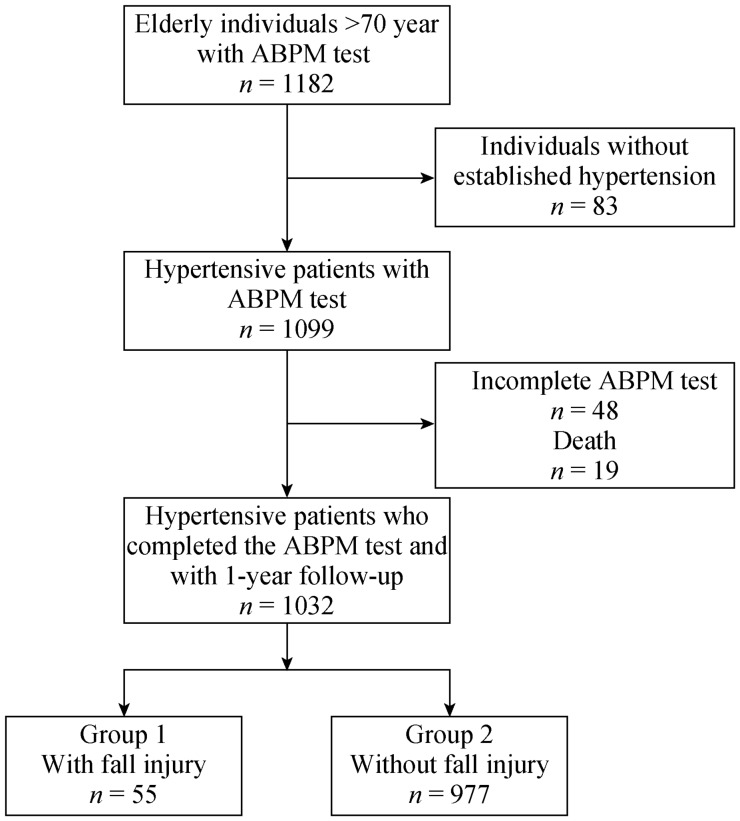
Overall 1032 hypertensive elderly patients were evaluated. Fifty-five (5.3%) had a fall injury episode in the year following ABPM. Patients with a fall injury were significantly older, and with higher rates of previous falls. Lower 24-h diastolic blood-pressure (67.3 ± 7.6 . 70.7 ± 8.8 mmHg; < 0.005) and increased pulse-pressure (74.7 ± 14.3 68.3 ± 13.7 mmHg; < 0.005), were found in the patients with a fall injury, compared to those without a fall injury. After adjustment for age, gender, diabetes mellitus and previous falls, lower diastolic blood-pressure and increased pulse-pressure were independent predictors of fall injury. Intensification of antihypertensive treatment following the 24-h ABPM was not associated with an increased rate of fall injury.
Low diastolic blood-pressure and increased pulse-pressure in 24-h ABPM were associated with an increased risk of fall injury in elderly hypertensive patients. Intensification of antihypertensive treatment following 24-h ABPM was not associated with an increased risk of fall injury.
跌倒损伤在老年人中很常见。本研究的目的是调查通过24小时动态血压监测(ABPM)测量的血压模式,或24小时ABPM后强化降压治疗,是否可能与老年高血压患者的跌倒损伤有关。
在一项回顾性研究中,对接受24小时ABPM检查的社区老年患者(年龄≥70岁)在ABPM后一年内的跌倒损伤情况进行评估。我们比较了有跌倒损伤和无跌倒损伤患者的临床特征、24小时ABPM模式以及24小时ABPM后高血压治疗的强化情况。
总共评估了1032例老年高血压患者。55例(5.3%)在ABPM后的一年内发生了跌倒损伤事件。有跌倒损伤的患者年龄显著更大,且既往跌倒发生率更高。与无跌倒损伤的患者相比,有跌倒损伤的患者24小时舒张压更低(67.3±7.6. 70.7±8.8 mmHg;<0.005),脉压增加(74.7±14.3 68.3±13.7 mmHg;<0.005)。在调整年龄、性别、糖尿病和既往跌倒因素后,较低的舒张压和增加的脉压是跌倒损伤的独立预测因素。24小时ABPM后强化降压治疗与跌倒损伤发生率增加无关。
24小时ABPM中舒张压降低和脉压增加与老年高血压患者跌倒损伤风险增加有关。24小时ABPM后强化降压治疗与跌倒损伤风险增加无关。