Al-Sharif Mohammad Nassir, Fayi Khalid Ali, Alobaidi Abdulsalam Ali, Alshamrani Bader Awadh
Department of Surgery, King Khalid University, Abha, Asir, Saudi Arabia.
J Family Med Prim Care. 2018 Jan-Feb;7(1):87-92. doi: 10.4103/jfmpc.jfmpc_264_17.
Colorectal cancer (CRC) has different forms of colon cancer or rectal cancer. CRCs are often considered together because they possess many similar features. A severe form of the disease with higher mortality rate increases with increase in age. The most common CRC risk factors include smoking, diabetes, and obesity. This study aims to evaluate the awareness of CRC in a random population of Asir region and to identify the subpopulation that can be recipients of awareness and screening programs.
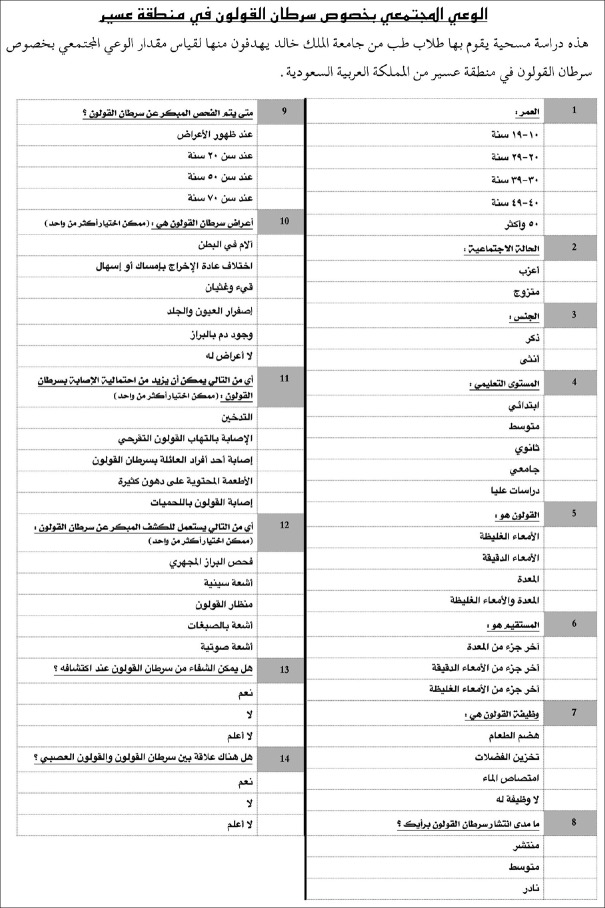
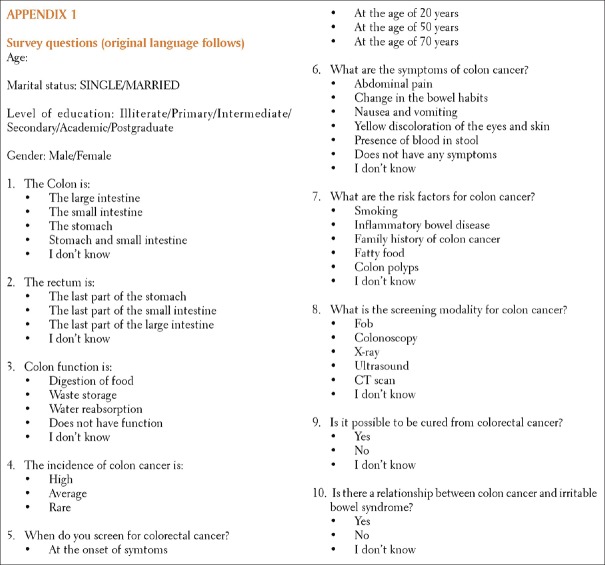
Cross-sectional nonprobable random sampling study using a self-administered questionnaire survey which was employed to include healthy males and females from Asir region. The questionnaire included ten questions in Arabic language and data were categorized according to gender, marital status, age, and level of education to determine whether these demographic groups possess difference in knowledge about CRC.
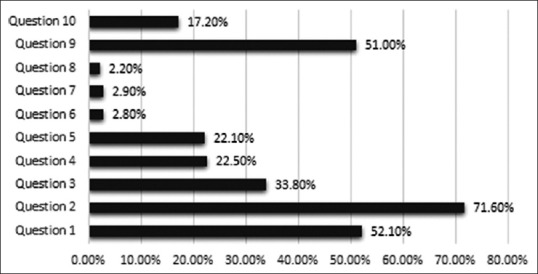
Most of the respondents (51% and 71.6%) knew what is colon and rectum. About 33.8% know the correct function of the colon while 22.5% know the correct incidence and 22.1% know the correct time of screening for CRC. Very few respondents know the symptoms, risks, and screening modalities of CRC. Pearson's Chi-square test was employed to evaluate the differences in responses in four demographic categories of the study population. <0.05 was considered as statistically significant.
Single less educated males lack knowledge of CRC. In addition, there is very low awareness of CRC symptoms, risk factors, and screening modalities among the entire surveyed population.
结直肠癌(CRC)包括结肠癌或直肠癌的不同形式。由于它们具有许多相似特征,通常将结直肠癌放在一起考虑。随着年龄增长,这种具有较高死亡率的严重疾病形式会增加。最常见的结直肠癌风险因素包括吸烟、糖尿病和肥胖。本研究旨在评估阿西尔地区随机人群对结直肠癌的认知,并确定可成为认知和筛查项目对象的亚人群。
采用自我管理问卷调查进行横断面非概率随机抽样研究,纳入阿西尔地区的健康男性和女性。问卷包括十个阿拉伯语问题,数据根据性别、婚姻状况、年龄和教育程度进行分类,以确定这些人口统计学群体在结直肠癌知识方面是否存在差异。
大多数受访者(51%和71.6%)知道结肠和直肠是什么。约33.8%的人知道结肠的正确功能,22.5%的人知道正确的发病率,22.1%的人知道结直肠癌的正确筛查时间。很少有受访者知道结直肠癌的症状、风险和筛查方式。采用Pearson卡方检验评估研究人群四个人口统计学类别的回答差异。P<0.05被认为具有统计学意义。
受教育程度较低的单身男性缺乏结直肠癌知识。此外,在整个调查人群中,对结直肠癌症状、风险因素和筛查方式的认知非常低。