Research Department of Epidemiology and Public Health, University College London, 1-19 Torrington Place, London, WC1E 6BT, UK.
Soc Psychiatry Psychiatr Epidemiol. 2018 Oct;53(10):1081-1090. doi: 10.1007/s00127-018-1548-4. Epub 2018 Jun 19.
To model the dynamic age-related rate of change in depressive symptomatology in later life and to test the hypothesis that low perceived neighbourhood social cohesion is associated with steeper trajectories of depressive symptoms in older adults.
We analysed data on 11,037 participants aged 50+ from the English Longitudinal Study of Ageing. Perceived social cohesion (PSC) of participants' neighbourhoods was assessed at baseline (2002/2003). Depressive symptoms were measured using CES-D scores (ranging from 0 to 8) on 7 occasions from baseline to 2014/2015. Trajectories of depressive symptoms by baseline PSC were estimated using latent growth modelling.
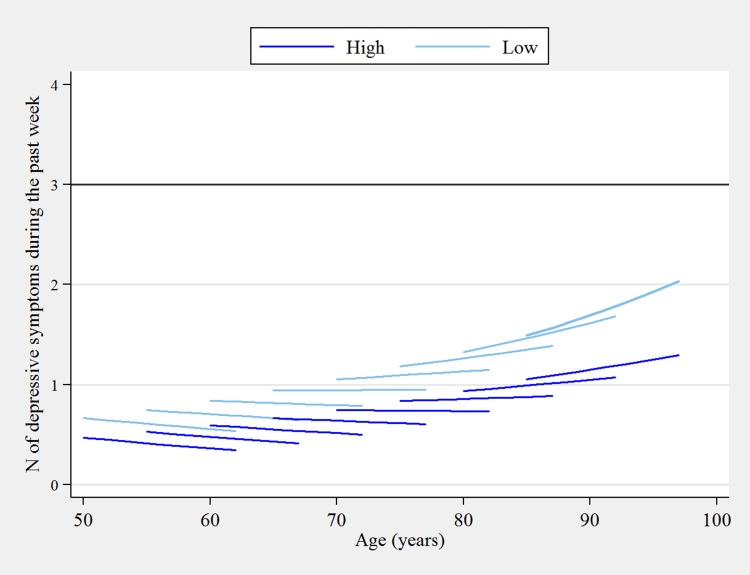
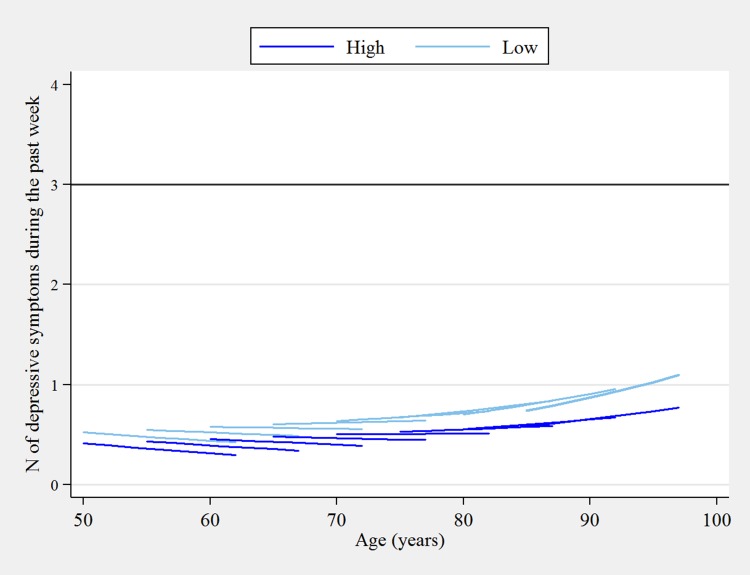
At baseline, adults with low PSC had more depressive symptoms than age counterparts with high PSC. Consistent with the U-shaped trajectory of depressive symptoms by age, the association between PSC tertile and changes in depressive symptoms over follow-up was modified by age. Fifty-year-old participants with low PSC reported an average decrease in CES-D score from 0.66 to 0.54 during the 12-year follow up, compared to a change from 0.47 to 0.34 for age counterparts with high PSC. By contrast, in persons aged 85 at baseline, the mean CES-D score increased from 1.09 to 1.30 for participants with high PSC, while the rise was greater (from 1.49 to 2.03) among those with low PSC. The main effects and interaction of PSC with age were robust to adjustment for socio-economic and health characteristics.
Depressive symptom trajectories by PSC appear to widen as adults reach old age.
建立老年人抑郁症状随年龄变化的动态模型,并检验假设,即低感知邻里社会凝聚力与老年人抑郁症状的发展轨迹更为陡峭有关。
我们分析了来自英国老龄化纵向研究的 11037 名 50 岁以上参与者的数据。参与者所在社区的感知社会凝聚力(PSC)在基线(2002/2003 年)进行评估。使用 CES-D 量表(范围为 0 至 8)在基线到 2014/2015 年的 7 次测量中评估抑郁症状。使用潜在增长模型估计抑郁症状的基线 PSC 轨迹。
在基线时,低 PSC 的成年人比高 PSC 的同龄人有更多的抑郁症状。与年龄相关的抑郁症状呈 U 型轨迹一致,PSC 三分位与随访期间抑郁症状变化之间的关联随年龄而变化。基线年龄为 50 岁的低 PSC 参与者报告 CES-D 评分从 0.66 平均下降到 0.54,而高 PSC 的同龄人从 0.47 下降到 0.34。相比之下,在基线年龄为 85 岁的人中,高 PSC 参与者的 CES-D 评分平均从 1.09 增加到 1.30,而低 PSC 参与者的增幅更大(从 1.49 增加到 2.03)。PSC 与年龄的主要影响和相互作用在调整社会经济和健康特征后仍然稳健。
随着成年人进入老年,PSC 划分的抑郁症状轨迹似乎会变宽。