Su Hongru, Yang Renren, Deng Qinglong, Qian Wenhao, Yu Jinming
Xuhui District Dental Centre, Shanghai, China.
Collaborative Innovation Centre of Social Risks Governance in Health, School of Public Health, Fudan University, Shanghai, China.
BMC Oral Health. 2018 Jun 19;18(1):111. doi: 10.1186/s12903-018-0565-8.
This study aims to understand the deciduous dental caries status of preschool children in Xuhui District of Shanghai, China and to analyze the associated risk factors.
In January of 2016, a cross-sectional investigation was conducted to examine the oral health of all the kindergarten children in Xuihui District of Shanghai, China. Meanwhile, a field questionnaire survey was conducted with the children's guardians to ascertain the potential risk factors associated with deciduous dental caries.
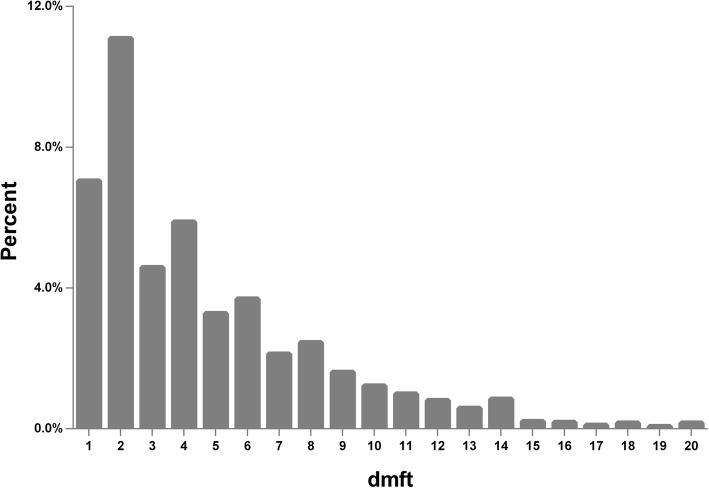
Among 11,153 children, the prevalence of deciduous dental caries was 47.02%, and the mean dmft score was 2.21. The first three predilection sites were maxillary central primary incisors, mandible second primary molars, and mandible first primary molars. There were statistically significant differences in caries prevalence and dmft among different age groups and different household registration (Hukou) types (P < 0.001). Multivariate Logistic regression suggested that the possible risk factors for deciduous caries included: older age, drinking sweetened beverages frequently, often or usually eating sweets before sleep compared to rarely/never eat them at this time, exclusive or predominant breastfeeding compared to exclusive or predominant artificial feeding and latter introduction of toothbrushing. On the other hand, Shanghai Hukou families, high educational level of guardians (high school or college education), regular parental support for children's toothbrushing, guardians' oral health knowledge, and a good perception about children's oral health conditions were shown as potential protective factors for deciduous dental caries.
The deciduous dental caries status of preschool children in Xuhui District of Shanghai was still serious. The caries prevalence in Xuhui, China, is associated with children's age, household registration type, oral health habits, feeding habits, guardians' education level, parental perception about children's oral health and knowledge about oral health.
本研究旨在了解中国上海徐汇区学龄前儿童乳牙龋病状况,并分析相关危险因素。
2016年1月,对中国上海徐汇区所有幼儿园儿童进行了横断面调查,以检查其口腔健康状况。同时,对儿童监护人进行了现场问卷调查,以确定与乳牙龋病相关的潜在危险因素。
在11153名儿童中,乳牙龋病患病率为47.02%,平均dmft得分为2.21。前三个好发部位是上颌乳中切牙、下颌第二乳磨牙和下颌第一乳磨牙。不同年龄组和不同户籍类型的龋病患病率和dmft存在统计学显著差异(P<0.001)。多因素Logistic回归分析显示,乳牙龋病的可能危险因素包括:年龄较大、经常饮用含糖饮料、与很少/从不在睡前吃甜食相比,经常或通常在睡前吃甜食、与人工喂养为主或完全人工喂养相比,母乳喂养为主或完全母乳喂养以及较晚开始刷牙。另一方面,上海户籍家庭、监护人高学历(高中或大专学历)、父母定期支持孩子刷牙、监护人的口腔健康知识以及对孩子口腔健康状况的良好认知被证明是乳牙龋病的潜在保护因素。
上海徐汇区学龄前儿童乳牙龋病状况仍然严重。中国徐汇区的龋病患病率与儿童年龄、户籍类型、口腔健康习惯、喂养习惯、监护人教育水平、父母对孩子口腔健康的认知以及口腔健康知识有关。