Institute of Special Animal and Plant Sciences, Chinese Academy of Agricultural Sciences, Changchun, 130112, Jilin, People's Republic of China.
State Key Lab for Molecular Biology of Special Economic Animals, 4899 Juye Street, Changchun City, 130112, Jilin, People's Republic of China.
Stem Cell Res Ther. 2018 Jun 19;9(1):166. doi: 10.1186/s13287-018-0917-y.
Deer antlers are the only known mammalian organ with vascularized cartilage that can completely regenerate. Antlers are of real significance as a model of mammalian stem cell-based regeneration with particular relevance to the fields of chondrogenesis, angiogenesis, and regenerative medicine. Recent research found that thymosin beta 10 (TMSB10) is highly expressed in the growth centers of growing antlers. The present study reports here the expression, functions, and molecular interactions of deer TMSB10.
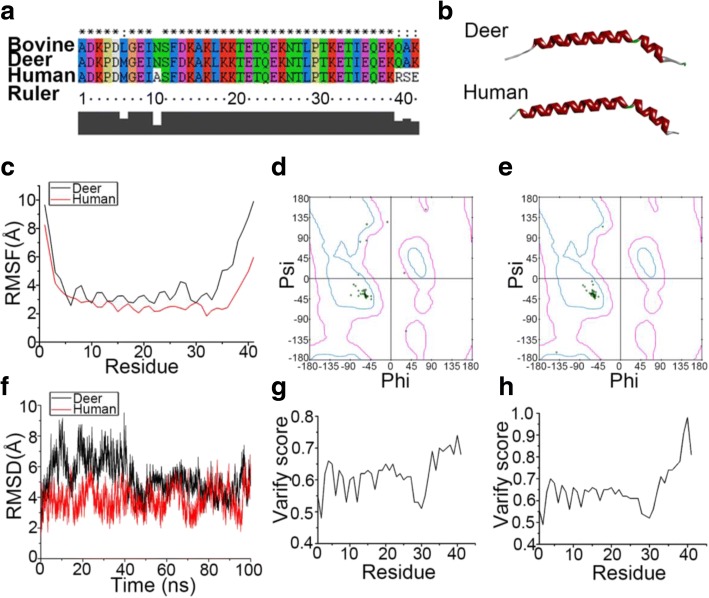
The TMSB10 expression level in both tissue and cells in the antler growth center was measured. The effects of both exogenous (synthetic protein) and endogenous deer TMSB10 (lentivirus-based overexpression) on antlerogenic periosteal cells (APCs; nonactivated antler stem cells with no basal expression of TMSB10) and human umbilical vein endothelial cells (HUVECs; endothelial cells with no basal expression of TMSB10) were evaluated to determine whether TMSB10 functions on chondrogenesis and angiogenesis. Differences in deer and human TMSB10 in angiogenesis and molecular structure were determined using animal models and molecular dynamics simulation, respectively. The molecular mechanisms underlying deer TMSB10 in promoting angiogenesis were also explored.
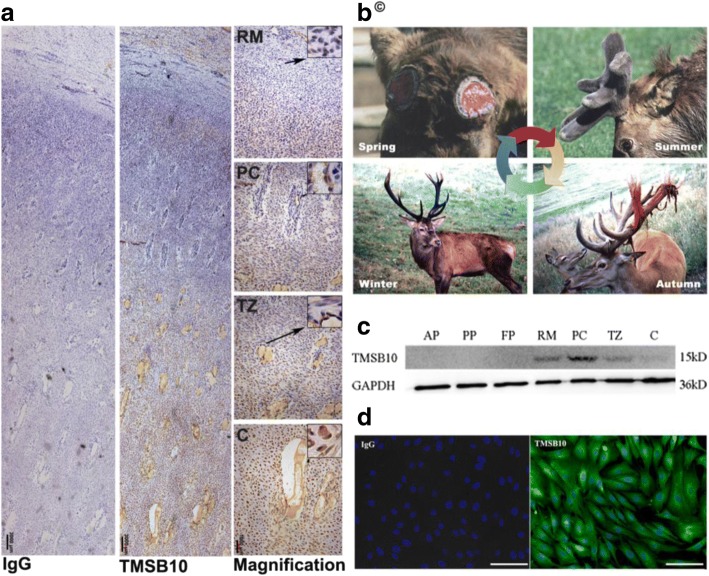
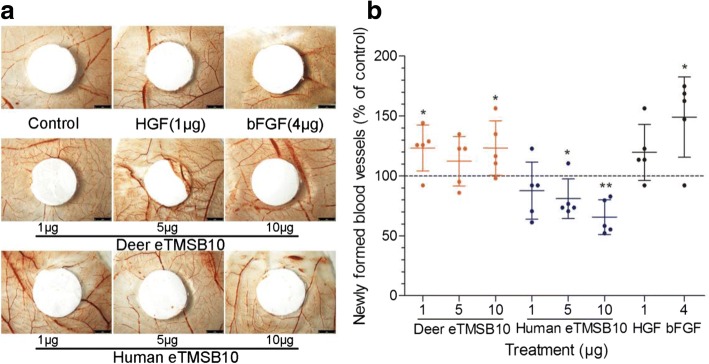
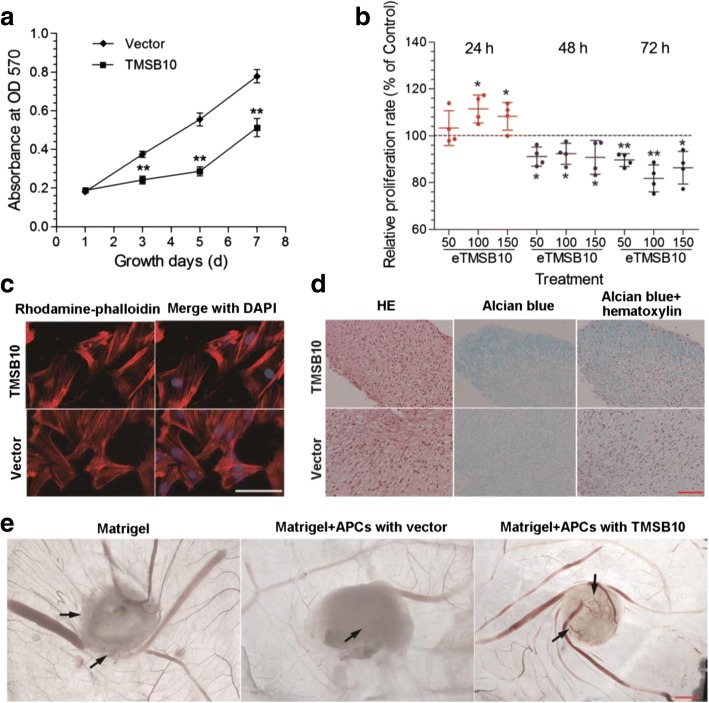
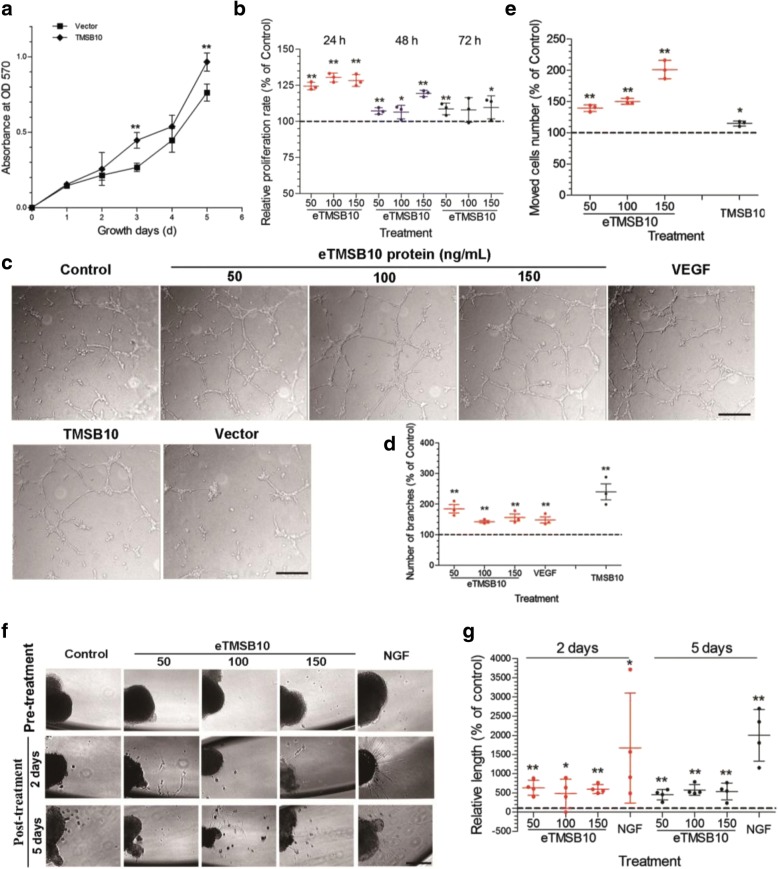
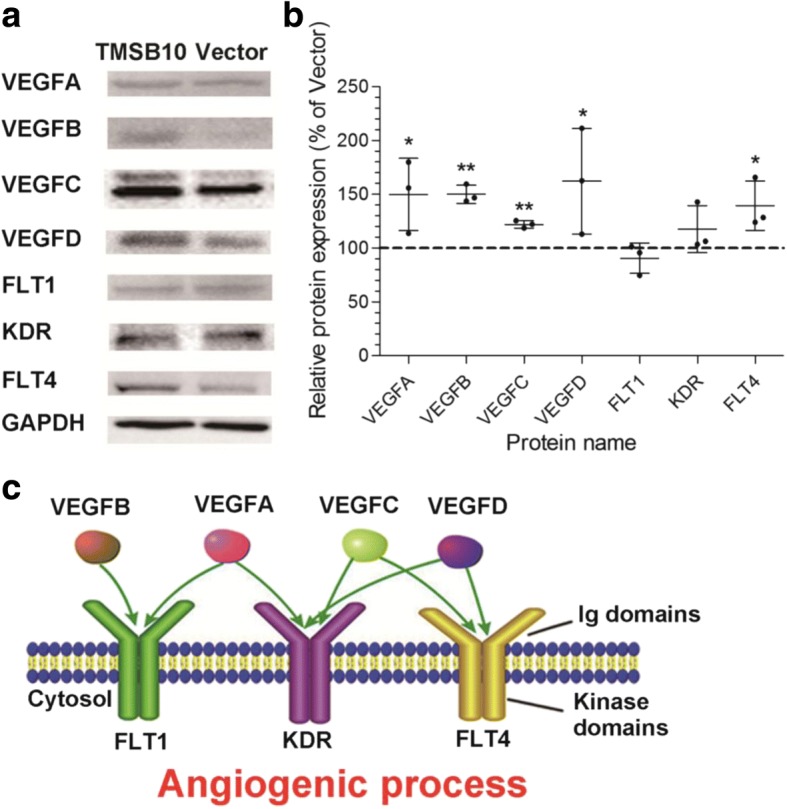
Deer TMSB10 was identified as a novel proangiogenic factor both in vitro and in vivo. Immunohistochemistry revealed that TMSB10 was widely expressed in the antler growth center in situ, with the highest expression in the reserve mesenchyme, precartilage, and transitional zones. Western blot analysis using deer cell lines further supports this result. Both exogenous and endogenous deer TMSB10 significantly decreased proliferation of APCs (P < 0.05), while increasing the proliferation of HUVECs (P < 0.05). Moreover, deer TMSB10 enhanced chondrogenesis in micromass cultures and nerve growth as assessed using a dorsal root ganglion model (P < 0.05). Deer TMSB10 was proangiogenic using models of chicken chorioallantoic membrane, tube formation, and aortic arch assay. At the molecular level, endogenous deer TMSB10 elevated the expression of vascular endothelial growth factor (VEGF), VEGF-B, VEGF-C, and VEGF-D, and VEGFR2 and VEGFR3 in HUVECs (P < 0.05).
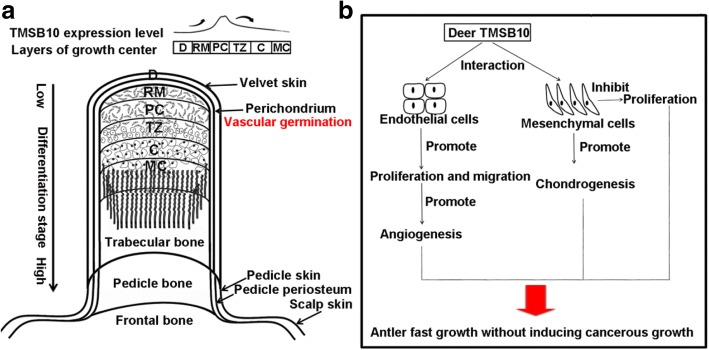
Deer TMSB10, in contrast to its human counterpart, was identified as a novel stimulating factor for angiogenesis, cartilage formation, and nerve growth, which is understandable given that deer antlers (as the arguably fastest mammalian growing tissue) may require this extra boost during a period of rapid growth and regeneration.
鹿角是唯一已知的具有血管化软骨的哺乳动物器官,能够完全再生。鹿角作为哺乳动物基于干细胞再生的模型具有重要意义,特别是在软骨发生、血管生成和再生医学领域。最近的研究发现,胸腺素β 10(TMSB10)在生长中的鹿角的生长中心高度表达。本研究报告了鹿 TMSB10 的表达、功能和分子相互作用。
测量鹿角生长中心组织和细胞中的 TMSB10 表达水平。评估外源性(合成蛋白)和内源性鹿 TMSB10(基于慢病毒的过表达)对鹿角成骨细胞(APCs;无基础 TMSB10 表达的未激活鹿角干细胞)和人脐静脉内皮细胞(HUVECs;无基础 TMSB10 表达的内皮细胞)的作用,以确定 TMSB10 是否在软骨发生和血管生成中发挥作用。使用动物模型和分子动力学模拟分别确定了鹿和人 TMSB10 在血管生成和分子结构上的差异。还探讨了鹿 TMSB10 促进血管生成的分子机制。
鹿 TMSB10 被鉴定为一种新的血管生成促进因子,无论是在体外还是体内。免疫组织化学显示 TMSB10 在原位鹿角生长中心广泛表达,在储备间充质、软骨前体和过渡区表达最高。使用鹿细胞系进行的 Western blot 分析进一步支持了这一结果。外源性和内源性鹿 TMSB10 均显著降低 APCs 的增殖(P<0.05),而增加 HUVECs 的增殖(P<0.05)。此外,鹿 TMSB10 增强了微团培养中的软骨发生和神经生长,如背根神经节模型所示(P<0.05)。鹿 TMSB10 在鸡绒毛尿囊膜、管形成和主动脉弓测定模型中具有血管生成作用。在分子水平上,内源性鹿 TMSB10 升高了 HUVECs 中血管内皮生长因子(VEGF)、VEGF-B、VEGF-C 和 VEGF-D 以及 VEGFR2 和 VEGFR3 的表达(P<0.05)。
与人类 TMSB10 不同,鹿 TMSB10 被鉴定为一种新的血管生成、软骨形成和神经生长刺激因子,这是可以理解的,因为鹿角(作为可能是哺乳动物中生长最快的组织)在快速生长和再生期间可能需要这种额外的促进。