Institut Pasteur de Tunis, LR11IPT02, Laboratory of Transmission, Control and Immunobiology of Infections (LTCII), Tunis-Belvédère 1002, Tunisia.
Université Tunis El Manar, Tunis 1068, Tunisia.
Int J Mol Sci. 2018 Jun 19;19(6):1801. doi: 10.3390/ijms19061801.
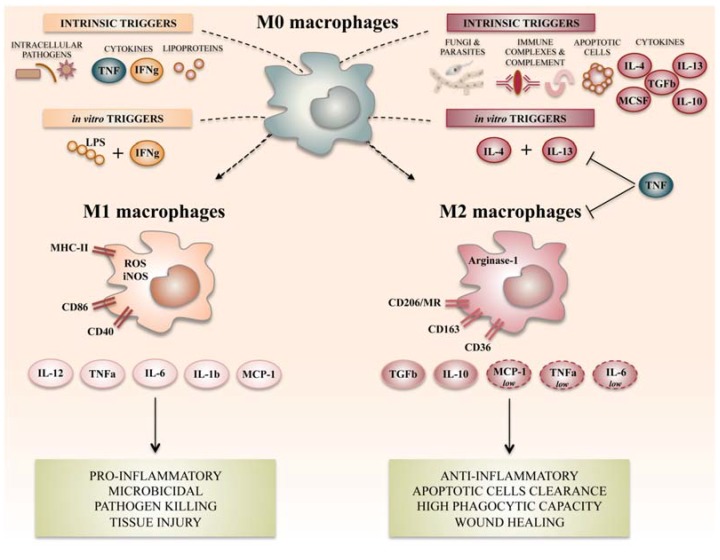
Experimental models have often been at the origin of immunological paradigms such as the M1/M2 dichotomy following macrophage polarization. However, this clear dichotomy in animal models is not as obvious in humans, and the separating line between M1-like and M2-like macrophages is rather represented by a continuum, where boundaries are still unclear. Indeed, human infectious diseases, are characterized by either a back and forth or often a mixed profile between the pro-inflammatory microenvironment (dominated by interleukin (IL)-1β, IL-6, IL-12, IL-23 and Tumor Necrosis Factor (TNF)-α cytokines) and tissue injury driven by classically activated macrophages (M1-like) and wound healing driven by alternatively activated macrophages (M2-like) in an anti-inflammatory environment (dominated by IL-10, Transforming growth factor (TGF)-β, chemokine ligand (CCL)1, CCL2, CCL17, CCL18, and CCL22). This review brews the complexity of the situation during infectious diseases by stressing on this continuum between M1-like and M2-like extremes. We first discuss the basic biology of macrophage polarization, function, and role in the inflammatory process and its resolution. Secondly, we discuss the relevance of the macrophage polarization continuum during infectious and neglected diseases, and the possibility to interfere with such activation states as a promising therapeutic strategy in the treatment of such diseases.
实验模型常常是免疫学范式的起源,例如巨噬细胞极化后的 M1/M2 二分法。然而,这种在动物模型中的明显二分法在人类中并不那么明显,M1 样和 M2 样巨噬细胞之间的分界线更像是一个连续体,其界限仍不明确。事实上,人类传染病的特点是在促炎微环境(由白细胞介素 (IL)-1β、IL-6、IL-12、IL-23 和肿瘤坏死因子 (TNF)-α 细胞因子主导)和由经典激活的巨噬细胞(M1 样)驱动的组织损伤与由替代性激活的巨噬细胞(M2 样)驱动的抗炎环境(由 IL-10、转化生长因子 (TGF)-β、趋化因子配体 (CCL)1、CCL2、CCL17、CCL18 和 CCL22 主导)之间来回转换,或者经常是混合模式。通过强调 M1 样和 M2 样极端之间的这种连续体,本文综述了传染病期间情况的复杂性。我们首先讨论了巨噬细胞极化的基本生物学、功能以及在炎症过程及其解决中的作用。其次,我们讨论了在感染性和被忽视的疾病中巨噬细胞极化连续体的相关性,以及作为治疗此类疾病的有前途的治疗策略来干预这种激活状态的可能性。