UMR-204 Nutripass, Institut de Recherche pour le Développement, IRD/UM/SupAgro, 34390 Montpellier, France.
UNICEF-Cambodia, Phnom Penh, Cambodia.
Nutrients. 2018 Jun 19;10(6):786. doi: 10.3390/nu10060786.
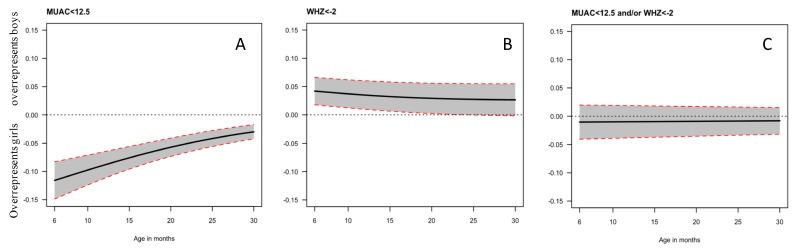
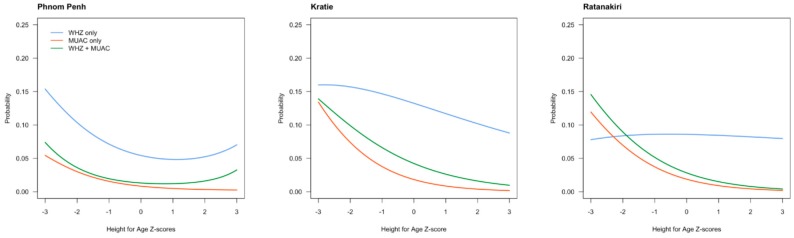
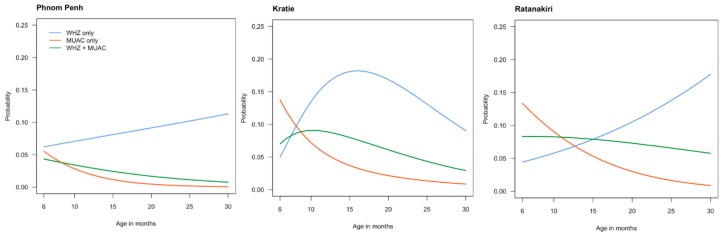
Malnutrition remains a serious health problem in Cambodia with over 10% of children less than five years of age suffering from acute malnutrition. In addition to the presence of nutritional edema, two indicators are recommended by the World Health Organization for the diagnosis of acute malnutrition: weight-for-height Z-scores (WHZ; with acute malnutrition defined as WHZ < −2 Z-score) and mid-upper arm circumference (MUAC, with acute malnutrition defined as MUAC < 12.5 cm). Earlier, we showed that WHZ and MUAC identified different subgroups of children with acute malnutrition. To explore factors associated with both indicators of acute malnutrition, we analyzed baseline data from a longitudinal study in three provinces in Cambodia: Phnom Penh (capital, urban environment), Kratie (rural province), and Ratanakiri (hilly, rural province). Data was available for 4381 children below 30 months of age. Malnutrition rates were higher in the two rural provinces than in the capital. Although both MUAC and WHZ showed gender bias, with MUAC identifying more girls, and WHZ identifying more boys with acute malnutrition, the gender effect was strongest for MUAC. The gender bias of MUAC diminished with older age, but remained significant up to 30 months of age. Only using both MUAC and WHZ as indicators resulted in gender neutral identification of acute malnutrition. WHZ alone always identified more children with acute malnutrition than MUAC alone. In Phnom Penh, MUAC alone identified only 11% with acute malnutrition in addition to WHZ. To conclude, both MUAC and WHZ showed gender bias in this cohort of Cambodian children. In Cambodia, implementation of a MUAC-only or a WHZ-only program for the identification of acute malnutrition would be unethical as it will lead to many children remaining undiagnosed.
营养不良仍然是柬埔寨的一个严重健康问题,超过 10%的 5 岁以下儿童患有急性营养不良。除了存在营养性水肿外,世界卫生组织还推荐了两个指标用于急性营养不良的诊断:身高别体重 Z 评分(WHZ;急性营养不良定义为 WHZ < -2 Z 评分)和上臂中部周长(MUAC,急性营养不良定义为 MUAC < 12.5cm)。早些时候,我们发现 WHZ 和 MUAC 可以识别出不同亚组的急性营养不良儿童。为了探讨与急性营养不良的这两个指标相关的因素,我们分析了柬埔寨三个省(金边市,城市环境;桔井省,农村省;腊塔纳基里省,丘陵,农村省)的一项纵向研究的基线数据。数据可用于 4381 名 30 个月以下的儿童。农村省份的营养不良率高于首都。虽然 MUAC 和 WHZ 都显示出性别偏见,MUAC 识别出更多的女孩,WHZ 识别出更多的男孩患有急性营养不良,但 MUAC 的性别影响最强。MUAC 的性别偏见随着年龄的增长而减弱,但在 30 个月之前仍然显著。仅使用 MUAC 和 WHZ 作为指标可以导致对急性营养不良的性别中立识别。WHZ 单独使用时,比 MUAC 单独使用时识别出更多患有急性营养不良的儿童。在金边市,单独使用 MUAC 只能识别出除 WHZ 外,11%的急性营养不良儿童。总之,在这个柬埔寨儿童队列中,MUAC 和 WHZ 都显示出性别偏见。在柬埔寨,实施 MUAC 或 WHZ 单独的方案来识别急性营养不良将是不道德的,因为这将导致许多儿童得不到诊断。