Goghari Vina M, Lawlor-Savage Linette
Department of Psychology, University of Toronto, Toronto, ON, Canada.
Department of Psychology, University of Calgary, Calgary, AB, Canada.
Front Aging Neurosci. 2018 Apr 25;10:112. doi: 10.3389/fnagi.2018.00112. eCollection 2018.
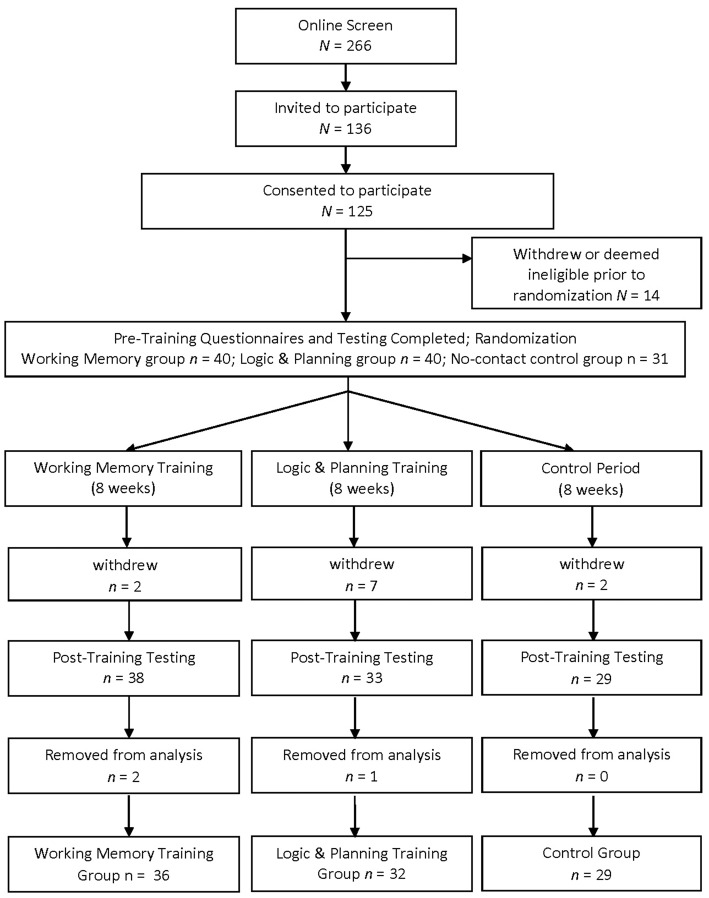
The idea that individualized, computer-based cognitive training improves cognitive functioning in non-trained domains is highly contested. An understudied area is whether cognitive training improves one's own perception of cognitive and day-to-day functioning. Furthermore, no studies have compared working memory training to programs that train higher-level processes themselves, namely logic and planning, in improving perception of cognitive abilities. We investigated self-reported changes in: (a) cognitive errors relevant to daily life; (b) expectations regarding training; and (c) impact of training on daily life, in healthy older adults who completed working memory training or logic and planning training. Ninety-seven healthy older adults completed 8-weeks of computerized cognitive training that targeted either working memory or logic and planning. Findings were compared to a no-training control group. Participants reported fewer cognitive failures relevant to daily life after training compared to the no-training control group, with a greater reduction in errors reported by the logic and planning training group compared to the working memory training group. Trainees' perception of training efficacy decreased over time. Nonetheless, approximately half of the participants in both training groups endorsed "some improvement" or more in self-perceived day-to-day functioning at post-testing. These results support the conclusion that individualized computerized cognitive training may enhance subjective perceptions of change and that higher level cognitive training may confer additional benefits. Findings suggest that cognitive training can enhance cognitive self-efficacy in healthy seniors.
基于计算机的个性化认知训练能改善未训练领域的认知功能这一观点备受争议。一个研究不足的领域是认知训练是否能改善个体对自身认知及日常功能的感知。此外,尚无研究比较工作记忆训练与训练更高层次认知过程(即逻辑和规划)的项目在改善认知能力感知方面的效果。我们调查了完成工作记忆训练或逻辑与规划训练的健康老年人在以下方面自我报告的变化:(a)与日常生活相关的认知错误;(b)对训练的期望;(c)训练对日常生活的影响。97名健康老年人完成了为期8周的针对工作记忆或逻辑与规划的计算机化认知训练。研究结果与无训练对照组进行了比较。与无训练对照组相比,参与者在训练后报告的与日常生活相关的认知失误减少,与工作记忆训练组相比,逻辑与规划训练组报告的错误减少幅度更大。随着时间的推移,受训者对训练效果的感知有所下降。尽管如此,两个训练组中约一半的参与者在测试后认可自我感知的日常功能有“一些改善”或更多改善。这些结果支持以下结论:个性化计算机化认知训练可能会增强对变化的主观感知,更高层次的认知训练可能会带来额外益处。研究结果表明,认知训练可以增强健康老年人的认知自我效能。