Bernaola Lina, Cosme Marco, Schneider Raymond W, Stout Michael
Department of Entomology, Louisiana State University Agricultural Center, Baton Rouge, LA, United States.
Laboratory of Mycology, Earth and Life Institute, Université catholique de Louvain, Louvain-la-Neuve, Belgium.
Front Plant Sci. 2018 Jun 5;9:747. doi: 10.3389/fpls.2018.00747. eCollection 2018.
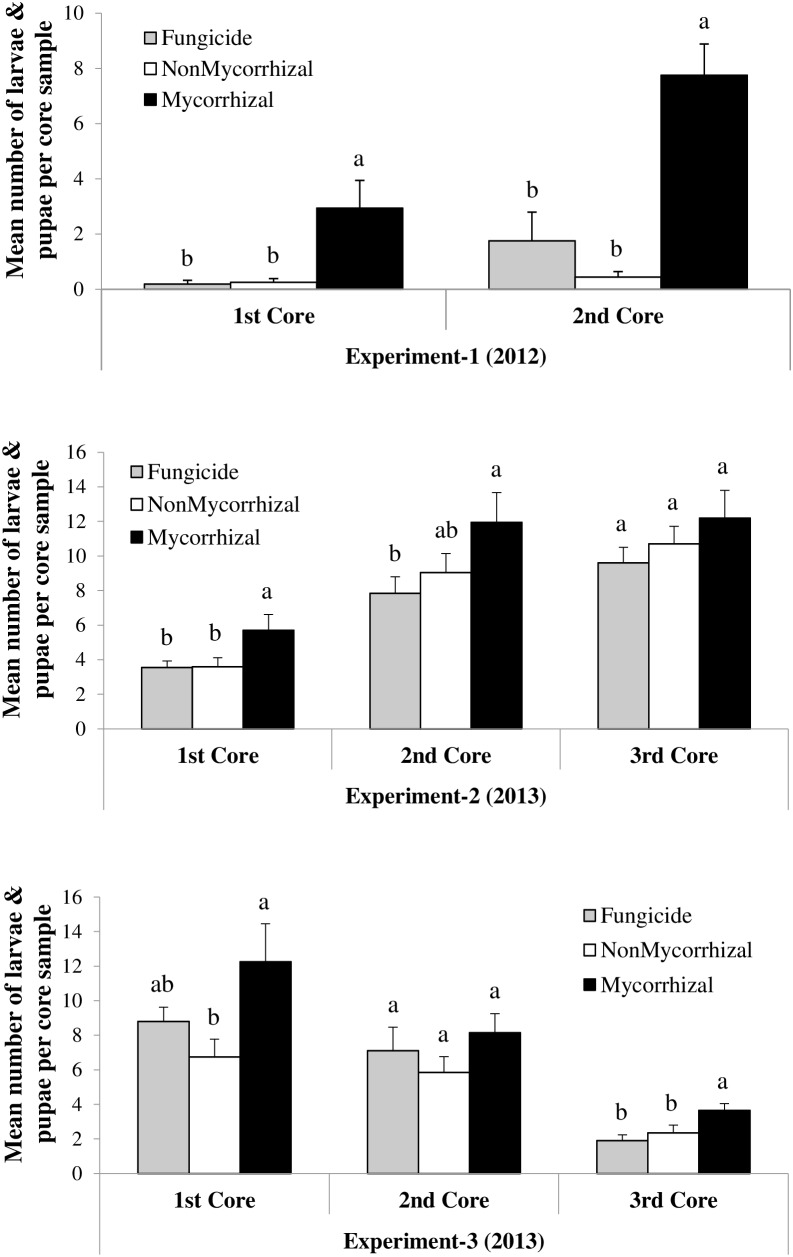
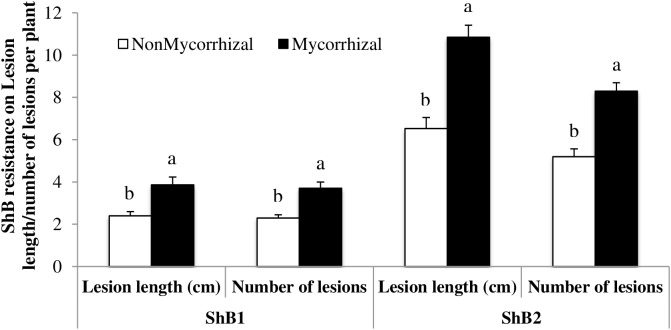
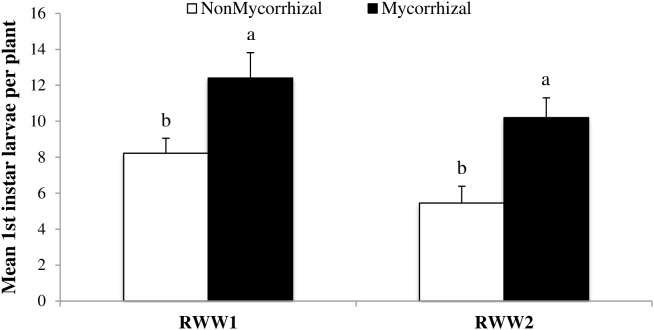
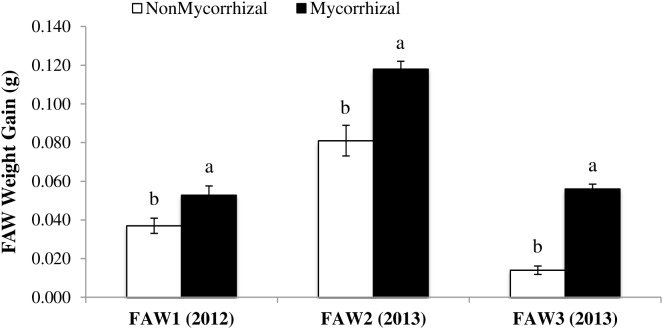
Plants face numerous challenges from both aboveground and belowground stressors, and defend themselves against harmful insects and microorganisms in many ways. Because plant responses to biotic stresses are not only local but also systemic, belowground interactions can influence aboveground interactions in both natural and agricultural ecosystems. Arbuscular mycorrhizal fungi (AMF) are soilborne organisms that form symbiotic associations with many plant roots and are thought to play a central role in plant nutrition, growth, and fitness. In the present study, we focused on the influence of AMF on rice defense against pests. We inoculated rice plants with AMF in several field and greenhouse experiments to test whether the interaction of AMF with rice roots changes the resistance of rice against two chewing insects, the rice water weevil ( Kuschel, RWW) and the fall armyworm (, FAW), and against infection by sheath blight (, ShB). Both in field and greenhouse experiments, the performance of insects and the pathogen on rice was enhanced when plants were inoculated with AMF. In the field, inoculating rice plants with AMF resulted in higher numbers of RWW larvae on rice roots. In the greenhouse, more RWW first instars emerged from AMF-colonized rice plants than from non-colonized control plants. Weight gains of FAW larvae were higher on rice plants treated with AMF inoculum. Lesion lengths and susceptibility to ShB infection were higher in rice plants colonized by AMF. Although AMF inoculation enhanced the growth of rice plants, the nutritional analyses of root and shoot tissues indicated no major increases in the concentrations of nutrients in rice plants colonized by AMF. The large effects on rice susceptibility to pests in the absence of large effects on plant nutrition suggest that AMF colonization influences other mechanisms of susceptibility (e.g., defense signaling processes). This study represents the first study conducted in the U.S. in rice showing AMF-induced plant susceptibility to several antagonists that specialize on different plant tissues. Given the widespread occurrence of AMF, our findings will help to provide a different perspective into the causal basis of rice systemic resistance/susceptibility to insects and pathogens.
植物面临来自地上和地下多种胁迫因素的诸多挑战,并通过多种方式抵御有害昆虫和微生物。由于植物对生物胁迫的反应不仅是局部的,也是系统性的,因此地下相互作用能够在自然和农业生态系统中影响地上相互作用。丛枝菌根真菌(AMF)是一类土壤生物,与许多植物根系形成共生关系,并被认为在植物营养、生长和健康方面发挥着核心作用。在本研究中,我们聚焦于AMF对水稻抗虫防御的影响。我们在多个田间和温室试验中用AMF接种水稻植株,以测试AMF与水稻根系的相互作用是否会改变水稻对两种咀嚼式昆虫——稻水象甲(Kuschel,RWW)和草地贪夜蛾(,FAW)以及纹枯病(,ShB)感染的抗性。在田间和温室试验中,当用AMF接种植物时,昆虫和病原体在水稻上的表现均增强。在田间,用AMF接种水稻植株导致水稻根系上的RWW幼虫数量更多。在温室中,从AMF定殖的水稻植株中羽化出的RWW一龄幼虫比未定殖的对照植株更多。用AMF接种物处理的水稻植株上FAW幼虫的体重增加更高。AMF定殖的水稻植株中纹枯病的病斑长度和易感性更高。虽然AMF接种促进了水稻植株的生长,但对根和地上部组织的营养分析表明,AMF定殖的水稻植株中养分浓度没有显著增加。在对植物营养没有重大影响的情况下,对水稻害虫易感性有很大影响,这表明AMF定殖会影响其他易感性机制(例如防御信号传导过程)。本研究是在美国首次针对水稻开展的研究,表明AMF诱导植物对几种专门侵害不同植物组织的拮抗物易感。鉴于AMF广泛存在,我们的研究结果将有助于为水稻对昆虫和病原体的系统抗性/易感性的因果基础提供不同的视角。